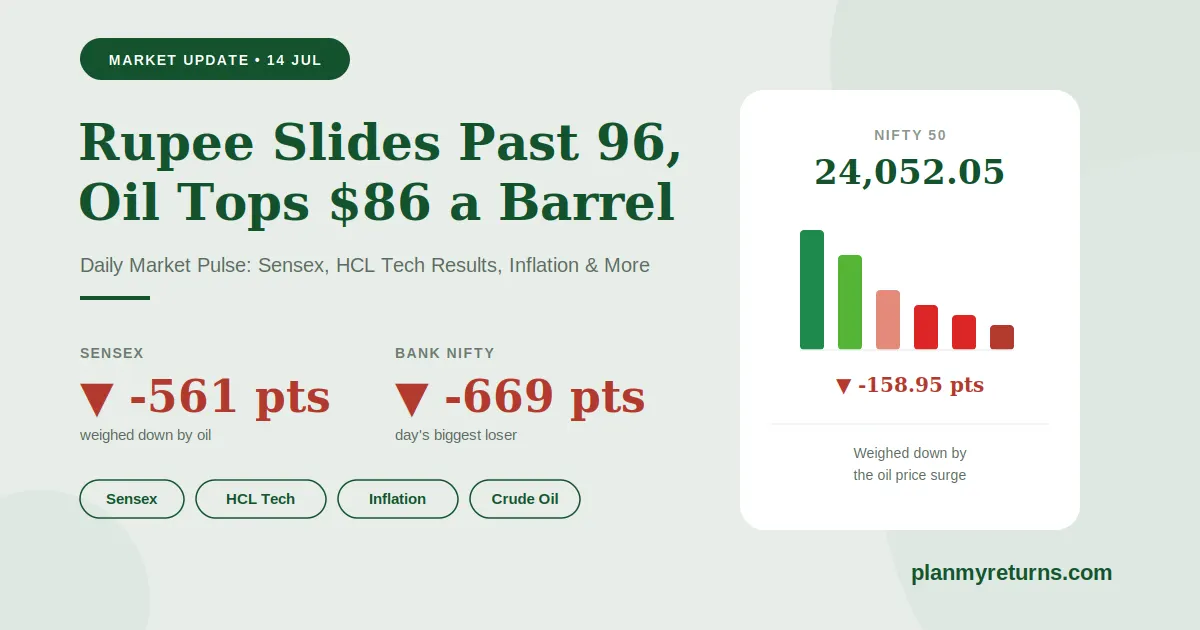
Today’s Overview: Markets fell as the US-Iran conflict escalated further, sending Brent crude past $86 a barrel and the Rupee below 96 to the Dollar for the first time. Bank Nifty led the decline as Realty, Auto and Financials sold off, while Pharma and Metal held up. HCL Tech beat profit estimates but its stock fell as guidance stayed unchanged, and fresh data showed India’s retail inflation has broken above the RBI’s 4% target for the first time since January 2025.
Today’s Top Finance Stories
1. Sensex, Nifty and Bank Nifty Fall as Iran Conflict Escalates Further
What happened: The Sensex fell 561.46 points (-0.72%) to close at 77,054.94, and the Nifty 50 slipped 158.95 points (-0.66%) to 24,052.05. Bank Nifty led the fall, down 669.15 points (-1.15%) to 57,462.30. Realty was the weakest sector, down 1.97%, followed by PSU Bank, Financial Services and Auto. Only Pharma and Metal ended in the green.
Why does it matter: Rate-sensitive sectors like banks, autos and realty fall hardest when oil prices spike, because investors worry about higher input costs and inflation squeezing company margins and consumer spending at the same time.
Key Takeaway: When oil prices spike sharply, it’s worth checking which sectors are falling. Banks, autos and aviation usually feel it first and hardest.
2. Rupee Slides Past 96 to the Dollar for the First Time
What happened: The Indian Rupee weakened around 0.6% to 96.25 against the US Dollar, crossing the 96 mark for the first time, as the sharp rise in crude oil prices increased India’s import bill worries.
Why does it matter: A weaker Rupee makes everything India imports, from crude oil to electronics to foreign education, more expensive. Crossing a round number like 96 doesn’t change the fundamentals overnight, but it often gets attention as a psychological marker of how much pressure the currency is under.
Key Takeaway: Round-number currency levels matter more for sentiment than substance. What matters more is the pace and reason behind the move.
3. India’s Retail Inflation Breaches RBI’s 4% Target for the First Time Since January 2025
What happened: Data released this week showed India’s retail inflation (CPI) rose to 4.38% in June, above the Reserve Bank of India’s 4% target for the first time in over a year. Today’s spike in oil prices adds to the risk of inflation staying elevated in the months ahead.
Why does it matter: The RBI’s main job is to keep inflation close to 4%. When inflation runs hot, the central bank is less likely to cut interest rates, and may even consider raising them, which directly affects your home loan EMI and other borrowing costs.
Key Takeaway: Rising inflation isn’t just a headline number. It directly shapes whether your loan interest rates are likely to fall, stay flat, or rise in the coming months.
4. HCL Tech Beats Profit Estimates, But Stock Falls Over 4% on Unchanged Guidance
What happened: HCL Technologies reported a 20% year-on-year rise in profit, comfortably beating estimates, but its stock still fell 4.64%, the worst performer on the Nifty 50 today. The reason: management kept its full-year revenue growth guidance unchanged at 1-4%, disappointing investors who had hoped for an upgrade.
Why does it matter: This is a classic “sell the news” reaction. When a company beats on current results but doesn’t raise its outlook for the future, the stock can still fall, because markets price in expectations, not just the latest quarter.
Key Takeaway: A strong quarterly result doesn’t guarantee a stock will rise. Forward guidance often matters more to investors than the numbers a company just reported.
5. Foreign Investors Turn Net Sellers, Snapping an Eight-Session Buying Streak
What happened: Foreign Institutional Investors (FIIs) turned net sellers today, pulling out roughly Rs 306 crore, ending an eight-session streak of continuous buying that had helped support the market’s recent recovery.
Why does it matter: FIIs are large, price-sensitive investors, and sustained buying from them is often a tailwind for the market. One day of selling isn’t a trend on its own, but it’s worth watching whether this becomes a pattern, especially with oil prices and the Rupee under pressure.
Key Takeaway: A single day of FII selling after a long buying streak is a signal to watch, not panic over. Look for whether it continues over the next few sessions.
6. Global Cues: US Inflation Cools, All Eyes on the Fed Chair’s Testimony
What happened: US inflation (CPI) eased to 3.5% in June, its first decline in five months, easing some pressure on the US Federal Reserve. Markets are now watching Fed Chair Kevin Warsh’s testimony before the US Congress today, with traders pricing in roughly a 51% chance of a rate hike in September versus a 23% chance rates stay unchanged.
Why does it matter: US Fed decisions influence global money flows, including into India. A more hawkish (rate-hike-leaning) Fed can make US assets more attractive relative to emerging markets like India, which can add to Rupee pressure and FII outflows.
Key Takeaway: What the US Federal Reserve does with interest rates doesn’t just affect America. It ripples into Indian markets through the Rupee and foreign investment flows.
Today’s Q1 Results
Plain-English summaries of the major companies that reported June-quarter (Q1 FY27) results around today’s session.
HCL Technologies
Consolidated net profit rose over 20% year-on-year to Rs 4,624 crore, up from Rs 3,843 crore. Revenue grew 14% to Rs 34,579 crore. The board declared an interim dividend of Rs 12 per share, record date 17 July, payable 27 July. Despite the beat, the stock fell as the company kept its FY27 revenue growth guidance unchanged at 1-4%, a cautious signal investors read as limited near-term upside.
ICICI Prudential Asset Management
Quarterly profit rose 23% year-on-year, comfortably ahead of expectations. Even so, the stock fell around 2.3% today, in line with the broader weakness across financial stocks rather than anything specific to the company’s results.
Market Snapshot
Equity and Bank Nifty figures are official closing levels for 14 July 2026. Gold, silver, crude, currency and crypto reflect rates reported through the evening; confirm crypto and commodity levels closer to 7 PM IST as these trade round the clock. Petrol and diesel are Mumbai retail rates; check local rates in your city as these vary by state taxes.
Top 5 Gainers & Losers Nifty 50, 14 July 2026
▲ Top Gainers
- Bharti Airtel +1.69%
Led gainers as telecom stayed resilient despite the broader market weakness.
- Cipla +1.69%
Pharma was one of only two sectors to close higher, with defensive buying in focus.
- Tata Steel +1.31%
Metal stocks gained, tracking firmer global commodity prices.
- Sun Pharma +1.17%
Added to the day’s defensive, Pharma-led gains.
- TCS +0.90%
Continued to hold up well in the days following its Q1 results.
▼ Top Losers
- HCLTech -4.64%
The day’s worst performer despite beating profit estimates, on unchanged guidance.
- Shriram Finance -2.47%
NBFC stocks came under pressure alongside the broader financials sell-off.
- InterGlobe Aviation (IndiGo) -2.33%
Aviation stocks fell as rising crude oil directly threatens fuel costs.
- Bajaj Finserv -2.28%
Tracked weakness across financial services stocks through the session.
- Bajaj Finance -1.90%
Extended losses alongside its group company Bajaj Finserv.
Retail Inflation (CPI)
Meaning: The Consumer Price Index (CPI), or retail inflation, measures how much the average cost of everyday goods and services, like food, fuel and rent, has risen over the past year. The RBI targets keeping this close to 4%.
Example: If CPI is 4.38%, as it was in June, something that cost Rs 100 a year ago now typically costs about Rs 104.38. When this number runs above the RBI’s target, it usually means loan interest rates are less likely to fall soon.
Tomorrow to Watch
- Fed Chair Kevin Warsh’s Congressional testimony and its impact on rate-hike expectations.
- Whether crude oil holds above $86 or eases as markets digest the US-Iran conflict.
- Whether the Rupee stabilises near 96 or weakens further against the Dollar.
- Whether FIIs resume buying or extend today’s selling into a trend.
- China’s Q2 GDP data, an important read on global growth.
- More Q1 FY27 earnings through the week as results season picks up pace.
Want to see how today’s news affects your own money?
Explore our full range of free financial calculators on PlanMyReturns, from inflation and home loan EMI planning to SIP calculators.
Explore All CalculatorsThis article is for general information only and is not investment advice. Read our full disclaimer.