The India–EU Free Trade Agreement is more than a headline. This article explains why markets reacted sharply, which five sectors stand to benefit the most, and how long term investors can identify real opportunities instead of chasing short term noise.
Understanding the India–EU Free Trade Agreement
India and the European Union have finalized a comprehensive Free Trade Agreement aimed at reducing tariffs, easing regulatory barriers, and boosting cross border investment. Together, they represent a market of over 1.8 billion people and nearly a quarter of global GDP.
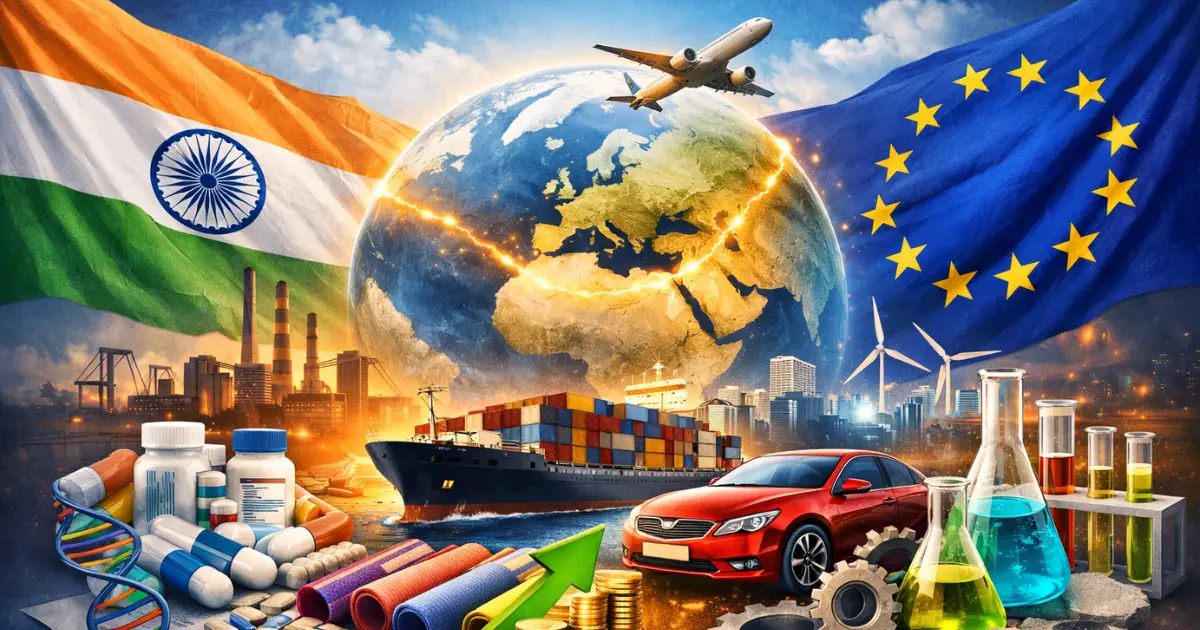
This deal is being called the “Engine of Global Growth” because it connects India’s manufacturing and services strength with Europe’s consumption power, capital, and technology.
The immediate reaction was visible in the Indian stock market, with a sharp rally as investors began pricing in future earnings growth.
Why the market reacted so strongly
The near 500 point jump in the Sensex was driven by three clear expectations:
- Export oriented Indian companies will gain easier access to EU markets.
- Lower tariffs improve profit margins for several sectors.
- Long term capital inflows from Europe into Indian manufacturing and infrastructure.
Markets move on expectations, not just current earnings. This rally reflects confidence in medium to long term growth rather than a one day trade.
Beyond the headlines: The 5 biggest winning sectors
1. Pharmaceuticals
India is already a global leader in generic medicines. The FTA reduces regulatory friction and improves market access to Europe.
Why pharma wins
- Faster approvals for Indian generic drugs
- Better pricing power in regulated EU markets
- Increased exports of APIs and specialty medicines
Investor insight
Focus on companies with strong EU compliance, diversified export revenue, and R&D capability. Regulatory quality matters more than size.
2. Textiles and Apparel
Textiles are among the largest beneficiaries due to tariff reductions on Indian garments entering Europe.
Why textiles win
- Tariff cuts improve price competitiveness against Bangladesh and Vietnam
- Strong demand for sustainable and organic fabrics in Europe
- Boost to employment driven manufacturing in India
Investor insight
Look for exporters with integrated manufacturing, stable European buyers, and ESG compliant processes.
3. Automobiles and Auto Components
This sector stands to benefit from lower duties and technology collaboration.
Why auto wins
- Easier export of Indian auto components to European OEMs
- Collaboration in EVs, batteries, and clean mobility
- Higher scale for component manufacturers
Investor insight
Component makers with EV exposure, export oriented order books, and strong balance sheets are better positioned than pure domestic players.
4. Information Technology and Digital Services
Services trade is a critical but often overlooked part of the agreement.
Why IT wins
- Improved access for Indian IT services firms
- Data flow clarity and digital trade provisions
- Strong demand for cost efficient tech solutions in Europe
Investor insight
Large IT firms benefit steadily, but mid cap digital engineering and cloud focused companies may see faster growth.
5. Chemicals and Specialty Manufacturing
European companies rely heavily on imports for chemicals and intermediates.
Why chemicals win
- Lower tariffs improve export viability
- India’s specialty chemicals fill EU supply gaps
- Strong long term contracts with European buyers
Investor insight
Prefer companies with diversified end use industries, low debt, and proven export relationships.
How long term investors should approach this opportunity
Step 1: Avoid chasing the rally
Short term market moves reflect sentiment. Long term returns come from earnings growth over several years.
Step 2: Study revenue exposure
Check how much of a company’s revenue already comes from Europe. Existing exporters benefit faster.
Step 3: Focus on balance sheet strength
FTA benefits take time. Companies with low debt and steady cash flows are better positioned to scale.
Step 4: Look beyond large caps
Mid cap exporters often see higher growth once trade barriers fall, though with higher risk.
Common mistakes investors should avoid
- Assuming every company in a sector will benefit equally
- Buying purely on news without checking valuations
- Ignoring execution risks like compliance and capacity constraints
- Treating the FTA as a short term trading trigger instead of a structural shift
Why this deal matters for India’s economy
The India–EU FTA supports India’s long term goals of:
- Expanding exports
- Moving up the manufacturing value chain
- Attracting foreign capital and technology
- Reducing dependence on a single export region
For investors, it strengthens the case for India as a multi year growth story rather than a cyclical trade.
The India–EU FTA is not just a policy announcement. It is a structural shift that strengthens India’s export economy. Investors who understand which sectors benefit and choose fundamentally strong companies are better positioned to gain from this long term opportunity.
Frequently Asked Questions
It is a trade pact that reduces tariffs, simplifies regulations, and promotes investment between India and the European Union.
Markets expect higher exports, better margins, and stronger earnings growth for key sectors over time.
Pharma, textiles, and auto components are among the biggest beneficiaries, followed by IT services and specialty chemicals.
The deal supports long term growth, but stock prices may consolidate in the short term. Fundamentals matter more than headlines.
Invest gradually, focus on quality companies, and avoid making decisions based only on one day market moves.