A complete comparison of PPF and NPS for FY 2026-27. Covers current interest rates and expected returns, Section 80C and 80CCD tax benefits under both regimes, lock-in and withdrawal rules, and a practical way to decide which one, or what mix of both, fits your goals.
What’s current for 2026: PPF continues at 7.1% per annum for FY 2026-27, unchanged since April 2020. NPS has seen real rule changes recently: employer contributions under Section 80CCD(2) now go up to 14% of basic salary plus DA for private sector employees under the new regime, and PFRDA revised exit norms in December 2025 to increase the lump sum withdrawal available to non-government subscribers at retirement. Verify the latest exit percentages on your NPS account provider’s platform before you plan around a specific figure, since these limits have been revised more than once in the past year.
PPF and NPS both show up on nearly every long-term investment checklist in India, and for good reason: both are government-backed, both offer real tax benefits, and both are built for goals decades away. But they work on almost opposite principles. One is a fixed-rate, fully guaranteed savings scheme. The other is a market-linked retirement account whose growth depends on how much equity exposure you choose.
This guide compares both side by side and gives you a practical framework to decide whether you need PPF, NPS, or a combination of both.
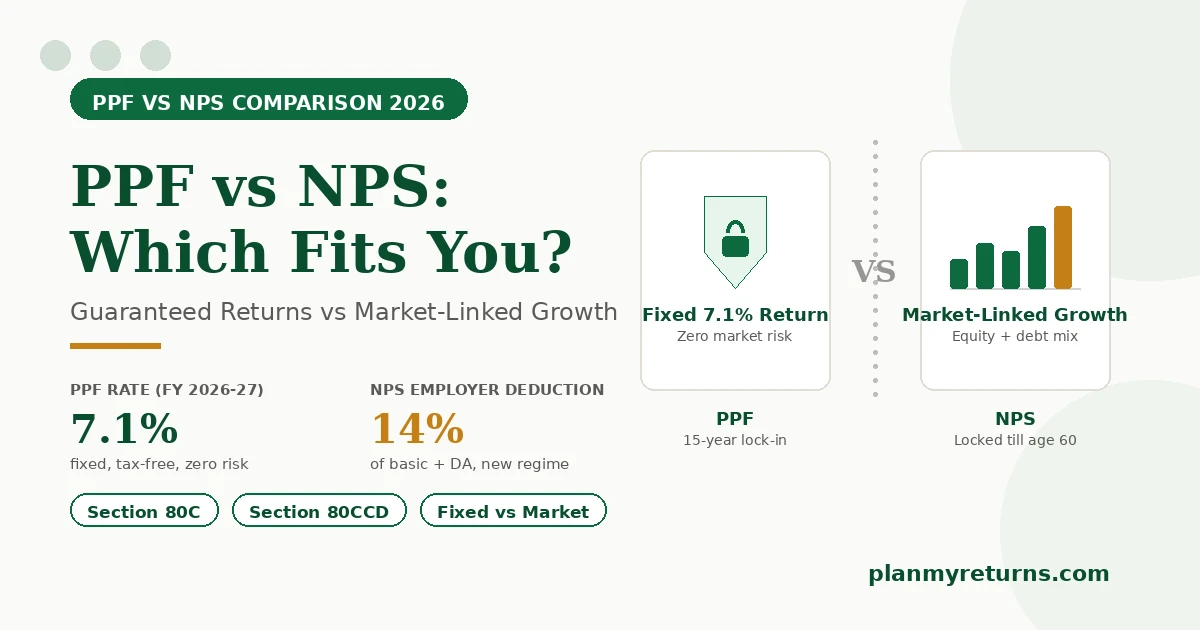
Quick Answer: Choose PPF if you want a fixed, tax-free, zero-risk return and can commit money for 15 years. Choose NPS if you want higher long-term growth potential through market exposure, additional tax deductions beyond Section 80C, and you are building specifically for retirement at 60. Most disciplined investors benefit from using both together rather than picking one exclusively.
PPF vs NPS: Side-by-Side Comparison
| Feature | PPF | NPS |
|---|---|---|
| Returns | Fixed, 7.1% p.a. for FY 2026-27, revised quarterly | Market-linked, depends on equity/debt mix chosen |
| Risk | Zero, sovereign-backed | Moderate to high, depending on equity allocation |
| Lock-in | 15 years, extendable in 5-year blocks | Until age 60, with limited partial withdrawals |
| Minimum/Maximum investment | ₹500 to ₹1.5 lakh per year | ₹1,000 minimum per year, no upper cap |
| Tax on contribution | Deductible up to ₹1.5 lakh under Sec 80C, old regime only | Deductible under 80CCD(1), 80CCD(1B), and 80CCD(2), mostly old regime; employer contribution works in both regimes |
| Tax on maturity | Fully tax-free (EEE) | Lump sum portion tax-free; annuity income taxed at slab rate |
| Liquidity | Partial withdrawal from the 7th year, loan facility from 3rd to 6th year | Limited partial withdrawal after 3 years for specific needs only |
| Who it suits | Conservative investors, anyone wanting a guaranteed tax-free instrument | Investors comfortable with market risk, building a dedicated retirement corpus |
How Returns Actually Compare
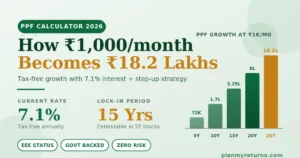
PPF’s return is simple to reason about because it is declared upfront: 7.1% per annum for FY 2026-27, compounded annually, unchanged since April 2020. There is no ambiguity about what you will earn.
NPS does not offer a declared rate. Your returns depend on your chosen fund manager and asset allocation across equity, corporate bonds, and government securities. Historically, NPS equity-heavy allocations have delivered higher long-term returns than PPF over 15 to 25 year horizons, but the path is volatile, and there is no guarantee that any specific historical average repeats going forward.
How to think about this: PPF gives you certainty of outcome. NPS gives you a higher probable outcome over a long horizon, in exchange for accepting that some years will show losses on paper. Your comfort with that volatility, not just the expected return, should guide the decision.
Tax Benefits: Old Regime vs New Regime
Key point for new-regime taxpayers: PPF gives you no upfront deduction under the new regime, only tax-free compounding. NPS is similar for your own contributions, but the employer contribution route under Section 80CCD(2) still works, and works better than before, since the new regime allows a higher 14% limit for private sector employees. If your employer offers a corporate NPS structuring option, this is the one lever still worth using under the new regime.
Want to see the actual numbers for your income and contribution amount? Compare PPF and NPS side by side with your own figures.
Try the PPF vs NPS CalculatorWithdrawal and Exit Rules
PPF: Loans, Partial Withdrawal, and Maturity
You can take a loan against your PPF balance between the 3rd and 6th financial year, and make partial withdrawals from the 7th year onward, capped at a portion of the balance. At 15 years, the entire corpus, including interest, is withdrawable completely tax-free, or you can extend the account in blocks of 5 years, with or without further contributions.
NPS: Partial Withdrawal and Retirement Exit
Before 60, you can withdraw up to 25% of your own contributions, not employer contributions or investment growth, after 3 years of membership, for specific purposes such as higher education, medical treatment, or a first home. At normal exit at 60, a portion of the corpus is available as a tax-free lump sum, and the remaining balance must be used to purchase an annuity, which then pays a taxable monthly pension. Exiting before 60 restricts the lump sum portion further and pushes more of the corpus into a mandatory annuity.
Recent change to watch: PFRDA revised exit norms in December 2025, increasing the lump sum share available to non-government NPS subscribers at retirement, a meaningful improvement over the older rule. Government employee rules remain more restrictive. Confirm the exact current percentage with your NPS account provider before finalising a retirement plan around it.
Which One Should You Choose?
- Choose PPF if: you want zero risk, a fixed and predictable return, and you are comfortable locking money away for 15 years with limited access before that.
- Choose NPS if: you are building specifically for retirement at 60, want higher long-term growth potential, and can accept market volatility along the way.
- Use both if: you want to combine PPF’s guaranteed floor with NPS’s growth potential, and you have room in the old regime to claim both the Section 80C and Section 80CCD(1B) deductions in the same year.
- On the new regime: lean on your employer’s NPS contribution under Section 80CCD(2), since it is one of the very few deductions still available, and treat PPF purely as a tax-free savings vehicle without expecting an upfront deduction.
Decision Checklist Before You Invest
- Confirm which tax regime you are on this year, since it changes which deductions actually apply to each instrument
- Confirm your time horizon: PPF works well for 15-year goals, NPS is built for retirement at 60
- Confirm your risk appetite, since NPS returns are not guaranteed and can be volatile in the short term
- Check whether your employer offers NPS contributions, since that route works in both tax regimes
- If you already max out Section 80C elsewhere, remember NPS’s extra Rs 50,000 deduction under Section 80CCD(1B) is independent of that limit
- Review your existing retirement accounts, such as EPF, before deciding how much more to lock into either PPF or NPS
Frequently Asked Questions
Conclusion
PPF and NPS are not really competitors, they are tools for different jobs. PPF is the reliable, guaranteed piece of a retirement plan. NPS is the growth-oriented piece, with a real tax edge for anyone maxing out Section 80C elsewhere, and one of the last meaningful deductions left for new-regime taxpayers through employer contributions. Decide based on your time horizon and risk appetite first, and let the tax benefit be the deciding factor only when both instruments otherwise suit your goal equally well.
Run your own numbers with the PPF Calculator and the NPS Calculator, or compare both directly using the PPF vs NPS Comparison Calculator. If you are also deciding between tax regimes, the Old vs New Tax Regime Calculator can help you see how each deduction plays out for your income level.