Every salaried employee in India faces the same question during tax season: Should I choose the old tax regime or the new tax regime?
The wrong choice can cost you ₹30,000 to ₹80,000 in extra taxes every year. And with the new tax regime becoming the default option from FY 2023-24 onwards, most people are unknowingly paying more tax than they need to.
The short answer: If your total deductions under Section 80C, 80D, HRA, and other sections exceed ₹3.75 lakh, the old regime likely saves you more money. If your deductions are below ₹1.5 lakh, the new regime is better. For everyone in between, you need to calculate your exact numbers.
That is exactly what the PlanMyReturns Tax Calculator does. Plug in your salary, deductions, and exemptions, and it tells you which regime saves you more, down to the exact rupee.
Let us break it down completely.
Quick Comparison: Old vs New Tax Regime at a Glance
| Feature | Old Tax Regime | New Tax Regime (Default) |
|---|---|---|
| Standard Deduction | ₹50,000 | ₹75,000 |
| Section 80C (₹1.5L) | Allowed | Not Allowed |
| HRA Exemption | Allowed | Not Allowed |
| Section 80D (Health Insurance) | Allowed | Not Allowed |
| Home Loan Interest (Section 24) | Allowed (up to ₹2L) | Not Allowed |
| NPS 80CCD(1B) ₹50,000 | Allowed | Not Allowed |
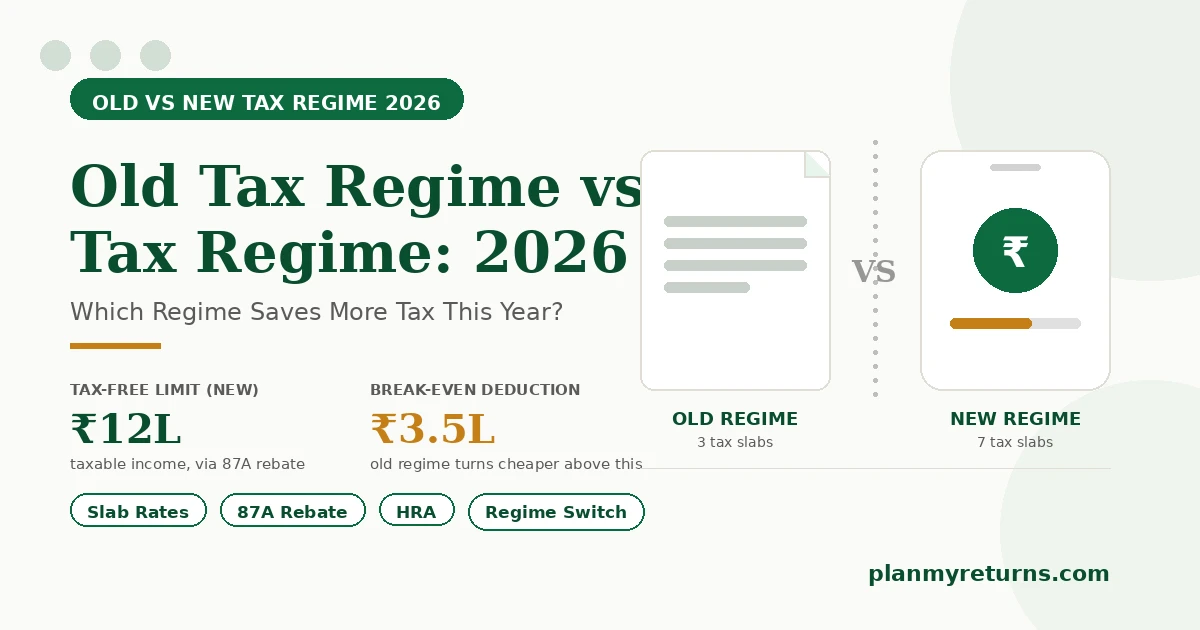
| Tax Rebate (Section 87A) | Up to ₹5L income | Up to ₹12L income |
| Surcharge Rate (above ₹5 Cr) | 37% | 25% (capped) |
| Switching | Can switch every year (salaried) | Default; can opt out |
Key Insight: The new regime offers lower slab rates and a higher rebate, but strips away nearly all deductions. The old regime has higher slab rates but lets you reduce your taxable income significantly through deductions and exemptions.
New Tax Regime Slab Rates for FY 2025-26 (AY 2026-27)
These are the income tax slab rates under the new tax regime, as announced in Budget 2025:
| Income Slab | Tax Rate |
|---|---|
| Up to ₹4,00,000 | Nil |
| ₹4,00,001 to ₹8,00,000 | 5% |
| ₹8,00,001 to ₹12,00,000 | 10% |
| ₹12,00,001 to ₹16,00,000 | 15% |
| ₹16,00,001 to ₹20,00,000 | 20% |
| ₹20,00,001 to ₹24,00,000 | 25% |
| Above ₹24,00,000 | 30% |
Under the new regime, if your total income is up to ₹12,00,000, you pay zero tax thanks to the Section 87A rebate of ₹60,000. After adding the ₹75,000 standard deduction, salaried employees earning up to ₹12,75,000 effectively pay no income tax under the new regime.
Old Tax Regime Slab Rates for FY 2025-26 (AY 2026-27)
| Income Slab | Tax Rate |
|---|---|
| Up to ₹2,50,000 | Nil |
| ₹2,50,001 to ₹5,00,000 | 5% |
| ₹5,00,001 to ₹10,00,000 | 20% |
| Above ₹10,00,000 | 30% |
The old regime has not changed its slab rates for several years. The advantage lies entirely in the deductions and exemptions it allows.
Real Salary Comparison: Old vs New Regime at Every Income Level
Let us calculate the actual tax liability under both regimes at different salary levels. These examples assume a salaried employee with typical deductions.
Scenario 1: Gross Salary ₹7,50,000 Per Year
Assumptions: ₹50,000 standard deduction (old) or ₹75,000 (new), ₹1,50,000 in 80C investments (EPF + PPF), ₹25,000 health insurance premium (80D), no HRA.
Under Old Regime: Taxable Income = ₹7,50,000 minus ₹50,000 (standard deduction) minus ₹1,50,000 (80C) minus ₹25,000 (80D) = ₹5,25,000. Tax = ₹2,500 + cess = ₹2,600. But with Section 87A rebate (taxable income under ₹5L after deductions), effective tax can be ₹0 if deductions bring it below ₹5L.
Under New Regime: Taxable Income = ₹7,50,000 minus ₹75,000 = ₹6,75,000. Tax = ₹13,750 + cess = ₹14,300. But Section 87A rebate applies since income is under ₹12L, so tax = ₹0.
Winner at ₹7.5L: Both regimes result in zero tax. No stress here.
Scenario 2: Gross Salary ₹10,00,000 Per Year
Assumptions: ₹1,50,000 in 80C, ₹25,000 in 80D, ₹1,80,000 HRA exemption, ₹50,000 NPS (80CCD).
Under Old Regime: Taxable Income = ₹10,00,000 minus ₹50,000 minus ₹1,50,000 minus ₹25,000 minus ₹1,80,000 minus ₹50,000 = ₹5,45,000. Tax = ₹12,500 + ₹9,000 (20% on ₹45,000) = ₹21,500 + 4% cess = ₹22,360.
Under New Regime: Taxable Income = ₹10,00,000 minus ₹75,000 = ₹9,25,000. Tax on ₹9,25,000 = ₹20,000 + ₹12,500 (10% on ₹1,25,000) = ₹32,500 + 4% cess = ₹33,800. But Section 87A rebate applies since taxable income is under ₹12L, so tax = ₹0.
Winner at ₹10L: New Regime saves ₹22,360. The expanded rebate under the new regime makes it the clear winner here, even without deductions.
Scenario 3: Gross Salary ₹15,00,000 Per Year
Assumptions: Same deductions as above, plus ₹2,00,000 home loan interest (Section 24).
Under Old Regime: Taxable Income = ₹15,00,000 minus ₹50,000 minus ₹1,50,000 minus ₹25,000 minus ₹1,80,000 minus ₹50,000 minus ₹2,00,000 = ₹8,45,000. Tax = ₹12,500 + ₹69,000 (20% on ₹3,45,000) = ₹81,500 + 4% cess = ₹84,760.
Under New Regime: Taxable Income = ₹15,00,000 minus ₹75,000 = ₹14,25,000. Tax = ₹20,000 + ₹40,000 + ₹33,750 (15% on ₹2,25,000) = ₹93,750 + 4% cess = ₹97,500.
Winner at ₹15L: Old Regime saves ₹12,740. Once your salary crosses ₹12.75L and you have substantial deductions (above ₹4L total), the old regime starts winning.
Scenario 4: Gross Salary ₹20,00,000 Per Year
Assumptions: All deductions maxed out (same as Scenario 3).
Under Old Regime: Taxable Income = ₹20,00,000 minus ₹50,000 minus ₹1,50,000 minus ₹25,000 minus ₹1,80,000 minus ₹50,000 minus ₹2,00,000 = ₹13,45,000. Tax = ₹12,500 + ₹1,00,000 + ₹1,03,500 (30% on ₹3,45,000) = ₹2,16,000 + 4% cess = ₹2,24,640.
Under New Regime: Taxable Income = ₹20,00,000 minus ₹75,000 = ₹19,25,000. Tax = ₹20,000 + ₹40,000 + ₹60,000 + ₹65,000 (20% on ₹3,25,000) = ₹1,85,000 + 4% cess = ₹1,92,400.
Winner at ₹20L: New Regime saves ₹32,240. At higher salaries, unless your total deductions exceed ₹5.5 to 6 lakh, the new regime’s lower slab rates beat the old regime.
The Breakeven Point: When Does Old Regime Beat New Regime?
This is the most important insight most tax articles miss.
The breakeven depends on your total deductions. Here is the approximate breakeven at different salary levels:
| Gross Salary | Minimum Deductions Needed for Old Regime to Win |
|---|---|
| Up to ₹12,75,000 | New regime wins (zero tax with rebate) |
| ₹13,00,000 to ₹15,00,000 | ₹3,75,000 or more in total deductions |
| ₹15,00,000 to ₹20,00,000 | ₹4,50,000 or more in total deductions |
| ₹20,00,000 to ₹30,00,000 | ₹5,50,000 or more in total deductions |
| Above ₹30,00,000 | ₹6,00,000+ in total deductions |
The rule of thumb: Add up all your deductions and exemptions (80C + 80D + HRA + NPS + Home Loan Interest + Standard Deduction). If this total exceeds ₹3.75 lakh to ₹5.50 lakh (depending on your income), the old regime saves you money.
Don’t guess. Use the PlanMyReturns Tax Calculator to get your exact breakeven number in 30 seconds.
Deductions You Lose in the New Tax Regime
When you choose the new tax regime, you give up these deductions entirely:
Section 80C (₹1,50,000 limit): This covers EPF (employee contribution), PPF, ELSS mutual funds, life insurance premium, NSC, 5-year FD, SSY, tuition fees, and home loan principal repayment. If you are maximizing 80C, you are giving up ₹1.5 lakh in deductions by choosing the new regime.
HRA Exemption: For salaried employees living in rented accommodation, this can be ₹1.5 lakh to ₹3 lakh depending on your salary and city. Metro city employees lose the most here. Read our HRA Exemption Calculation Guide for detailed examples.
Section 80D (Health Insurance): You lose up to ₹25,000 for self/family and an additional ₹25,000 to ₹50,000 for parents. If you are paying ₹40,000 or more in health insurance premiums, this deduction alone is worth ₹12,000 to ₹15,000 in tax savings under the old regime.
NPS Section 80CCD(1B): The additional ₹50,000 deduction for NPS contributions is not available under the new regime. However, employer NPS contribution under 80CCD(2) up to 14% of basic salary is available under both regimes.
Home Loan Interest (Section 24): The ₹2,00,000 deduction on home loan interest for self-occupied property is not available in the new regime. If you have a home loan, this is a massive deduction you would be giving up.
Leave Travel Allowance (LTA): Not available under the new regime. This can be ₹20,000 to ₹50,000 depending on your salary structure.
Who Should Definitely Choose the New Tax Regime?
The new regime is better for you if:
You are a young professional with minimal investments. If you have just started working and do not have a home loan, significant rent payments, or ₹1.5 lakh in 80C investments, the new regime’s lower slab rates and higher rebate will save you money.
Your salary is up to ₹12,75,000. You pay zero tax under the new regime thanks to the Section 87A rebate. No deductions needed. No investment proofs to submit. No paperwork.
You prefer simplicity over savings. The new regime requires zero tax planning effort. No need to chase investment proofs in March. No HRA receipts. No 80C investment pressure. For some people, the simplicity is worth a small extra tax payment.
You earn above ₹50 lakh. The new regime caps the highest surcharge at 25% compared to 37% in the old regime. For very high earners, this surcharge difference can save ₹2 lakh or more.
Who Should Definitely Stick with the Old Tax Regime?
The old regime is better for you if:
You have a home loan. The ₹2 lakh interest deduction under Section 24 is a game-changer. Combined with 80C (principal repayment), a home loan can give you ₹3.5 lakh in deductions alone.
You live in a metro city on rent. HRA exemption for someone paying ₹25,000 or more per month in rent in Mumbai, Delhi, Bangalore, or Chennai can be ₹1.5 lakh to ₹3 lakh. This single exemption can tip the balance toward the old regime.
You are a disciplined investor already maximizing 80C. If you are already investing ₹1.5 lakh in PPF, ELSS, or EPF, plus ₹50,000 in NPS, plus paying health insurance premiums, your deductions likely exceed the breakeven point.
You have dependent parents with medical expenses. Section 80D allows up to ₹50,000 for senior citizen parents’ health insurance. Combined with your own 80D, this is up to ₹75,000 in deductions.
How to Switch Between Old and New Tax Regime
For salaried employees, you can switch between regimes every financial year. Here is how:
At the start of the financial year: Inform your employer which regime you want for TDS purposes by submitting your investment declaration. If you do not inform them, the new regime is applied by default.
While filing ITR: Even if your employer deducted TDS under one regime, you can switch to the other regime while filing your Income Tax Return. The excess tax paid will be refunded by the Income Tax Department.
For business income (ITR-3/ITR-4): Once you choose the old regime, you can switch back to the new regime only once. After that, the choice is permanent. This restriction does not apply to salaried employees filing ITR-1 or ITR-2.
Important deadline: The last date to switch for FY 2025-26 is the ITR filing deadline, typically 31st July 2026 for salaried employees (unless extended by the Income Tax Department).
Example: Priya’s Tax Comparison
Let us look at a realistic example. Priya is a 32-year-old software engineer in Bangalore.
Priya’s Details:
Her gross salary is ₹18,00,000 per year. She pays ₹22,000 per month in rent. Her basic salary is ₹7,50,000. Her EPF contribution (employee share) is ₹21,600 per year. She invests ₹1,28,400 in ELSS mutual funds (topping up 80C to ₹1,50,000). Her health insurance premium is ₹30,000 (self and family). She contributes ₹50,000 to NPS. She has no home loan.
Old Regime Calculation for Priya:
Starting with her gross salary of ₹18,00,000, she subtracts: ₹50,000 (standard deduction) + ₹1,50,000 (80C: EPF + ELSS) + ₹30,000 (80D) + ₹50,000 (NPS 80CCD) + ₹1,74,000 (HRA exemption, calculated as the minimum of actual HRA received, rent minus 10% of basic, or 50% of basic for metro). Her taxable income becomes ₹13,46,000.
Tax on ₹13,46,000 under old slabs: ₹12,500 + ₹1,00,000 + ₹1,03,800 = ₹2,16,300. Add 4% cess: ₹2,24,952.
New Regime Calculation for Priya:
Starting with ₹18,00,000, she subtracts only ₹75,000 (standard deduction). Taxable income = ₹17,25,000.
Tax on ₹17,25,000 under new slabs: ₹20,000 + ₹40,000 + ₹60,000 + ₹25,000 (20% on ₹1,25,000) = ₹1,45,000. Add 4% cess: ₹1,50,800.
Result: Priya saves ₹74,152 per year by choosing the new regime. Despite having ₹4,54,000 in total deductions, the new regime still wins because of its significantly lower slab rates at her income level.
But wait. If Priya also had a home loan with ₹2,00,000 annual interest, her old regime taxable income would drop to ₹11,46,000. Tax would be ₹12,500 + ₹1,00,000 + ₹43,800 = ₹1,56,300 + cess = ₹1,62,552. Now the old regime saves her ₹11,752. The home loan tips the balance.
This is why you must calculate your specific numbers. Use the PlanMyReturns Tax Calculator and try both scenarios in under a minute.
5 Common Mistakes People Make When Choosing a Tax Regime
Mistake 1: Assuming the new regime is always better because it is the default. The government made the new regime default for administrative simplicity, not because it saves everyone money. For employees with deductions above ₹3.75 lakh, the old regime often saves more.
Mistake 2: Forgetting to count EPF as an 80C deduction. Your employer’s EPF deduction (employee share) counts toward the ₹1.5 lakh 80C limit. Many people forget this and underestimate their total deductions.
Mistake 3: Not claiming HRA properly. If you pay rent and your salary has an HRA component, the HRA exemption can be your single largest tax-saving tool. Many employees skip this because they find the calculation confusing.
Mistake 4: Comparing without including cess. The 4% health and education cess applies on both regimes. Always compare the final amount including cess, not just the base tax.
Mistake 5: Ignoring the investment benefit of 80C. The old regime “forces” you to invest ₹1.5 lakh in instruments like PPF, ELSS, and NPS. This is not a cost; it is wealth building. The ₹1.5 lakh you invest in ELSS at 12% CAGR grows to ₹46 lakh in 25 years. You can calculate this using our SIP Calculator.
What Changed in Budget 2025 for Tax Regimes?
The Union Budget 2025 introduced several changes to the new tax regime that make it more attractive:
Higher tax rebate under Section 87A: The rebate limit was increased to ₹12,00,000 of taxable income. This means salaried employees earning up to ₹12,75,000 (after ₹75,000 standard deduction) pay zero tax under the new regime.
Revised slab structure: The new regime now has 7 slabs instead of the earlier 6, with the nil-tax threshold raised to ₹4,00,000 and better distribution of rates across income levels.
No changes to the old regime: The old regime’s slab rates, deduction limits, and exemptions remain unchanged. This means the gap between the two regimes has widened, making the new regime more competitive for a larger group of taxpayers.
Standard deduction increased to ₹75,000: Applicable only under the new regime (₹50,000 in the old regime). This ₹25,000 difference further tilts the balance toward the new regime for people with minimal other deductions.
Calculate Your Exact Tax Under Both Regimes Now
Stop guessing. Stop relying on generic advice. Your tax situation is unique because of your specific salary structure, rent amount, investment habits, and family situation.
The PlanMyReturns Tax Calculator compares both regimes side by side with your actual numbers. Enter your gross salary, deductions, and exemptions, and see exactly which regime saves you more money this financial year.
It takes 30 seconds. It could save you ₹30,000 or more.
Frequently Asked Questions
Yes, salaried employees filing ITR-1 or ITR-2 can switch between the old and new tax regime every financial year. You make the choice while filing your income tax return. There is no restriction on switching for salaried employees. However, if you have business income and file ITR-3 or ITR-4, the switching rules are more restrictive.
Yes, the new tax regime has been the default regime since FY 2023-24. If you do not explicitly choose the old regime while filing your ITR, the new regime will be applied automatically. Salaried employees should inform their employer at the start of the year if they want TDS deducted under the old regime.
No, Section 80C deductions are not available under the new tax regime. This includes PPF, ELSS, life insurance, NSC, 5-year FD, and home loan principal repayment. The only major deduction available under the new regime is the ₹75,000 standard deduction and employer NPS contribution under Section 80CCD(2).
Salaried employees with gross income up to ₹12,75,000 pay zero tax under the new regime. This is calculated as ₹12,00,000 (Section 87A rebate limit) plus ₹75,000 (standard deduction). For non-salaried individuals without standard deduction, the zero-tax limit is ₹12,00,000.
For most home loan holders, the old regime is better because it allows deduction of up to ₹2,00,000 on home loan interest (Section 24) and up to ₹1,50,000 on principal repayment (Section 80C). Together, this ₹3,50,000 in deductions usually pushes the old regime ahead. However, if your salary is below ₹12,75,000, the new regime’s zero-tax benefit might still be better.
Yes, absolutely. Tax saving should never be the only reason to invest. PPF offers guaranteed 7.1% returns with sovereign safety. ELSS mutual funds offer potential market-linked returns of 12 to 15% over the long term. Even without tax deductions, these are excellent wealth-building tools. Use the PlanMyReturns PPF Calculator to see your PPF maturity value.
The standard deduction is ₹75,000 under the new tax regime and ₹50,000 under the old tax regime for FY 2025-26. This is a flat deduction available to all salaried employees regardless of actual expenses.
No, HRA (House Rent Allowance) exemption is not available under the new tax regime. This is one of the biggest deductions you give up by choosing the new regime. For employees paying ₹20,000+ monthly rent in metro cities, this exemption alone can be worth ₹1.5 lakh to ₹3 lakh.