A clear, plain-language decision guide comparing the Unified Pension Scheme (UPS) and the National Pension System (NPS). Understand the 50% guaranteed pension formula, Dearness Relief compounding, pro-rata rules, age-wise decision frameworks, and calculate your exact benefits.
Central government employees in India are facing a major crossroads: stay with the National Pension System (NPS) or opt into the Unified Pension Scheme (UPS).
The core tension is easy to grasp: one scheme guarantees a fixed monthly paycheck backed by the government, while the other invests your retirement savings into the market for compounding growth. However, choosing between them is not simply a matter of “guaranteed versus market.” Your decision determines your retirement lump-sum cash, your spouse’s pension, how well your income beats inflation at age 75, and whether your children inherit your wealth. This guide walks you through every rule with real numbers and clear examples.
Short Answer: If you are within 10 to 15 years of retirement, want guaranteed monthly income, and need full protection against inflation via Dearness Relief, UPS is almost unbeatable. If you are in your 20s or early 30s with 25 to 35 years of career ahead, want a massive 60% tax-free lump sum at retirement, and want your full wealth inherited by your heirs, NPS with high equity exposure can build a significantly larger financial cushion.
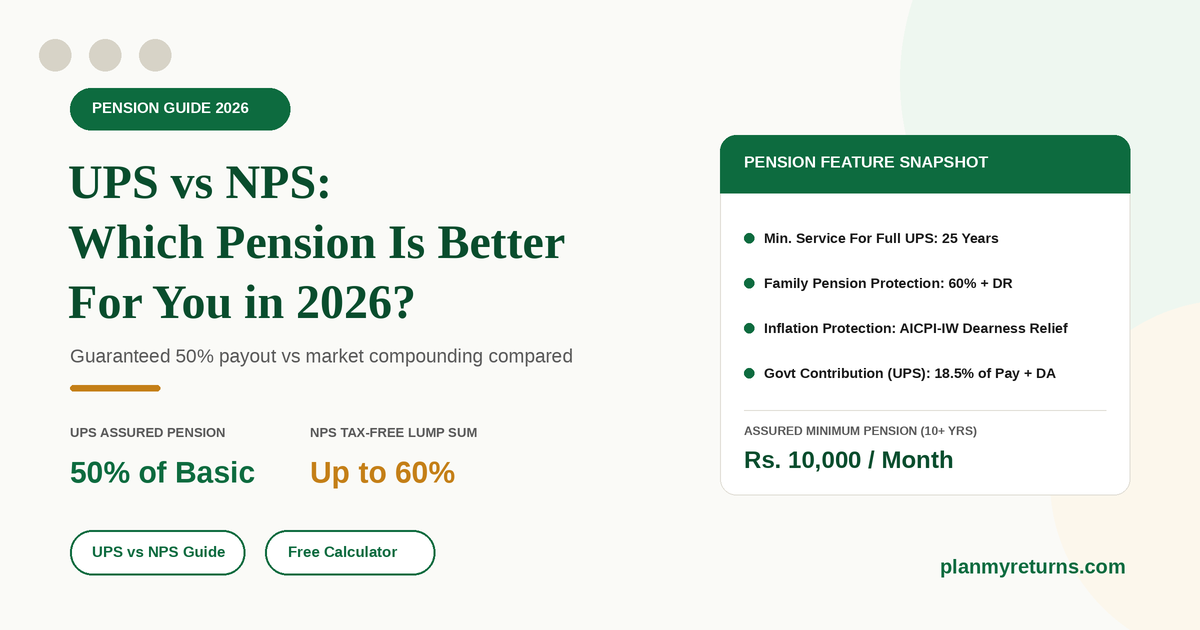
- UPS guarantees a pension equal to 50% of your average basic pay over your final 12 months, provided you have 25 years of service.
- Employees with 10 to 24 years of service receive a proportionate (pro-rata) pension, with a guaranteed minimum floor of ₹10,000 per month.
- UPS payouts include Dearness Relief (DR), meaning your monthly income increases automatically twice a year as consumer prices rise.
- NPS does not guarantee any fixed sum; your payout depends on your market investment growth and prevailing annuity rates at age 60.
- NPS allows you to take 60% of your accumulated corpus as a tax-free lump sum, while UPS gives a separate formula-based lump sum that does not reduce your pension.
- The government contributes 18.5% of your pay plus DA under UPS, compared to 14% under NPS. Your own contribution is 10% under both.
- Once you choose UPS, your decision is permanent and cannot be reversed.
Core Concepts Defined in Plain English
Before comparing the formulas, let’s break down the technical terms into simple words:
The 5 Pillars: Where UPS and NPS Really Differ
Pension Guarantee: Fixed Formula vs. Market Compounding
Under UPS, your pension is guaranteed: 50% of your average basic pay drawn in the last 12 months before retirement, assuming you complete 25 years of qualifying service. If you serve between 10 and 24 years, your pension is calculated proportionately (e.g., 20 years of service gives 40% of basic pay). In NPS, there is no guaranteed return. Your monthly pension depends entirely on how much your investment fund grew and the annuity rate available when you retire.
The Inflation Difference: Dearness Relief vs. Flat Annuity
This is often the deciding factor for retirees. UPS pensions include Dearness Relief, revised every six months. If you retire at age 60 with a ₹40,000 monthly pension, that payout will steadily climb to ₹65,000 by age 70 and over ₹80,000 by age 75 (assuming typical 5% inflation). In contrast, most NPS annuities pay a flat, unchanging amount for life. A fixed ₹25,000 monthly annuity bought at age 60 will still be ₹25,000 at age 80, having lost more than half its real purchasing power.
Retirement Lump Sum: 10% Emoluments vs. 60% Corpus
In NPS, you can withdraw up to 60% of your total accumulated retirement corpus completely tax-free on your retirement day. For an employee with a ₹1 crore NPS corpus, that means ₹60 lakh cash directly into their account. Under UPS, you receive a separate lump-sum payout calculated as 1/10th (10%) of your monthly emoluments (Basic Pay + DA) for every completed six-month block of service. While this UPS lump sum does not reduce your monthly pension, it is typically much smaller than a compounding 60% NPS withdrawal.
Family Pension and Wealth Inheritance
If a UPS pensioner passes away, their spouse receives an assured family pension equal to 60% of the last drawn pension, along with Dearness Relief. However, after the spouse passes away, the pension ends and no capital is returned to children. In NPS, the entire accumulated corpus belongs to you. If you choose an annuity with return of purchase price, the original capital is refunded to your children or nominees upon demise, preserving family wealth.
Government Contribution: 18.5% vs. 14%
Both schemes deduct 10% of your (Basic Pay + Dearness Allowance) each month. However, under UPS, the central government increases its contribution from 14% to 18.5%. This extra 4.5% does not go into your personal account; it feeds into a centralized government reserve pool that funds the guaranteed 50% baseline and lifelong inflation adjustments for all members.
Compare UPS vs NPS With Your Own Numbers
Calculate your assured monthly UPS pension and lump sum compared to your projected NPS annuity side by side.
Estimates are for planning purposes. UPS pension assumes standard central government rules (50% of basic pay for 25+ years service, ₹10,000 minimum floor). NPS monthly pension assumes 40% of corpus is annuitized at an indicative 6.5% rate. Run comprehensive scenarios on our dedicated UPS Pension Calculator.
How Pro-Rata UPS Pension Works (10 to 24 Years Service)
Many government employees wonder what happens if they retire before completing 25 years. Under UPS rules, full 50% pension requires 25 years of service. If you serve between 10 and 24 years, your pension is calculated proportionately:
| Years of Qualifying Service | Proportion of Basic Pay | Example Pension (on ₹70,000 Basic Pay) | Minimum Guarantee Applied |
|---|---|---|---|
| 25+ Years | 50.0% | ₹35,000 / month + DR | Full Assured Pension |
| 20 Years | 40.0% | ₹28,000 / month + DR | Exceeds ₹10,000 floor |
| 15 Years | 30.0% | ₹21,000 / month + DR | Exceeds ₹10,000 floor |
| 10 Years | 20.0% | ₹14,000 / month + DR | Exceeds ₹10,000 floor |
| 10 Years (Junior scale, ₹40k basic) | 20.0% (₹8,000) | ₹10,000 / month + DR | Yes (boosted to ₹10,000 floor) |
| Under 10 Years | 0% monthly pension | Only accumulated balance / gratuity | Not eligible for monthly pension |
How Inflation Widens the Gap: A 15-Year Look
To see why Dearness Relief is powerful, compare how payouts evolve over 15 years of retirement for an employee starting at age 60 with a ₹40,000 monthly UPS pension versus a ₹22,000 monthly NPS annuity:
| Retirement Age | UPS Monthly Pension (Assumes 5% Annual DR Growth) | NPS Monthly Annuity (Standard Fixed Payout) | Monthly Gap |
|---|---|---|---|
| Age 60 (Retirement Year) | ₹40,000 | ₹22,000 | UPS +₹18,000 / month |
| Age 65 (5 Years in) | ₹51,050 | ₹22,000 | UPS +₹29,050 / month |
| Age 70 (10 Years in) | ₹65,150 | ₹22,000 | UPS +₹43,150 / month |
| Age 75 (15 Years in) | ₹83,150 | ₹22,000 | UPS +₹61,150 / month |
Did You Know? In NPS, you can invest part of your 60% lump sum into a Systematic Withdrawal Plan (SWP) in mutual funds to generate monthly income. While not guaranteed like UPS, it allows your remaining wealth to continue growing during retirement.
Side-by-Side Comparison: UPS vs. NPS
| Feature | Unified Pension Scheme (UPS) | National Pension System (NPS) |
|---|---|---|
| Pension Guarantee | Assured: 50% of last 12 months’ average basic pay (25+ years service) | None: Depends entirely on market compounding and corpus size |
| Minimum Pension | ₹10,000 per month (after 10 years qualifying service) | No minimum guarantee |
| Inflation Protection | Yes: Dearness Relief (DR) revised biannually based on AICPI-IW | No: Standard annuities offer fixed monthly payouts |
| Employee Contribution | 10% of (Basic Pay + DA) | 10% of (Basic Pay + DA) |
| Govt Contribution | 18.5% of (Basic Pay + DA) | 14% of (Basic Pay + DA) |
| Retirement Lump Sum | 1/10th of (Basic + DA) per 6-month service (separate payout) | Up to 60% of total corpus withdrawn tax-free |
| Tax on Monthly Pension | Taxable as salary income in pensioner’s tax slab | Taxable as regular income in pensioner’s tax slab |
| Family Pension | 60% of retiree’s pension to spouse + Dearness Relief | Annuity continues for spouse, or balance corpus returned to nominees |
| Wealth Inheritance | No corpus returned after spouse passes away | 100% of remaining corpus or annuity purchase price goes to nominees |
| Investment Risk | Zero market risk for the employee | Market-linked (equity, corporate bonds, government gilts) |
Real-Life Scenario: Comparing Total Retiral Payouts
Consider an employee retiring after 30 years of service with a final monthly basic salary of ₹80,000 and prevailing Dearness Allowance of 53% (total monthly emoluments: ₹1,22,400). Here is how both options look:
Notice the trade-off: The UPS pensioner receives nearly double the monthly cash flow, and that pension continues rising with inflation throughout retirement. However, the NPS subscriber receives a massive ₹60 lakh cash lump sum that can be deployed into debt funds, real estate, or an SWP to generate independent wealth.
Want to test your exact salary level and service tenure? Run the numbers on our dedicated tool.
Try UPS Pension CalculatorAge-Wise Framework: Which One Should You Pick?
If You Are Under Age 35 (25+ Years of Service Ahead)
With 25 to 35 years of active career ahead, time is on your side. If you choose an active asset allocation with 50% to 75% in equity (Scheme E), your long-term compounding is likely to create a massive corpus that far exceeds formula-based ceilings. Furthermore, you will receive 60% of that huge corpus tax-free at retirement, and the remaining capital remains 100% inheritable by your children.
If You Are Between Age 35 and 45 (15 to 25 Years of Service)
This is the most critical decision bracket. Log into your CRA portal and examine your current PRAN account balance. If your fund has delivered strong annualized returns (10%+ CAGR) and you are comfortable continuing with equity exposure, NPS can still win. However, if your corpus growth has lagged or you prioritize risk-free income after retirement, locking into UPS is the safer path.
If You Are Age 45 or Above (Under 15 Years of Service Left)
You have fewer years left for market compounding to recover from potential economic downturns. Market crashes near retirement can severely hurt an NPS portfolio. Locking into an assured 50% basic pay with lifelong Dearness Relief guarantees that your post-retirement lifestyle is completely insulated from stock market fluctuations.
Decision Checklist: How To Finalize Your Choice
| Step | Action To Take |
|---|---|
| 1 | Check your total completed service years and estimate how many years you have left before superannuation. |
| 2 | Log into your CRA portal and check your current accumulated NPS PRAN balance. |
| 3 | Run your projected basic pay on our UPS Pension Calculator to see your assured 50% figure. |
| 4 | Evaluate whether your family priorities require upfront liquidity (NPS) or lifetime inflation-proof monthly cashflow (UPS). |
| 5 | Review your gratuity entitlement with our Gratuity Calculator to understand your total day-one retirement liquidity. |
| 6 | Remember that opting into UPS is final and irreversible once submitted. |
Important Note: This guide provides educational comparisons based on published central government regulations and standard financial principles. Because individual promotions, pay scales, and family financial goals vary, consider running your exact numbers through our tools and speaking with a qualified financial advisor before submitting your pension option form.
What is the primary difference between UPS and NPS?
The Unified Pension Scheme (UPS) guarantees a predictable monthly pension equal to 50% of your last 12 months’ average basic pay (for 25+ years of service) along with inflation-indexed Dearness Relief. The National Pension System (NPS) does not guarantee any fixed amount; your pension depends entirely on how much your market-linked corpus grows over your career.
How is the UPS pension calculated if I have less than 25 years of service?
If you have completed between 10 and 24 years of service, your pension is calculated proportionately: (Years of Service / 25) × 50% of your average basic pay. If you have completed at least 10 years, you are also guaranteed a minimum pension of ₹10,000 per month plus Dearness Relief.
How does Dearness Relief protect UPS pensioners from inflation?
Under UPS, pensioners receive Dearness Relief (DR) revisions twice every year linked to the All India Consumer Price Index for Industrial Workers (AICPI-IW). While standard NPS annuities pay a fixed monthly amount that loses buying power over time, a UPS pension increases steadily as living costs rise.
Can an employee switch back to NPS after opting for UPS?
No. The option to switch from NPS to UPS is a one-time opportunity and is completely irrevocable once exercised.
What is the retirement lump sum difference between UPS and NPS?
In NPS, you can withdraw up to 60% of your accumulated corpus completely tax-free on retirement day. Under UPS, you receive a separate lump sum equal to 1/10th (10%) of your monthly emoluments (Basic Pay + DA) for every completed six-month block of service, which does not reduce your monthly pension.
Who benefits more from remaining in NPS instead of switching to UPS?
Employees in their 20s and early 30s with 25 to 35 years of service ahead who actively choose equity-oriented asset allocations (up to 75% equity) can build a massive compounding corpus in NPS. They also retain 100% wealth ownership, allowing the entire remaining balance to be inherited by children, unlike UPS which only provides a 60% spousal family pension.