
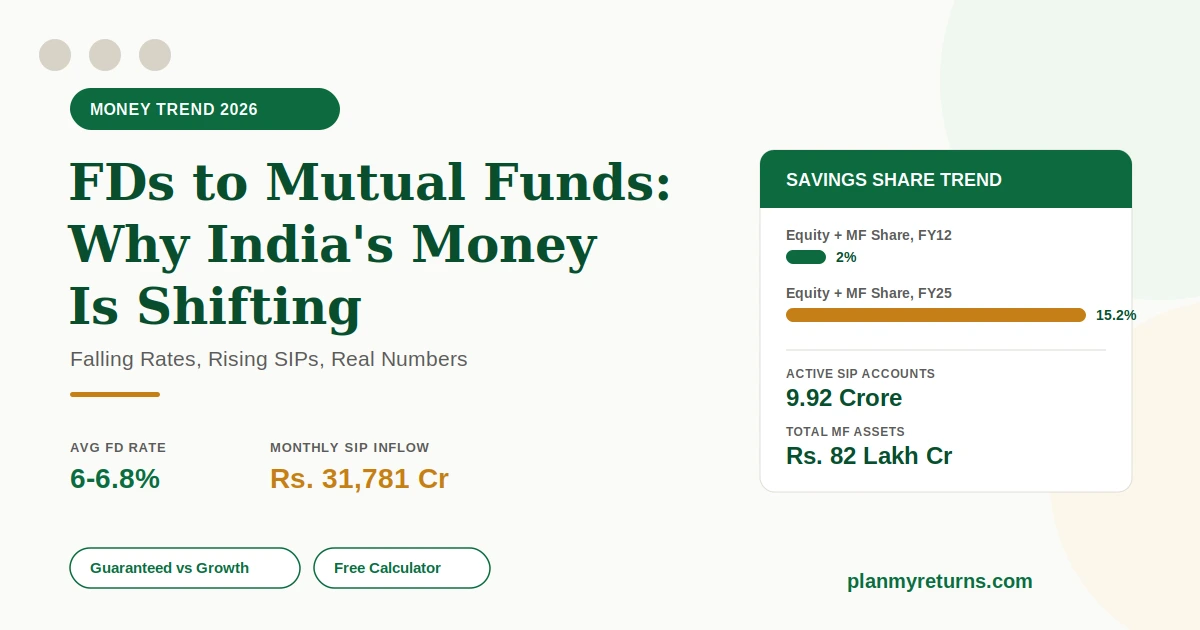
A simple, plain-language look at why so many Indian households are moving money out of fixed deposits and into mutual funds right now. Real numbers, a fair look at both sides, and a free calculator to compare them for your own money.
For decades, the standard advice in most Indian households was simple: put your savings in a fixed deposit. It was safe, familiar, and every bank offered one. That habit is changing fast. More and more people are now putting new savings into mutual funds through SIPs instead, and the numbers behind this shift are large enough that it’s worth understanding why.
This guide explains what’s driving the shift, in plain words, with real numbers. You’ll also find a free calculator below to compare an FD and a SIP using your own numbers.
Short Answer: FD interest rates have fallen as the RBI cut rates through 2025, while prices have kept rising steadily. This has squeezed the real, after-inflation return on FDs. At the same time, starting a SIP has become as easy as a few taps on a phone. Together, these two changes have pushed a growing share of household savings from FDs toward mutual funds.
- FD rates at most large banks have dropped to around 6% to 6.8%, lower than a few years ago.
- After adjusting for inflation, a 6% FD often leaves only a small real return, sometimes close to zero.
- SIPs have grown from about ₹4,000 crore a month in 2016 to over ₹31,000 crore a month in 2026.
- Mutual funds are not risk-free. Their value can fall, unlike a fixed deposit’s guaranteed return.
- This is not an all-or-nothing choice. Many households now use both, FDs for safety and SIPs for growth.
- Short-term goals and emergency funds are still usually better suited to FDs, not market-linked options.
What’s Actually Happening, In Simple Terms
The Reserve Bank of India cut its policy rate several times through 2025, and banks followed by lowering their FD rates. At the same time, prices for everyday goods have kept rising at a steady pace. When you subtract inflation from your FD’s interest rate, what’s left over, your real return, has gotten thinner than it used to be.
Why The Shift Is Happening: Five Reasons
FD rates have fallen noticeably
As of August 2026, most large banks offer FD rates between 6% and 6.8% for regular tenures. This is a step down from the higher rates savers were used to a few years ago, and it’s made FDs feel less rewarding for long-term goals.
Inflation is quietly eating into FD returns
With prices rising steadily, a 6% FD often leaves only a small real gain once inflation is subtracted. For long-term goals like retirement, this thin real return has pushed many savers to look for options with higher long-term growth potential.
Starting a SIP is now genuinely easy
Ten years ago, investing in a mutual fund meant paperwork and a branch visit. Today it takes minutes on a phone, with KYC done digitally and monthly SIP payments set up through UPI. This convenience has removed a major barrier that used to keep people away from mutual funds.
Financial awareness has grown fast
More people are learning about investing through videos, articles and finance influencers than ever before. This wider awareness has made mutual funds feel less intimidating and more like a normal part of monthly saving.
SIPs match how people already save
A SIP works a lot like a recurring deposit: a fixed amount, deducted automatically every month. For many people, this made the switch feel natural rather than risky, since the habit of saving stayed the same, only where the money went changed.
Compare FD vs SIP With Your Own Numbers
See both side by side, including what inflation does to your FD’s real value.
This is a simple estimate to help you plan. It is not exact financial advice. FD figures use the guaranteed rate you entered. Mutual fund growth is only a projection based on past trends and is not guaranteed.
To Be Fair: When FDs Still Make Sense
The shift toward mutual funds doesn’t mean FDs are pointless. For certain situations, an FD is still the better tool, and it’s worth being honest about that.
| Use This Money For | Better Fit | Why |
|---|---|---|
| Emergency fund | FD or savings account | You need the exact amount, available fast, with no risk of loss |
| A goal 1-2 years away | FD or RD | Not enough time for market ups and downs to average out |
| Money you cannot risk losing | FD | Guaranteed return matters more than higher potential growth |
| A goal 7+ years away | SIP / Mutual Fund | More time for growth to outweigh short-term market swings |
| Retirement savings | Mix of both, weighted toward SIP | Balances long-term growth with some guaranteed stability |
Worth Remembering: Use our Inflation Calculator to see exactly how much a fixed-rate return like an FD is really worth after a few years of rising prices. It often looks different from the headline interest rate.
A Simple, Real Example
Say you invest ₹5 lakh for 10 years. Here’s roughly how an FD and a mutual fund SIP compare, using typical rates from this year.
The mutual fund shows a bigger number here, but remember, this is only a projection based on past averages. Markets can also underperform for stretches of time. The FD’s smaller number is the one you can actually count on, no matter what happens.
Want to see both grow with your exact numbers? Try our dedicated calculators side by side.
Try SIP CalculatorFive Easy Steps If You’re Considering The Switch
| Step | What To Do |
|---|---|
| 1 | Make sure your emergency fund is already in a safe, liquid place like an FD |
| 2 | Sort your goals by how many years away they are |
| 3 | Keep short-term goals in FDs or RDs, not mutual funds |
| 4 | Start a small SIP for long-term goals, rather than moving everything at once |
| 5 | Review your mix once or twice a year, not every week |
Please Note: This guide is meant to help you understand the topic, not to tell you exactly what to do. Mutual fund returns are never guaranteed and can go down as well as up. It’s a good idea to talk to a qualified financial advisor before making a big change to your savings.
Why are Indians moving money from FDs to mutual funds?
FD interest rates have fallen as the RBI cut rates through 2025 and into 2026, while inflation has stayed steady. This has narrowed the real, after-inflation return on FDs. At the same time, mutual funds and SIPs have become much easier to start through mobile apps, pushing more savers toward market-linked options for at least part of their money.
Are mutual funds safer than FDs?
No, they carry different types of risk. An FD gives a fixed, guaranteed return and your principal does not fall in value. A mutual fund’s value can go up or down with the market, so there is no guarantee, but it has historically offered higher long-term growth than FDs.
Should I stop investing in FDs completely?
Not necessarily. FDs still make sense for short-term goals, emergency funds, or money you cannot afford to see drop in value. Most financial planners suggest keeping some money in FDs for safety and stability, while directing new, long-term savings toward SIPs for growth.
What is the current average FD interest rate in India?
As of August 2026, most major banks offer FD rates between 6% and 6.8% for regular tenures, with some small finance banks offering up to 8% or higher on select tenures. This is lower than the FD rates seen a few years earlier, mainly due to RBI rate cuts through 2025.
How much have SIP investments grown in India?
Monthly SIP inflows crossed roughly ₹31,781 crore in June 2026, compared to about ₹4,000 crore a month in 2016. Nearly 9.92 crore SIP accounts are now active in India, and the share of equity and mutual funds in household financial savings has grown from around 2% in FY12 to over 15% in FY25.
Is it safe for a beginner to move money from FD to SIP?
It can be, but beginners should move gradually rather than all at once. Starting a small SIP alongside an existing FD, rather than breaking the FD immediately, lets you get comfortable with market ups and downs before committing a larger amount.