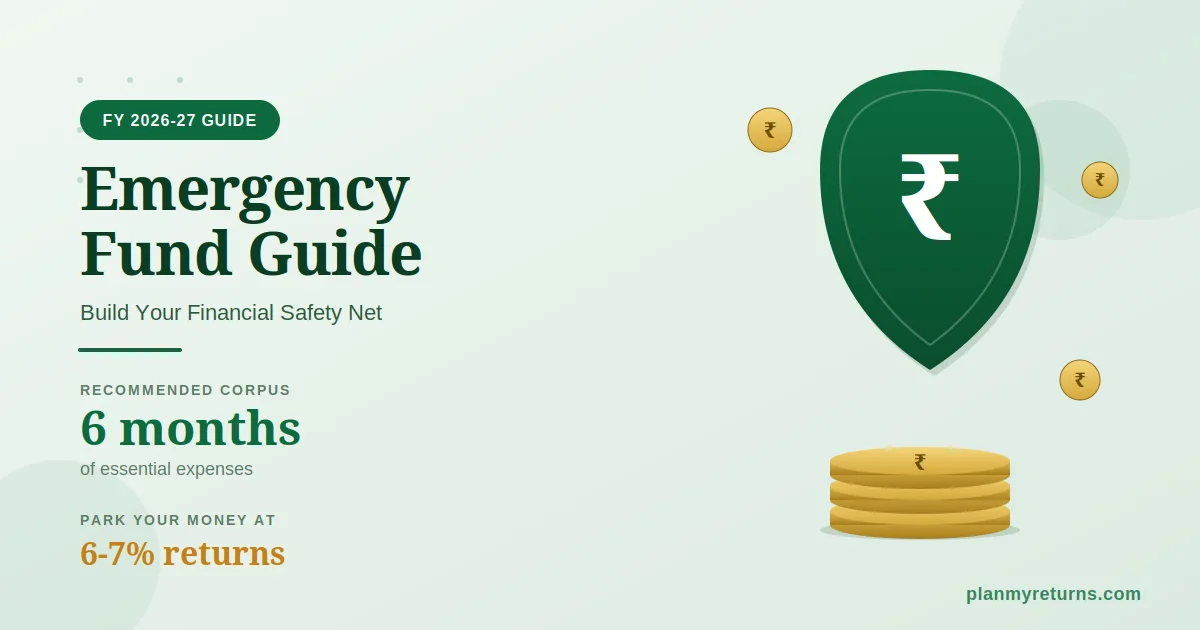
A complete guide to building your emergency fund in India for 2026 with exact corpus targets by income level, the smartest places to park it, and a 12-month roadmap to financial safety.
An emergency fund is the financial cushion that covers your essential expenses for 3 to 12 months when life throws you a curveball. Job loss, medical emergency, sudden home repair, family crisis. Without an emergency fund, even small surprises force you into expensive personal loans, credit card debt, or worse, breaking your long-term investments at the wrong time.
Yet most Indians do not have one. A 2025 RBI household financial survey showed that 67% of urban Indian households have less than 1 month of expenses saved. The first investment goal of any financial plan in India must be the emergency fund. Not SIPs. Not insurance. Not tax saving. Emergency fund first.
This guide answers exactly how much emergency fund you need based on your situation, where to keep it for the right balance of safety and returns, and the smartest 12-month roadmap to build one.
Quick rule: Calculate your emergency fund based on monthly expenses, not monthly salary. If you save ₹20,000 from a ₹70,000 salary, your real expenses are ₹50,000. A 6-month fund means ₹3,00,000, not ₹4,20,000.
How Many Months of Expenses Do You Actually Need?
The standard “6 months” rule is a starting point, not a one-size-fits-all answer. Your ideal emergency fund depends on three factors. Job stability, number of earners in the household, and dependents.
Special cases to consider. If you work in a volatile industry (startups, IT contractors, real estate), bump your fund to 9 months even with a stable salary. If you have a chronic illness in the family or aging parents, add 2 to 3 extra months for medical contingency. If you are within 5 years of a major life goal (home purchase, child’s college), keep an extra month of buffer.
The Exact Formula: Calculate Your Emergency Fund Target
Forget thumb rules. Use the actual formula to get a number that fits your life:
Step 1: Calculate your monthly essential expenses. Not what you spend. What you must spend even in a crisis. Include:
Step 2: Multiply by your buffer months (3, 6, 9, or 12 based on the section above).
Real example: Rohit and Anjali, both salaried, live in Pune. Their monthly essentials: rent ₹25,000 + EMIs ₹18,000 + groceries ₹12,000 + utilities ₹5,000 + insurance ₹4,000 + school fees ₹8,000 + transport ₹5,000 = ₹77,000/month. They have 1 child, both work in private companies. A 6-month buffer means ₹4,62,000 as their emergency fund target.
Skip the manual math.
Calculate your exact emergency fund target in 30 seconds.
Emergency Fund Targets by Salary Bracket (2026)
Based on typical Indian household expense ratios (60 to 70% of take-home), here is what your emergency fund should look like:
These numbers assume typical Indian metro household expense patterns. Your actual essentials may be higher or lower. Use the Emergency Fund Calculator to enter your real numbers and get a personalized target.
Where to Park Your Emergency Fund: The 3-Tier Strategy
The biggest mistake Indians make with emergency funds is keeping all the money in a savings account earning 2.5 to 3%. The second biggest is locking it in a 5-year FD. Both extremes hurt you. Use this 3-tier strategy instead:
Tier 1: Savings Account (1 month worth)
What to keep here: Roughly 1 month of essential expenses. This is your “I need cash right now” tier. Hospital deposit at 2 AM. Emergency travel ticket. Plumber asking for cash on arrival.
Best options in 2026: High-interest savings accounts from Bandhan Bank, IDFC First Bank, RBL Bank, AU Small Finance Bank (5 to 7% interest). Avoid keeping this in regular SBI/HDFC/ICICI savings accounts that pay 2.5 to 3%.
For Rohit and Anjali (₹4.62L target): Keep ₹77,000 in a high-interest savings account for instant access.
Tier 2: Liquid Mutual Funds (2 to 3 months worth)
What to keep here: 2 to 3 months of essential expenses. This tier handles real emergencies. Job loss, prolonged illness, unexpected home repair. Money is available within 24 hours via instant redemption (up to ₹50,000) or next-day redemption.
Why liquid funds beat savings accounts: No lock-in, no exit load after 7 days, returns of 6 to 7% (more than double a savings account), and zero capital risk. As per Budget 2025, gains are taxed at your slab rate (no LTCG benefit anymore for debt funds), but the post-tax return still beats savings accounts.
Best liquid funds in 2026: Parag Parikh Liquid Fund, ICICI Prudential Liquid Fund, Aditya Birla Sun Life Liquid Fund, HDFC Liquid Fund. Check expense ratio (lower is better) and 1-year returns before choosing.
For Rohit and Anjali: Keep ₹2,31,000 (3 months) in a liquid fund. At 6.5% returns, this earns ₹15,000/year vs ₹6,900 in a savings account at 3%.
Tier 3: Sweep-In FD or Short-Term Debt Funds (Rest)
What to keep here: The remaining 2 to 3 months of your fund. This tier is for prolonged emergencies that last beyond a few weeks. Extended job loss, chronic medical treatment, family obligations.
Two good options:
Option A: Sweep-in / Auto-sweep FD. Banks like SBI, ICICI, and HDFC offer accounts where amounts above a threshold (say ₹25,000) automatically convert to short-term FDs (7 to 90 days) earning 6.5 to 7%. When you need money, it auto-liquidates with no penalty. This is the simplest option for most people.
Option B: Ultra-short or low-duration debt funds. Slightly higher returns than liquid funds (6.5 to 7.5%) but require T+1 to T+3 redemption time. Good for the deepest tier of your emergency corpus that you are unlikely to touch.
For Rohit and Anjali: Keep ₹1,54,000 in a sweep-in FD. Money earns 6.8% while sitting idle, and breaks instantly if needed.
Want safer returns than savings accounts?
Compare FD vs Liquid Fund returns side by side.
Where NOT to Keep Your Emergency Fund
Avoid these completely. Each of these has destroyed real Indian families during job losses and medical emergencies because the money was not accessible when needed.
1. Stocks and Equity Mutual Funds. Markets fall 30 to 40% in crises. The exact moment you lose your job is often the exact moment markets crash. Selling stocks in a panic locks in losses. Equity is for 5+ year goals, not emergencies.
2. ELSS, PPF, or Tax-Saving Investments. ELSS has a 3-year lock-in. PPF has a 15-year lock-in with limited partial withdrawal. Both are wealth creation tools, not emergency funds.
3. Long-term FDs (3 to 5 years). Premature withdrawal charges 0.5 to 1% penalty plus you lose the higher interest rate. A ₹3 lakh, 5-year FD broken in year 2 can lose you ₹15,000 to ₹20,000.
4. Gold (Physical or Sovereign Gold Bonds). Physical gold has 5 to 10% making charges (lost when selling). SGBs have an 8-year maturity with limited early exit. Gold prices can drop 15 to 20% in a year. Not stable enough.
5. Real Estate. Selling a property takes 6 to 18 months in India. Not exactly an emergency.
6. Insurance Policies (Endowment, ULIP). Surrendering before 5 years gives you back 30 to 60% of premiums paid. You lose the rest. Use term insurance for cover, mutual funds for investing.
7. Credit Cards. Using a credit card during a job loss is suicide. 36 to 48% annual interest on a balance you cannot repay creates a debt spiral that takes years to escape. Credit cards are payment instruments, not emergency funds.
The 12-Month Roadmap to Build Your Emergency Fund
Building a 6-month fund feels overwhelming when you start at zero. Break it into milestones:
How to free up money to save: Track every expense for 1 month using an app or spreadsheet. Cancel unused subscriptions. Switch to a higher-interest savings account. Consolidate high-interest debts. Use cashback cards for recurring bills (then pay off in full).
Automation is everything. Set up an auto-debit on the 2nd of every month (right after salary credit) to a separate savings account or liquid fund SIP. Out of sight, out of mind. You cannot spend what is not in your account.
Real-Life Example: Vikram’s Emergency Fund Saved His Family
Vikram, 34, IT Manager in Hyderabad. Wife is a homemaker. 2 kids, ages 5 and 8. Monthly take-home: ₹1,20,000. Monthly essentials: ₹85,000.
In late 2025, Vikram started building an emergency fund using the 3-tier strategy. Target: 6 months × ₹85,000 = ₹5,10,000. He saved ₹35,000/month for 14 months and reached his target by early 2027.
Allocation: ₹85,000 in IDFC First Bank savings account (Tier 1), ₹2,55,000 in Parag Parikh Liquid Fund (Tier 2), ₹1,70,000 in SBI Sweep-in FD (Tier 3).
Then it happened. In May 2027, his company announced layoffs. Vikram lost his job. With 2 kids in school and a homemaker wife, the pressure could have been crushing.
Instead, Vikram used Tier 1 savings to cover Month 1 expenses. Started withdrawing ₹85,000/month from his liquid fund for the next 3 months while job hunting. He landed a new role in Month 5 at a 15% higher salary. Net impact on his long-term investments: zero. He never had to break a single SIP, sell a stock, or take a personal loan.
The math: Without the emergency fund, those 5 months would have meant ₹4,25,000 of personal loans at 14% interest = ₹59,500 extra interest over 3 years. The emergency fund earned him ₹22,000 in interest while protecting him. Net benefit: ₹81,500.
Be Vikram. Not the family without a safety net.
Calculate your emergency fund target now.
Plan Your Complete Financial Safety Net
An emergency fund is the foundation. Once it is in place, layer in the rest of your financial plan using these calculators on PlanMyReturns.
After your emergency fund is built, start a SIP for long-term wealth creation. Buy adequate term insurance to protect your family. Track your savings growth using the FD Calculator for Tier 3 of your fund. Plan for retirement with the Retirement Calculator. Save for your children’s education using the Education Planning Calculator. And know your exact spending power with the Take Home Salary Calculator.
Explore all free financial calculators at PlanMyReturns Calculators. Every calculation follows transparent methodology and assumptions you can verify.
Frequently Asked Questions: Emergency Fund