
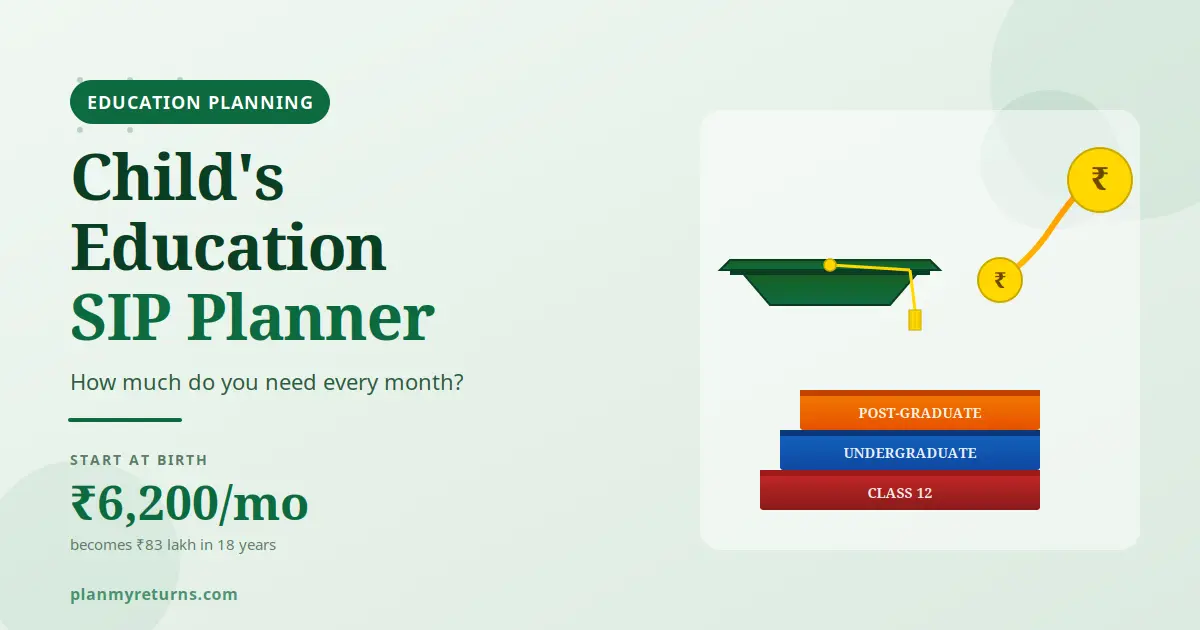
A complete guide to calculating exactly how much SIP you need every month to fund your child’s higher education in India and abroad in 2026, with realistic cost projections, education inflation, and goal-based mutual fund strategy.
To fund your child’s higher education in India by 2044, you need a monthly SIP of approximately ₹6,000 to ₹10,000 starting from your child’s birth, assuming 12% mutual fund returns and 10% education inflation. For studying abroad, the requirement jumps to ₹15,000 to ₹30,000 per month. The exact amount depends on the type of course, country, and how early you start.
Education in India is getting expensive faster than almost anything else. IIT fees have grown from ₹50,000 per year in 2008 to over ₹3 lakh in 2026. A premier MBA at IIM Ahmedabad now costs ₹30 lakh for 2 years, up from ₹4 lakh just 18 years ago. Studying abroad? Even more brutal. A typical 2-year MS in the US easily crosses ₹75 lakh today.
This guide shows you exactly how much SIP to start today based on your child’s age and target education goal, with real numbers for engineering, medical, MBA, and overseas studies in 2026.
The Compounding Truth. Starting a ₹5,000 SIP at your child’s birth grows to ₹38 lakh by age 18. The same SIP started when your child is 8 grows to only ₹15 lakh. Time is the most powerful variable in education planning, not the SIP amount.
How Much Does Higher Education Cost in India in 2026?
Before you can calculate the SIP, you need a realistic target amount. Here are current 2026 costs for the most popular career paths Indian parents plan for:
Reality Check. These are 2026 costs. By the time your newborn turns 18 (year 2044), multiply each number by 5x to 6x to account for 10% education inflation. A ₹25 lakh MBA today will cost ₹1.4 crore in 2044.
Education Cost Projection: What Will It Cost in the Future?
This is where most parents underestimate. Here is the future cost of an education that costs ₹15 lakh today, projected at 10% education inflation:
So if you’re planning for engineering 18 years away, your real target is not ₹15 lakh. It is ₹83 lakh. This is why parents who plan with today’s prices end up shockingly underfunded when the time comes.
Calculate your child’s exact education corpus.
Get future cost projections based on inflation and timeline.
SIP Required: Exact Monthly Investment by Goal and Timeline
Now the most important table. Here is exactly how much you need to invest every month via SIP to reach common education goals, assuming 12% mutual fund CAGR and 10% education inflation:
The Crorepati Plan: ₹5,000 SIP for 18 Years
Want to see the magic of compounding for child education? Here is what a simple ₹5,000 monthly SIP grows into across different time horizons at 12% returns:
The lesson is brutal but clear. The same ₹5,000 monthly investment delivers ₹38 lakh if started at birth, but only ₹8 lakh if started when the child is 10. That is a 5x difference for the same monthly effort. Every year of delay costs your child a real shot at the college of their choice.
Find your exact monthly SIP amount.
Calculate corpus needed and SIP required for your child’s specific goal.
Step-by-Step: How to Plan Your Child’s Education SIP
Identify the Goal and Timeline
Decide what your child’s likely education path is. Engineering? Medical? MBA after graduation? Study abroad? You don’t need to be 100% sure. Plan for the most expensive realistic option. If your child shifts to a cheaper path, the surplus becomes their wedding or business seed money.
Calculate the timeline: For undergrad, plan for 17-18 years from birth. For post-graduation, plan for 21-22 years.
Calculate the Future Cost
Take today’s cost and apply 10% education inflation for the number of years until the goal. Use the formula: Future Cost = Today’s Cost × (1.10)^years. Or skip the math and use the Education Planning Calculator.
Example: Engineering costs ₹15 lakh today. In 18 years at 10% inflation, future cost = 15 × (1.10)^18 = ₹83.4 lakh.
Determine the Monthly SIP
Use the SIP formula or calculator to find what monthly amount, invested at 12% expected returns, will grow into your future cost target. For ₹83 lakh in 18 years at 12%, you need approximately ₹6,200/month.
Round it up. Always plan with a 10-15% buffer for unexpected costs like coaching, hostel deposits, books, and laptops.
Choose the Right Mutual Fund Mix
For 10+ year horizons, allocate aggressively to equity. Sample 70-30 portfolio: 40% in a Nifty 50 Index Fund (UTI Nifty 50 Index, HDFC Nifty 50 Index), 30% in a Flexi Cap Fund (Parag Parikh Flexi Cap), 20% in a Mid Cap Fund (Motilal Oswal Midcap), 10% in a Hybrid/Debt fund.
For goals less than 5 years away, shift to 60% debt + 40% equity. For goals less than 3 years, move to 100% debt or liquid funds to protect against market crashes.
Set Up Auto-Debit and Step-Up
Start a monthly SIP via your AMC or platform (Zerodha Coin, Groww, Kuvera, MF Central). Enable auto-debit on the 5th of every month so investing happens before spending.
Crucial: Set up a 10% annual step-up. Increasing your SIP by 10% every year matches your salary growth and dramatically increases the final corpus. A flat ₹6,000 SIP for 18 years gives ₹45 lakh. A step-up SIP starting at ₹6,000 gives ₹70+ lakh.
Review and Rebalance Annually
Review the portfolio every March-April. Check if returns are on track. If a fund consistently underperforms its category for 3 years, switch. Rebalance allocation when one asset class crosses 5% of target.
As the goal approaches (3 years away), gradually shift from equity to debt to lock in gains. This is called the “glide path” approach.
SIP vs SSY vs Child Plan: What Actually Works in 2026
Indian parents get pitched three main options for child education planning. Here is the honest comparison:
The verdict: Mutual Fund SIP wins on returns, liquidity, and flexibility. For girl children, combine it with SSY for the safe debt portion. Avoid child insurance plans entirely. They blend insurance and investment poorly, and you end up overpaying for both.
Buy Term Insurance Separately. If you’re planning for your child’s future, you also need a pure term life insurance plan covering 15-20x your annual income. This protects the goal if anything happens to you. Calculate your cover with the Term Insurance Calculator.
Real-Life Example: Anil’s Plan for Daughter Aanya
Anil, 32, IT Manager in Pune. Daughter Aanya is 1 year old. Goal: Engineering at IIT in 17 years.
Today’s IIT cost: ₹15 lakh for 4 years. At 10% education inflation over 17 years, future cost = ₹15 lakh × (1.10)^17 = approximately ₹75.7 lakh.
Anil’s plan: ₹6,800/month SIP at expected 12% returns will grow to ₹76 lakh in 17 years. He splits it as follows:
Anil also enabled a 10% annual step-up. By Aanya’s 17th birthday in 2042, his projected corpus is approximately ₹98 lakh, comfortably covering IIT fees with surplus for laptop, hostel deposits, and a buffer.
Total contribution over 17 years (with step-up): approximately ₹35 lakh. Returns generated: ₹63 lakh. That is the power of starting early and staying disciplined.
Build your child’s education plan in 5 minutes.
Get exact monthly SIP, future cost, and corpus projection.
5 Common Mistakes Parents Make in Education Planning
Mistake 1: Planning with today’s prices. Engineering costs ₹15 lakh today, not ₹15 lakh in 2042. Always inflate future costs by 10% per year. Use the Inflation Calculator to see how prices will rise.
Mistake 2: Buying child insurance plans. The 4-6% returns from traditional child plans guarantee underfunding. The “Sum Assured on death” feature is better delivered via cheap term insurance + mutual fund SIP separately.
Mistake 3: Investing in FDs for long-term education goals. FDs deliver 6.5-7% pre-tax (4-5% post-tax for 30% bracket). Education inflation is 10%. You’re guaranteed to fall behind. Equity is essential for 10+ year goals.
Mistake 4: Stopping SIPs during market crashes. The 2020 COVID crash and the 2024-25 correction made many parents stop SIPs. Those who continued got the lowest NAVs and the highest returns. Never stop SIPs during downturns. That is when SIPs work hardest.
Mistake 5: Not having an emergency fund. If you raid your child’s SIP every time the AC breaks or the car needs servicing, the corpus gets destroyed. Keep 6 months of expenses in a separate emergency fund. Calculate the size with the Emergency Fund Calculator.
Tax Saving + Education Planning: ELSS Strategy
Smart parents use ELSS mutual funds to hit two goals at once. ELSS qualifies for Section 80C deduction (up to ₹1.5 lakh tax saving) AND delivers 12-15% equity returns. The 3-year lock-in is irrelevant if your child’s education is 10+ years away.
Sample combo: Invest ₹12,500/month (₹1.5 lakh/year) in ELSS to fully exhaust your 80C limit. This gives you ₹46,800 annual tax saving (in 30% slab) plus a strong equity engine for your child’s education corpus. Calculate your exact ELSS returns using the ELSS Calculator.
Combined with a small ₹1,000/month SSY contribution for girl children, you get tax saving + guaranteed returns + equity growth all in one strategy.
Plan Your Complete Family Financial Journey
Education is just one of multiple goals you need to plan for. Use these calculators on PlanMyReturns to build a complete plan:
For your daughter’s education, combine SIP with SSY using the SSY Calculator. Plan your child’s wedding fund alongside education using the Marriage Planning Calculator. Don’t forget your own retirement. Many parents over-fund children and underfund themselves. Estimate your needs with the Retirement Calculator. Planning to buy a bigger home as the family grows? Check affordability with the Home Loan EMI Calculator.
Explore all free financial calculators at PlanMyReturns Calculators. Every calculation follows transparent methodology and assumptions you can verify.
Frequently Asked Questions: Child Education SIP Planning