A complete guide to the best large cap mutual funds in India for 2026, with 5-year returns, expense ratios, and beginner-friendly recommendations to help you start your equity investment journey safely.
Large cap mutual funds invest at least 80% of their assets in India’s top 100 companies by market capitalization, as per SEBI categorization rules. These are the safest equity mutual funds because they hold stocks of well-established giants like Reliance, TCS, HDFC Bank, ICICI Bank, and Infosys. For beginners stepping into equity investing for the first time, large cap funds are the recommended starting point.
In 2026, with Nifty 50 hitting record highs and market valuations stretched, picking the right large cap fund matters more than ever. The wrong fund can give you 8% returns when peers give 14%. Over 20 years, that 6% gap turns ₹10 lakh into ₹47 lakh instead of ₹1.4 crore.
This guide covers the top 5 large cap mutual funds in India for 2026, what makes them stand out, who should invest in them, and how to start your first SIP today.
Why large cap funds for beginners? They are less volatile than mid cap and small cap funds. Crashes are smaller. Recovery is faster. You sleep peacefully even during market corrections. That stability matters when you are new to equity investing.
What is a Large Cap Mutual Fund?
SEBI defines large cap companies as the top 100 listed companies in India by market capitalization. A large cap mutual fund must invest at least 80% of its portfolio in these top 100 stocks. The remaining 20% can go into mid cap, small cap, or debt instruments at the fund manager’s discretion.
These funds give you exposure to India’s biggest, most stable businesses through one investment. You own a slice of Reliance, TCS, HDFC Bank, Infosys, ICICI Bank, and 95 other blue-chip companies, all in a single fund.
Large cap funds are also called “bluechip funds” by many AMCs. The names ICICI Prudential Bluechip Fund, Canara Robeco Bluechip Equity Fund, and Aditya Birla Sun Life Frontline Equity Fund all refer to large cap funds. Bluechip is just a marketing term. The SEBI category is large cap.
How We Selected the Top Large Cap Funds for 2026
We evaluated all 30+ large cap mutual funds in India on these parameters before shortlisting the top 5:
- Consistency of returns: 3-year, 5-year, and 10-year CAGR above category average
- Expense ratio below 1.5% for direct plans (lower the better)
- Fund size above ₹5,000 crore (high AUM signals investor trust)
- Fund manager tenure of at least 5 years (stability matters)
- Beta close to 1 (moves in line with market, not too volatile)
- Sharpe ratio above 0.5 (good risk-adjusted returns)
The funds below have been consistently ranked by Value Research, Morningstar, and AMFI as top performers in the large cap category as of Q1 2026.
Top 5 Best Large Cap Mutual Funds 2026
Nippon India Large Cap Fund
Why it stands out: Nippon India Large Cap Fund has been the most consistent performer in the large cap category over the last 5 years. Fund manager Sailesh Raj Bhan has managed it since 2007, providing exceptional stability. The fund follows a value-conscious approach and avoids overpriced stocks.
Top holdings (2026): HDFC Bank, Reliance Industries, ICICI Bank, Larsen & Toubro, Bharti Airtel, ITC.
Best for: Beginners who want a tested fund with a proven track record. Ideal for monthly SIPs of ₹2,000 to ₹25,000.
Minimum SIP: ₹500/month. Use the SIP Calculator to plan your monthly investment.
ICICI Prudential Bluechip Fund
Why it stands out: India’s largest large cap fund by AUM. Massive investor trust. Anish Tawakley has managed it since 2018 with a disciplined investment process. Strong performance in both bull and bear markets.
Top holdings (2026): ICICI Bank, HDFC Bank, Reliance Industries, Infosys, Axis Bank, Bharti Airtel.
Best for: Risk-averse beginners who prefer the largest, most popular fund. Excellent for first-time SIP investors.
Minimum SIP: ₹100/month (one of the lowest). Calculate your SIP returns with the SIP Calculator.
HDFC Top 100 Fund
Why it stands out: One of the oldest large cap funds in India, launched in 1996. Over 28+ years of track record. Fund manager Rahul Baijal continues the disciplined HDFC investing philosophy. The fund focuses on quality stocks with strong fundamentals.
Top holdings (2026): HDFC Bank, ICICI Bank, Reliance Industries, Larsen & Toubro, NTPC, ITC.
Best for: Beginners who value brand trust and long track record. Suitable for retirement-focused investors.
Minimum SIP: ₹100/month. Plan your retirement corpus with the Retirement Calculator.
How much will your large cap SIP grow?
Calculate the future value of your monthly SIP investment.
Mirae Asset Large Cap Fund
Why it stands out: Lowest expense ratio among top large cap funds. The fund follows a quality-focused, growth-at-reasonable-price approach. Co-managed by Gaurav Khandelwal and Gaurav Misra. Strong downside protection during market corrections.
Top holdings (2026): HDFC Bank, ICICI Bank, Reliance Industries, Infosys, Bharti Airtel, Axis Bank.
Best for: Cost-conscious beginners who want the cheapest large cap fund without compromising on quality.
Minimum SIP: ₹500/month.
Canara Robeco Bluechip Equity Fund
Why it stands out: Best downside protection in the category. During the 2020 COVID crash and 2022 corrections, this fund fell less than peers and recovered faster. Fund manager Shridatta Bhandwaldar has managed it since 2019. Conservative approach suits cautious beginners.
Top holdings (2026): HDFC Bank, ICICI Bank, Infosys, Reliance Industries, TCS, Larsen & Toubro.
Best for: First-time investors who fear market crashes. Good for conservative beginners and those near retirement.
Minimum SIP: ₹1,000/month.
Quick Comparison: All 5 Funds Side-by-Side
How Much Will ₹10,000 Monthly SIP Grow To?
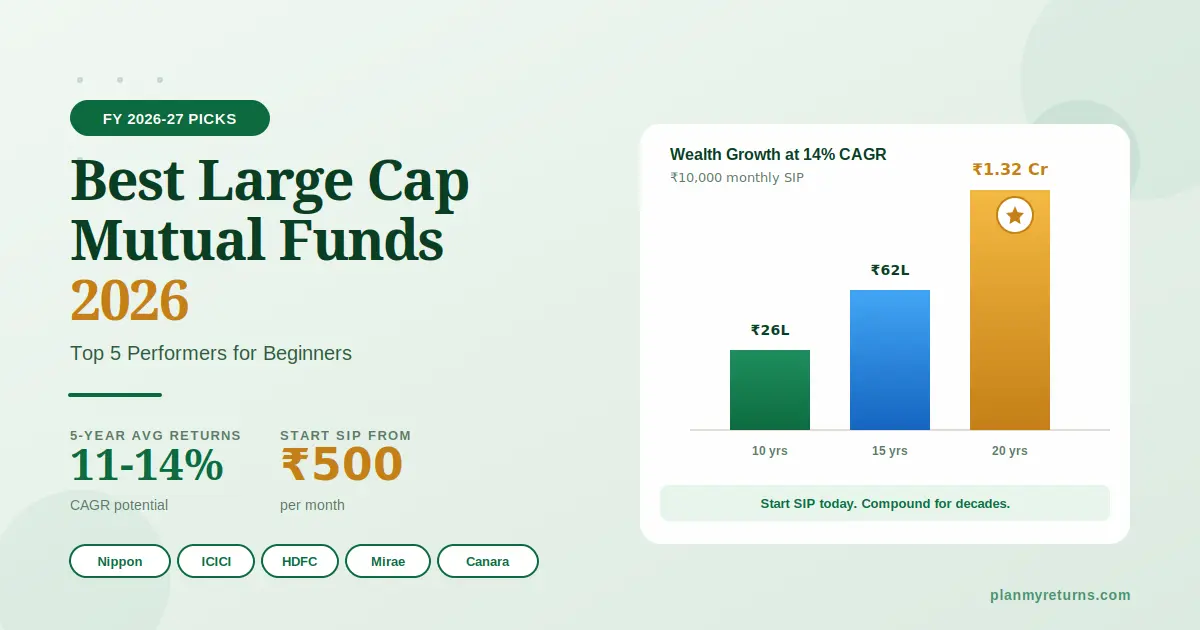
If you start a ₹10,000 monthly SIP in a top large cap mutual fund and continue for the long term, here is how your wealth could grow at an assumed 14% CAGR:
This is the magic of compounding. The longer you stay invested, the more dramatic the growth. A 20-year SIP turns ₹24 lakh of contributions into over ₹1.3 crore. Use the SIP Calculator to plan your exact corpus based on your target.
Want to be a crorepati? A ₹7,500 monthly SIP at 14% CAGR for 20 years gets you to ₹1 crore. Use the Crorepati Calculator to find your exact monthly amount needed.
How to Invest in Large Cap Mutual Funds: Step-by-Step
Starting your first large cap mutual fund SIP takes 10 minutes. Here is the exact process:
- Step 1: Complete KYC online with PAN, Aadhaar, and a selfie. Sign up on a platform like Groww, Zerodha Coin, ET Money, or Kuvera.
- Step 2: Pick one large cap fund from this list. For most beginners, ICICI Prudential Bluechip or Mirae Asset Large Cap is a safe default.
- Step 3: Choose Direct Plan with Growth option. Direct plans have lower expense ratios. Growth option compounds your wealth automatically.
- Step 4: Set up a SIP of any amount (start with ₹500 or ₹1,000 if you are unsure). Pick a date 2 to 3 days after your salary credit.
- Step 5: Set up auto-debit (eMandate) so the SIP runs automatically every month.
- Step 6: Stay invested for 5+ years. Do not stop SIPs during market crashes. That is when you buy the most units.
Common Mistakes Beginners Make with Large Cap Funds
Mistake 1: Investing in too many funds. Beginners often invest in 5 to 10 mutual funds thinking diversification helps. It does not. All large cap funds hold similar stocks. One large cap fund is enough.
Mistake 2: Stopping SIP during market crashes. The biggest mistake. SIPs work best when markets fall, because you buy more units at lower prices. Continue your SIP. Do not panic.
Mistake 3: Choosing Regular Plan instead of Direct Plan. Regular plans pay commission to distributors and have 0.8 to 1.2% higher expense ratio. Over 20 years, that 1% difference reduces your corpus by 20%. Always pick Direct Plan.
Mistake 4: Investing for 1 to 2 years only. Equity funds are not for short-term goals. If you need money within 3 years, use FDs or debt funds instead. Compare returns with the FD Calculator.
Mistake 5: Chasing past returns. Just because a fund returned 25% last year does not mean it will repeat. Look at 5-year and 10-year consistency, not 1-year returns.
Real-Life Example: Arjun’s Investment Plan
Arjun, 27, Software Engineer in Hyderabad. Annual salary: ₹12,00,000. New investor.
Arjun has never invested in mutual funds before. He has ₹1,50,000 in savings and ₹15,000 surplus every month after expenses.
His plan: Start a ₹10,000/month SIP in Nippon India Large Cap Fund (Direct Growth). Keep ₹1,50,000 as emergency fund in a liquid fund or savings account. Invest the remaining ₹5,000/month later in a flexi cap fund for diversification (after 1 year of large cap experience).
Expected outcome: At 14% CAGR over 20 years, his ₹10,000 monthly SIP grows to ₹1.32 crore. Total invested: ₹24 lakh. Wealth gained: ₹1.08 crore.
Tax impact: If Arjun redeems after 20 years, LTCG above ₹1.25 lakh per year is taxed at 12.5%. Even with tax, his post-tax corpus is over ₹1.2 crore. Calculate exact LTCG using the Capital Gains Calculator.
Plan your large cap SIP like Arjun.
Calculate your exact monthly investment to reach any wealth target.
Large Cap Funds vs Other Options for Beginners
Use the Lumpsum Calculator if you want to invest a one-time amount instead of SIP, and the PPF Calculator to compare wealth creation versus PPF.
Plan Your Complete Investment Journey
A large cap mutual fund is the foundation of your equity portfolio, not the entire structure. Once you have 6 to 12 months of large cap SIP experience, gradually expand your portfolio.
Calculate your retirement corpus needs with the Retirement Calculator. Plan child’s education using the Education Planning Calculator. Build emergency funds using the Emergency Fund Calculator. Plan a dream home with the Dream Home Calculator.
Explore all free financial calculators at PlanMyReturns Calculators. Every calculation follows transparent methodology and assumptions you can verify.
Frequently Asked Questions