A complete retirement planning guide for Indians who want to retire at 50 with financial independence. Calculate your exact corpus, monthly SIP, and asset allocation based on age, expenses, and inflation for FY 2026-27.
Retiring at 50 in India is achievable. But it requires a clear corpus target, disciplined investing, and protection from inflation. The biggest mistake most Indians make is using current expenses to plan retirement. By the time you actually retire, expenses double or triple. Healthcare costs alone inflate at 12-14% per year, faster than your salary grows.
So how much money do you really need to retire at 50? The answer depends on three numbers: your current age, your current monthly expenses, and your expected lifespan. Using these inputs, the right retirement corpus typically lands between ₹5 crore and ₹8 crore for most middle-class Indians today.
This guide walks you through the exact math. We cover the corpus calculation framework, real-life scenarios for different ages, asset allocation strategies, and the FIRE movement in India. Use the Retirement Calculator to get your personalized number.
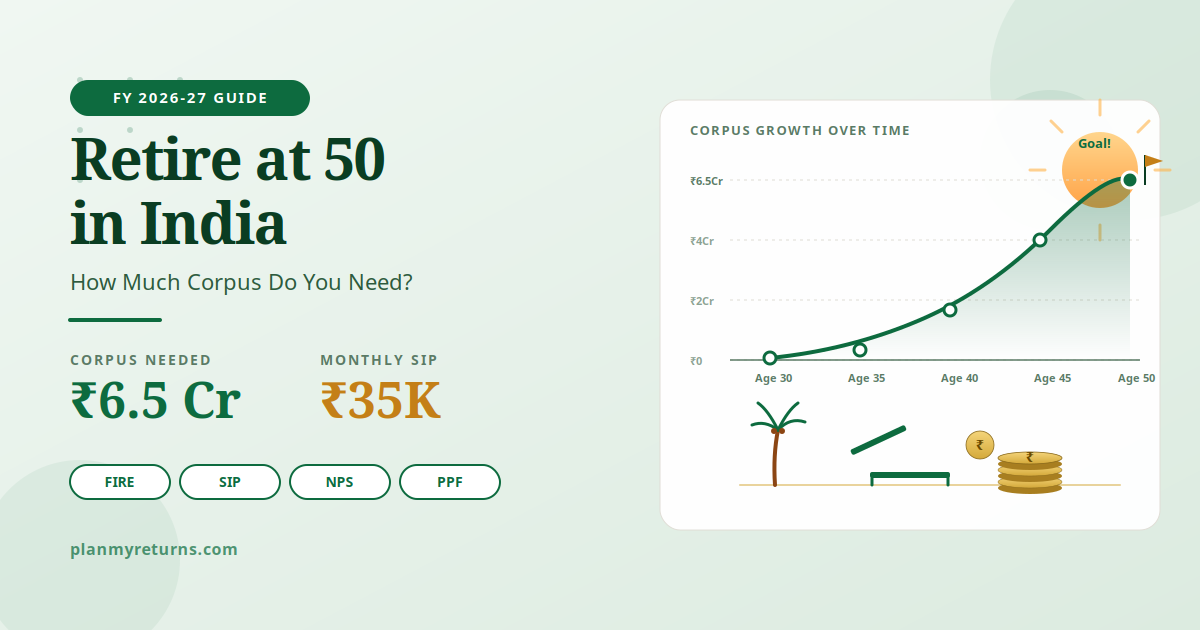
Quick reality check: If you are 30 today and want to retire at 50 with ₹75,000 monthly expenses (today’s value), you need approximately ₹6.5 crore. That requires a monthly SIP of ₹35,000 in equity mutual funds at 12% CAGR. Sounds big, but it is achievable.
The 25x Rule: How Much Retirement Corpus Do You Need?
The simplest retirement formula is the 25x rule: your retirement corpus should equal 25 times your annual expenses at retirement. If your annual expenses at retirement will be ₹20 lakh, you need ₹5 crore. The rule assumes a 4% safe withdrawal rate.
But the 25x rule has one big flaw for Indians: it doesn’t fully account for high inflation (6% general, 12% healthcare) and longer post-retirement years. For early retirement at 50, most Indian planners recommend the 30x rule: 30 times your retirement-year annual expenses. This gives you a safer 3.33% withdrawal rate.
Quick formula for retirement at 50:
The result: a 30-year-old with ₹75,000 current monthly expenses needs to build ₹6.5 crore in 20 years to retire at 50 comfortably. This calculation factors in 30+ years of post-retirement life, inflation, and healthcare costs.
Get YOUR exact retirement number in 60 seconds.
Enter your age, current expenses, and goals. Our calculator does the math.
Corpus Required at Different Monthly Expense Levels
Your retirement corpus directly depends on your lifestyle. The higher your monthly expenses, the bigger the corpus you need. Here’s a quick reference table for someone retiring at 50, with 20 years to go:
Most Indian families fit the “comfortable” or “premium” categories. The corpus might look intimidating, but compound interest does the heavy lifting if you start early. A monthly SIP of just ₹35,000 from age 30 grows to ₹6.5 crore by age 50 at 12% returns.
How Much Monthly SIP Do You Need? By Age
The earlier you start, the smaller your monthly SIP needs to be. This is the magic of compounding. To build a ₹6.5 crore corpus by age 50, here’s what you need to invest monthly based on your current age (assuming 12% equity returns):
The 5-year delay tax is brutal. Starting at 25 vs 30 means you save ₹17,000 less every month for 25 years. Starting at 30 vs 35 doubles your monthly SIP requirement. Starting at 40 makes early retirement nearly impossible without a major income jump or windfall.
Pro tip: Use Step-up SIPs. Instead of a flat ₹35,000 SIP, start with ₹25,000 and increase by 10% every year. This matches your salary growth and reduces upfront pressure. Use the SIP Calculator to model step-up scenarios.
The 5-Step Retirement Planning Framework
Calculate Your Future Monthly Expenses
Start by tracking your current monthly expenses for 3 months. Include rent, food, utilities, transport, entertainment, kids’ education, and insurance premiums. Don’t include EMIs that will end before retirement.
Future Value Formula: Future Monthly = Current Monthly × (1.06)^years. For ₹75,000 today over 20 years: ₹75,000 × 3.207 = ₹2,40,000. Always add a 10-15% buffer for healthcare inflation, which runs at 12-14% per year in India.
Tip: Don’t underestimate medical expenses. Indians spend an average ₹50,000 to ₹2 lakh per year on healthcare after age 60. Include this even if you have insurance, because insurance premiums also rise sharply post-60. Use the Inflation Calculator to project your exact future expenses.
Determine Your Target Corpus
Multiply your future annual expenses by 30. This gives you a corpus that can sustain 30+ years of post-retirement life with a 3.33% safe withdrawal rate.
Why 30x and not 25x? If you retire at 50 in India, you might live until 85 or 90. That’s 35-40 years of retirement. The classic 4% rule (25x) assumes 30 years. For early retirement, conservative withdrawal rates protect against sequence-of-returns risk and unexpected medical bills.
Adjust for legacy goals: If you want to leave money for children or charity, add another 5-10x. So if your annual need is ₹30 lakh, target ₹10.5-12 crore instead of ₹9 crore. The Retirement Calculator automatically factors all these variables.
Pick Your Asset Allocation
The classic rule: Equity allocation = 100 minus your age. So at 30, you should hold 70% equity, 30% debt. At 40, it’s 60% equity. At 50 (retirement), shift to 40-50% equity for some growth post-retirement.
Recommended split for early retirement:
• Equity (70-80%): Index funds (Nifty 50, Nifty Next 50), large cap mutual funds, flexi cap funds. SIP via the SIP Calculator to plan amounts.
• Debt (15-20%): PPF, EPF, debt mutual funds. PPF is excellent for tax-free returns. Use the PPF Calculator to see how PPF grows over 15-25 years.
• NPS (5-10%): National Pension System adds ₹50,000 extra tax deduction under 80CCD(1B). Use the NPS Calculator to project your pension.
• Gold (5%): Sovereign Gold Bonds for inflation hedge.
Automate and Increase Your SIPs
Set up auto-debit SIPs on the 1st or 2nd of every month, right after salary credit. This is the single most important habit in retirement planning. Manual investing fails because you spend first and invest what’s left, which is often nothing.
The 10% step-up rule: Increase your SIP by 10% every April (along with your salary hike). A ₹25,000 SIP becomes ₹27,500 next year, ₹30,250 the year after. Over 20 years, this adds ₹2-3 crore extra to your corpus compared to a flat SIP.
Don’t time the market: Continue SIPs even during market crashes. Crashes are when you accumulate more units at lower prices. The 2020 COVID crash and 2022 correction created millionaires for SIP investors who stayed disciplined.
Review Annually and Rebalance
Once a year, check your portfolio against your target. If equity has surged and now makes 85% of your portfolio (instead of target 70%), book some profits and shift to debt. This rebalancing locks in gains and reduces risk.
The 5-year mid-course correction: Every 5 years, redo the entire calculation. Your expenses, income, and goals change. The retirement corpus you needed at 30 might be higher at 35 due to lifestyle inflation, kids’ education, or new goals.
Track your net worth: Use the Net Worth Calculator annually to see your progress. Watching your net worth grow is the best motivation to continue SIPs.
Real-Life Example: Rohan’s Path to Retirement at 50
Rohan, 30, Senior Engineer at an MNC in Pune. Take-home salary: ₹1,40,000/month. Current monthly expenses: ₹70,000. Goal: Retire at 50.
Rohan’s first task was to project his future expenses. ₹70,000 today × 1.06^20 = ₹2.24 lakh per month at age 50. Annual expenses: ₹26.9 lakh. Adding a 10% healthcare buffer: ₹29.6 lakh annual.
His target corpus using the 30x rule: ₹29.6 lakh × 30 = ₹8.9 crore. To build this in 20 years at 12% CAGR, his required monthly SIP: ₹47,000.
That looked impossible at first. He couldn’t invest ₹47,000 from his ₹1.4 lakh salary while paying rent and supporting parents. So Rohan used the step-up SIP approach.
His plan:
• Start with ₹30,000/month SIP at age 30
• Increase SIP by 10% every year (matching his salary hikes)
• Allocation: ₹20,000 in Nifty 50 Index Fund, ₹8,000 in Mirae Asset Large Cap, ₹2,000 in Parag Parikh Flexi Cap
• Additional: ₹12,500/month in PPF (₹1.5 lakh/year for 80C deduction)
• Plus: ₹4,167/month in NPS for the extra ₹50,000 deduction under 80CCD(1B)
By age 50, Rohan’s projection: ₹9.2 crore corpus. ₹7.5 crore from equity SIPs, ₹1.2 crore from PPF, ₹50 lakh from NPS. He plans to retire and maintain his lifestyle by withdrawing 3.5% annually (₹32 lakh/year) for 35+ years.
Build your own retirement plan like Rohan.
Calculate corpus, SIP amount, and asset allocation in one place.
FIRE Movement in India: Lean FIRE vs Fat FIRE
FIRE stands for Financial Independence, Retire Early. It’s a global movement where people save 40-70% of income to build a corpus large enough to retire decades before traditional retirement age. The Indian FIRE community has adapted the concept into multiple flavors:
The Coast FIRE approach is the most practical for Indians. Build a ₹2-3 crore corpus by age 35, then stop adding to it. The corpus compounds on its own and reaches ₹15-20 crore by age 60. Use the FIRE Calculator to model these scenarios.
5 Common Retirement Planning Mistakes Indians Make
Mistake 1: Using current expenses to plan. Most people calculate corpus based on today’s ₹50,000 expenses. After 20 years of 6% inflation, that becomes ₹1.6 lakh. They underestimate the corpus needed by 70-80%.
Mistake 2: Relying on real estate as retirement plan. “My flat will fund my retirement” is a dangerous assumption. Real estate is illiquid, gives 5-7% returns (often less than inflation), and you can’t sell parts of a flat to pay monthly bills. Treat real estate as a separate asset, not your retirement plan.
Mistake 3: Buying traditional LIC plans for retirement. LIC endowment and money-back plans give 4-6% returns. After tax and inflation, your real returns are zero or negative. Use term insurance for life cover and equity mutual funds for wealth creation. Check actual returns of any LIC plan using calculators like the LIC Jeevan Labh Calculator.
Mistake 4: Stopping SIPs during market crashes. The biggest wealth-destroying mistake. SIP investors who continued through 2020 (COVID crash) and 2022 (correction) generated 30-40% extra returns by buying low. Treat market crashes as discount sales, not disasters.
Mistake 5: Not factoring healthcare costs. Indians spend disproportionately on healthcare after 60. A heart surgery can cost ₹5-8 lakh. Cancer treatment runs ₹15-25 lakh. Build a separate ₹50 lakh to ₹1 crore healthcare buffer in your corpus, especially if family history includes diabetes, heart disease, or cancer.
Where to Invest for Retirement Corpus
For early retirement, your corpus needs aggressive growth in the accumulation phase (ages 25-45) and stability protection in the consolidation phase (ages 45-50+). Here’s the recommended allocation:
Plan your asset mix using the Asset Allocation Calculator. Don’t forget your Emergency Fund (6 months of expenses) before aggressive investing. An emergency fund prevents you from breaking SIPs during job loss or medical emergencies.
Tax efficiency matters: Use the Income Tax Calculator to optimize your old vs new tax regime choice. Old regime with 80C, 80CCD(1B) and home loan deductions often beats new regime if your salary is above ₹15 lakh and you maximize all deductions.
Plan Your Complete Financial Journey
Retirement is the biggest financial goal, but it’s not the only one. Use these calculators on PlanMyReturns to plan every life stage.
Calculate your monthly SIPs with the SIP Calculator. Build your child’s education fund using the Education Planning Calculator. Plan a home purchase via the Home Loan EMI Calculator. Calculate post-retirement income using the SWP Calculator to see how your corpus generates monthly income. And see your overall financial health with the Net Worth Calculator.
Explore all free financial calculators at PlanMyReturns Calculators. Every calculation follows transparent methodology and assumptions you can verify.
Frequently Asked Questions: Retirement at 50