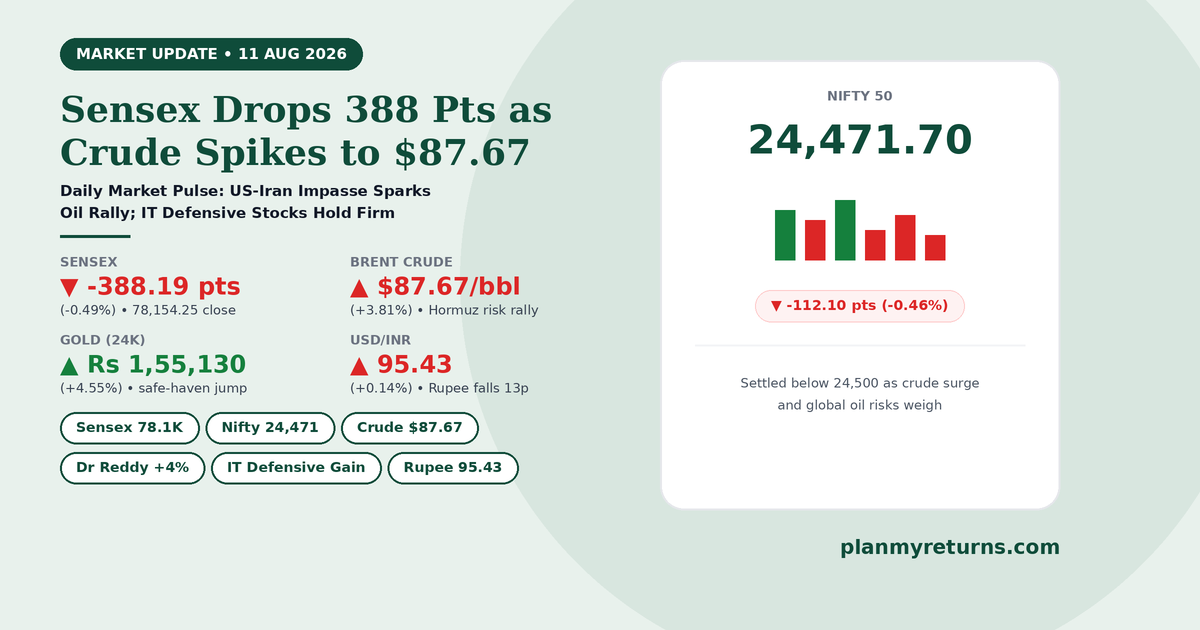
Today’s Overview: Indian stock markets closed lower on August 11, 2026, as rising crude oil prices near $87.67 per barrel and geopolitical uncertainty surrounding US-Iran negotiations weighed on investor sentiment. The BSE Sensex fell 388.19 points to 78,154.25, while Nifty 50 dropped 112.10 points to 24,471.70. Defensive IT buying helped limit deeper benchmark losses.
Today’s Top Finance Stories
1. Why Did Sensex Fall 388 Points and Nifty Drop Below 24,500 on 11 August 2026?
What happened: Benchmark Indian equity indices surrendered recent gains on Tuesday. The BSE Sensex tumbled -388.19 points (-0.49%) to close at 78,154.25, while the Nifty 50 slipped -112.10 points (-0.46%) to 24,471.70. Bank Nifty also eased -220.70 points (-0.38%) to close at 57,466.25.
Why does it matter: Profit booking across consumer goods, metals, and real estate counters accelerated as crude oil prices spiked. Investors looking to cost-average equity holdings during market dips can project positions using a Stock Average Calculator or manage systematic contributions via a SIP Calculator.
Key Takeaway: Geopolitical energy cost pressures created temporary headwinds, pulling Nifty 50 below its immediate 24,500 support level.
2. How Does Brent Crude Surging to $87.67/barrel Impact Indian Stocks and Inflation?
What happened: International Brent crude oil prices surged +3.81% to $87.67 per barrel on 11 August as Middle East supply disruption fears intensified following an impasse in US-Iran negotiations regarding the Strait of Hormuz. The Indian Rupee weakened by 13 paise to close at 95.43 against the US Dollar.
Why does it matter: India imports over 85% of its crude requirements; rising energy costs widen the trade deficit and squeeze operating margins for energy-intensive manufacturing industries. Investors measuring inflation impacts on household purchasing power can check calculations with an Inflation Calculator.
Key Takeaway: Higher crude oil prices elevate import costs and currency pressure, prompting cautious stance across domestic cyclical sectors.
3. What Drove Safe-Haven Gold Prices to Jump to Rs 1,55,130 per 10g Today?
What happened: Domestic 24K retail gold rates jumped +4.55% to ₹1,55,130 per 10 grams (₹15,513/g) on 11 August, while silver rates rose +1.21% to ₹2,35,000 per kg on strong international spot demand.
Why does it matter: Geopolitical tensions and cooling global interest rate expectations spurred institutional safe-haven allocation into bullion. Individuals reviewing long-term asset allocation targets can estimate compounding wealth goals using a Compound Interest Calculator.
Key Takeaway: Heightened geopolitical risk boosts safe-haven demand for gold, making bullion an effective portfolio hedge during market volatility.
4. Why Did TCS, Infosys, and IT Stocks Hold Firm Against Market Weakness?
What happened: Defensive technology counters bucked the market trend on 11 August, with IT leader TCS gaining +0.68%, Infosys rising +0.65%, and HCL Tech advancing +0.60%. Pharma heavyweight Dr. Reddy’s Laboratories led all Nifty 50 gainers with a +4.10% surge.
Why does it matter: Export-oriented technology and healthcare shares benefit from Rupee weakening and offer steady earnings visibility during domestic cyclical slowdowns. Investors planning long-term lumpsum equity allocations can project potential returns using a Lumpsum Calculator.
Key Takeaway: Strategic allocation to defensive sectors like IT and pharma cushions overall portfolio performance against macro market pullbacks.
5. Policy and Global Watch: US-Iran Negotiation Impasse, Rupee Weakening, and Fitch Rating Update
What happened: Globally, Fitch Ratings affirmed India’s sovereign credit rating with a stable outlook on 11 August, highlighting robust domestic economic fundamentals. However, impasse in US-Iran peace talks raised concerns over Middle East energy shipping lanes, leading FIIs and DIIs to adopt a cautious stance.
Why does it matter: Stable sovereign credit ratings reassure foreign investors despite short-term oil volatility. Taxpayers planning annual savings and tax strategies can evaluate liabilities with an Old vs New Tax Regime Calculator.
Key Takeaway: Strong sovereign rating fundamentals support India’s long-term economic outlook even as short-term geopolitical noise impacts sentiment.
News & Stock Updates
Macro, Regulatory & Economy Updates
- Sovereign Credit Rating: Fitch Ratings affirmed India’s sovereign rating with a ‘Stable’ outlook, citing strong growth and healthy banking system balance sheets.
- Currency Market: Indian Rupee fell 13 paise to settle at 95.43 against US Dollar as crude oil spiked to $87.67/bbl.
- Derivatives Ban List: National Stock Exchange (NSE) retained SAIL and Bandhan Bank under F&O ban list ahead of weekly Nifty expiry.
- SEBI Inspection Mandate: Joint exchange-depository audits intensified across market infrastructure institutions to enhance price discovery.
Corporate & Stock Action Buzzers
- Dr. Reddy’s Laboratories: Soared +4.10% to lead Nifty 50 gainers after receiving key US FDA product approvals.
- TCS & Infosys: Advanced +0.68% and +0.65% respectively as investors moved capital into defensive IT exports.
- Nestle India: Declined -2.32% on profit booking and raw material margin concerns.
- UltraTech Cement: Slipped -2.23% as higher petcoke and energy costs weighed on building material counters.
- Tata Consumer Products: Slipped -3.10% following profit taking after recent gains.
- Eicher Motors: Rose +0.47% to ₹8,012.50 supported by steady Royal Enfield monthly export numbers.
Market Snapshot
Equity figures are official closing levels for 11 August 2026. Gold and silver rates shown are indicative 24K retail reference rates (10g and 1kg). Note that retail gold and silver prices vary across cities (e.g., Mumbai, Delhi, Chennai, Hyderabad, Bengaluru) due to local taxes/octroi, transportation costs, and jeweller margins. Crude and currency reflect round-the-clock evening rates.
Top Gainers & Losers Nifty 50, 11 August 2026
▲ Top 5 Gainers
- Dr. Reddy’s Laboratories +4.10%
Led Nifty gainers on US FDA approval news.
- TCS +0.68%
IT frontliners provided defensive downside support.
- Infosys +0.65%
Gained on Rupee depreciation and export demand.
- HCL Tech +0.60%
Steady buying in large-cap technology counters.
- Eicher Motors +0.47%
₹8,012.50 | Supported by healthy monthly sales.
▼ Top 5 Losers
- Tata Consumer Products -3.10%
Profit taking after previous session gains.
- Nestle India -2.32%
Raw material margin worries weighed on FMCG.
- UltraTech Cement -2.23%
Higher fuel and energy input cost concerns.
- IndusInd Bank -1.79%
Selective selling across banking stocks.
- Bharti Airtel -1.43%
₹1,915.20 | Telecom heavyweight profit booking.
Geopolitical Risk Premium
Meaning: A Geopolitical Risk Premium refers to the additional price increment built into commodity prices (such as crude oil or gold) due to potential supply disruptions caused by international conflict or trade disputes.
Example: A surging geopolitical risk premium pushed Brent crude oil prices up 3.8% to $87.67 per barrel on 11 August 2026.
Frequently Asked Questions
Why did the Sensex fall 388 points on 11 August 2026?
The BSE Sensex dropped 388.19 points (-0.49%) to 78,154.25 and Nifty fell 112.10 points (-0.46%) to 24,471.70 as Brent crude oil surged near $87.67/bbl amid Middle East shipping concerns, triggering profit booking in consumer goods and metals.
Why did gold prices jump to Rs 1,55,130 per 10g today?
24K gold rates jumped 4.55% to ₹1,55,130 per 10g as global investors sought safe-haven assets amid US-Iran negotiation uncertainties and cooling US rate hike expectations.
Which sectors held firm despite market selling on Tuesday?
Defensive IT heavyweights like TCS (+0.68%) and Infosys (+0.65%) along with pharma major Dr. Reddy’s (+4.10%) outperformed the benchmark indices.
Upcoming Market Catalysts to Watch
- India Inflation & IIP Stats: July CPI inflation and industrial production data scheduled on August 12.
- US CPI Inflation Release: US inflation stats due this week to guide global monetary policy expectations.
- Remaining Q1 Results: F&O earnings from major industrial counters including Bharat Forge and Bosch.
Plan Your Financial Strategy with PlanMyReturns Tools
Explore free financial calculators to plan long-term investments, calculate loan EMIs, and optimize tax outflows:
- SIP Calculator: Calculate systematic investment returns for long-term wealth creation
- Stock Average Calculator: Calculate average share purchase costs during stock market consolidations
- Home Loan EMI Calculator: Estimate monthly installments and interest schedules on home loans
- Old vs New Tax Regime Calculator: Compare annual tax liabilities under both tax regimes
- Inflation Calculator: Estimate the impact of changing prices on household purchasing power
About PMR Pulse
PMR Pulse is PlanMyReturns’ daily educational market wrap designed to help beginner Indian investors understand why equity markets moved, how global events impact domestic finances, and how to make informed wealth creation decisions.
Disclaimer: Content on PMR Pulse is provided for general informational and educational purposes only and does not constitute financial or investment advice. Read our full disclaimer.