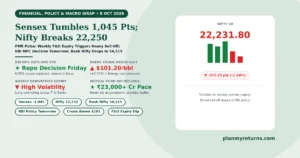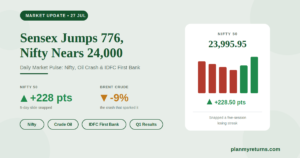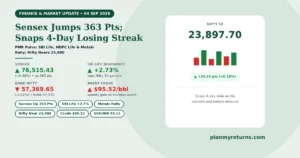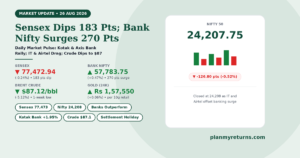
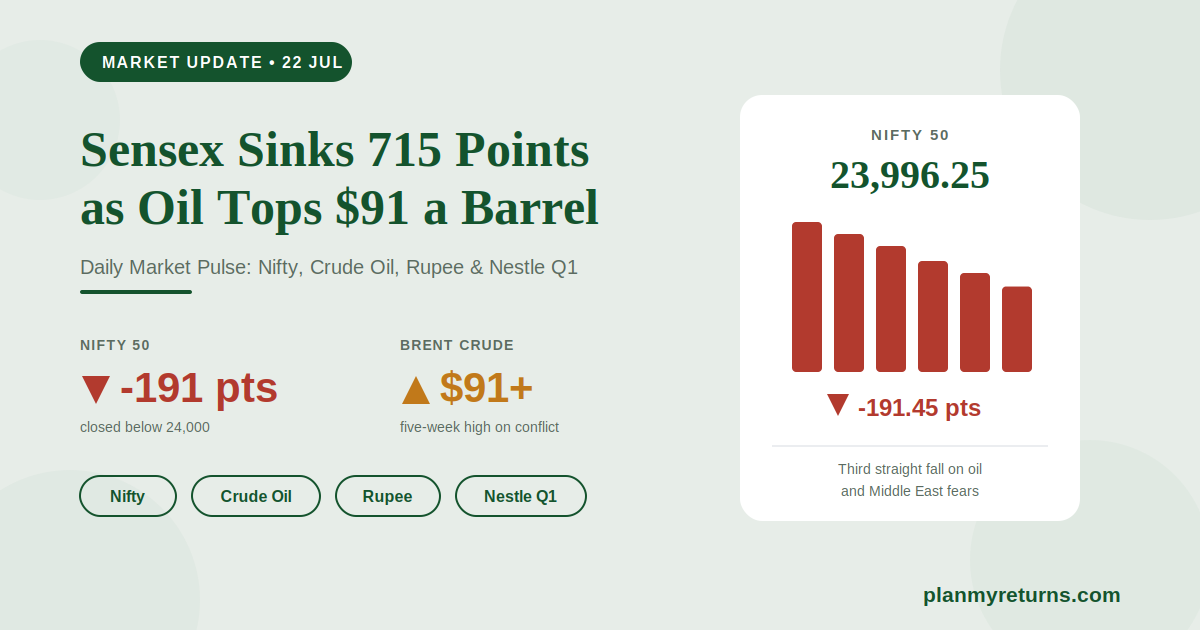
Today’s Overview: Markets fell for a third straight session. The Sensex dropped 715 points (-0.92%) to 76,755 and the Nifty closed below 24,000. A surge in crude oil above $91, driven by fresh Middle East conflict, hurt India as a big oil importer. The Rupee slid to a record low near 96.57, while gold and silver rose as safe havens.
Today’s Top Finance Stories
1. Sensex Falls 715 Points, Nifty Slips Below 24,000 in a Third Straight Loss
What happened: The Sensex tumbled -715.06 points (-0.92%) to close at 76,755.05, and the Nifty 50 fell -191.45 points (-0.79%) to 23,996.25, ending below the 24,000 mark. Bank Nifty dropped -1.23% to 57,126.80. The India VIX, often called the market’s fear gauge, jumped +5.47% to 13.29. Media, Realty, PSU Bank and IT led the fall, while only FMCG and Auto managed to close higher. Broader markets were weaker, with the Midcap 100 down -1.09% and Smallcap 100 down -1.54%.
Why does it matter: This was the steepest fall in nearly two weeks. What made it unusual is that Indian markets dropped even as US and Asian markets rose, because the one factor hurting India the most, expensive oil, matters far more here than in most other economies.
Key Takeaway: India does not always follow global markets. A local pressure point like costly oil can pull our indices down even on a globally green day.
2. Crude Oil Jumps Above $91, and Why That Hurts India
What happened: Brent crude, the global oil benchmark, climbed above $91 a barrel, a roughly five-week high. Prices spiked after the United States launched strikes on Iran and Iran retaliated by targeting sites in Kuwait, Bahrain and Jordan. Shipping through the Strait of Hormuz, a narrow channel that carries a large share of the world’s oil, has been disrupted.
Why does it matter: India buys more than 80% of its oil from abroad. When crude jumps, the import bill swells, the Rupee weakens and the risk of higher inflation rises. That is why a conflict thousands of kilometres away can hit Indian markets and household budgets.
Key Takeaway: Oil is India’s biggest import. A sharp, sustained rise in crude is one of the few things that can rattle Indian markets on its own.
3. Rupee Hits a Record Low Near 96.57 as Oil and Outflows Bite
What happened: The Rupee weakened by about 33 paise to a record closing low near 96.57 against the US Dollar, from 96.24 the previous day. Costly oil, foreign investors pulling money out of Indian shares and a general rush to safety all pushed the currency lower.
Why does it matter: A weaker Rupee makes imports, overseas travel and foreign education more expensive, and it can feed into everyday inflation. A record low means the Rupee has never been weaker against the Dollar.
Key Takeaway: Oil and the Rupee move together. When crude rises, India’s import bill grows, and the Rupee usually feels the strain soon after.
4. Earnings Bright Spot: Nestle and Bajaj Auto Lift FMCG and Auto
What happened: Amid the sea of red, two earnings winners stood out. Bajaj Auto was the top Nifty gainer, jumping +5.72% to a 52-week high after strong first-quarter results, and Nestle India rose +2.87% on a sharp jump in profit. FMCG and Auto were the only sectors to close in the green.
Why does it matter: This shows how company results can override a weak market. When a business reports strong profit growth, buyers often step in regardless of the wider mood. Full numbers are in the Results section below.
Key Takeaway: Strong earnings can lift a stock even on a falling day. On weak days, the market rewards proven performers and punishes the rest.
5. IndiGo Is the Day’s Biggest Loser as Fuel-Cost Fears Rise
What happened: InterGlobe Aviation, which runs IndiGo, was the worst performer on the Nifty 50, falling -3.54%. Jet fuel is an airline’s single biggest cost, and it tracks crude oil closely. With oil spiking, investors worried that IndiGo’s fuel bill will rise and squeeze its profit.
Why does it matter: It is a clear example of how one commodity move ripples into a specific sector. The same oil rally that lifted energy producer ONGC hurt an oil consumer like an airline.
Key Takeaway: High oil helps producers and hurts heavy fuel users. Knowing who consumes what explains why stocks move in opposite directions on the same news.
6. Gold and Silver Climb as Investors Rush to Safety
What happened: While shares fell, gold rose about +1.08% to near Rs 1,44,441 per 10 grams and silver added roughly +1.01% to about Rs 2,26,050 per kilogram. With conflict in the Middle East and nervous equity markets, investors moved money into precious metals.
Why does it matter: Gold and silver are seen as safe havens, meaning they often rise when stocks fall and fear grows. This is why holding a little gold, including through a gold-backed cushion, can steady a portfolio during rough patches.
Key Takeaway: Gold and silver often zig when stocks zag. A small allocation to safe havens can soften the blow on volatile days.
Today’s Q1 Results
A simple summary of the major June-quarter (Q1 FY27) results behind today’s biggest movers.
Nestle India
Nestle India reported its results during Wednesday’s session. Standalone net profit jumped +47.9% year-on-year to Rs 975.12 crore, from Rs 659.23 crore a year earlier. Revenue rose +25.2% to Rs 6,378.18 crore. Operating profit (EBITDA) grew about +39.8% to Rs 1,538 crore, and the operating margin widened to 24.1% from 21.6%. The strong numbers pushed the stock to a 52-week high before it closed up 2.87%.
Bajaj Auto
Bajaj Auto declared its results on 21 July, and the stock reacted on Wednesday. Consolidated net profit rose +45.9% year-on-year to Rs 3,225.63 crore, from Rs 2,210.44 crore. Revenue jumped +65.1% to Rs 21,688.83 crore, though the company noted this is not directly comparable with last year because it changed the scope of what it consolidates after an overseas acquisition. The result drove the stock to a 52-week high and made it the top Nifty gainer.
Market Snapshot
Equity and Bank Nifty figures are official closing levels for 22 July 2026. Gold, silver, crude, currency and crypto reflect rates reported through the evening; confirm crypto and commodity levels closer to 7 PM IST as these trade round the clock. Brent is shown as an approximate level given the fast-moving conflict. Petrol and diesel are Mumbai retail rates; check local rates in your city as these vary by state taxes.
Top 5 Gainers & Losers Nifty 50, 22 July 2026
▲ Top Gainers
- Bajaj Auto +5.72%
Top gainer, hit a 52-week high on strong Q1 results.
- Nestle India +2.87%
Rallied after a near 48% jump in quarterly profit.
- Tata Consumer +1.24%
Gained on defensive buying in FMCG stocks.
- ONGC +0.89%
Oil producer supported by the rise in crude prices.
- Power Grid +0.77%
Defensive utility stock held firm in a weak market.
▼ Top Losers
- InterGlobe Aviation (IndiGo) -3.54%
Biggest loser on rising jet-fuel cost worries.
- Dr Reddy’s Laboratories -2.74%
Pharma stocks saw fresh profit-booking.
- Jio Financial Services -2.18%
Fell amid broad selling in financial stocks.
- SBI -2.16%
Banking heavyweights dragged the index lower.
- Infosys -1.99%
Slid with the wider IT-sector weakness.
Safe-Haven Asset
Meaning: A safe-haven asset is something investors buy when they are nervous, because it tends to hold or gain value while riskier assets like shares fall. Gold, silver and some strong currencies are classic examples.
Example: On 22 July, Indian shares dropped sharply, but gold rose over 1% as worried investors shifted money into it for safety. That opposite movement is exactly what a safe haven is meant to do.
Next Session to Watch
- Indo-MIM, a precision engineering components maker, opens its IPO on Thursday, 23 July.
- Whether crude oil cools off or extends its rally on fresh Middle East news.
- Whether the Rupee stabilises or slides further past its record low of 96.57.
- More Q1 FY27 earnings through the week as results season gathers pace.
- Whether foreign investors keep selling or turn buyers again.
- Global cues from US and Asian markets overnight.
Costly oil, a record-low Rupee and rising gold all touch your wallet. See how.
Run the numbers on PlanMyReturns: measure the bite of rising prices with our inflation calculator, plan a pricier overseas education, or check what you can borrow against your gold.
Explore All CalculatorsThis article is for general information only and is not investment advice. Read our full disclaimer.