A simple guide to asset allocation for Indian investors. Learn how equity, debt, and gold work together, what the age-based rule of thumb actually means, how rebalancing protects your plan, and why chasing the single best return usually backfires over the long run.
Most investors spend their energy picking the next winning stock or fund, when the decision that shapes their outcome the most is far less exciting: how much to put in equity, how much in debt, and how much in gold. This mix, called asset allocation, decides more of your portfolio’s long-term behaviour than any individual investment choice you make within it.
This guide explains asset allocation in plain terms, why balance often serves you better than swinging for the highest return, and how to build and maintain an allocation that fits your own goals.
Quick Answer: Asset allocation is the split of your money across equity, debt, gold, and cash based on your goals and risk appetite. It matters more than chasing returns because it controls how much your portfolio falls during a downturn, which determines whether you stay invested long enough to actually earn the return you were promised on paper.
What Asset Allocation Actually Means
Every investment falls into a broad asset class: equity (stocks and equity mutual funds), debt (fixed deposits, bonds, debt funds), gold, and cash or cash equivalents. Each behaves differently in different market conditions. Equity tends to grow the fastest over long periods but swings the hardest in the short term. Debt is steadier and provides ballast. Gold often moves independently of both, especially during periods of stress.
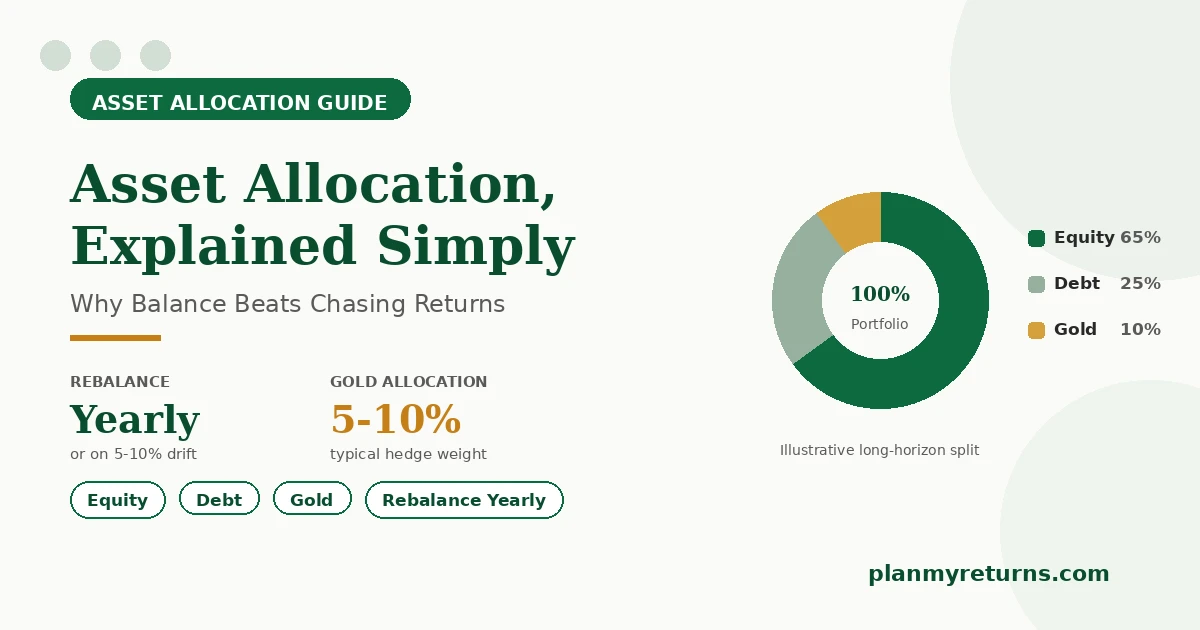
Asset allocation is simply the percentage you assign to each of these categories. A 70:20:10 split, for example, means 70% equity, 20% debt, and 10% gold. The specific numbers matter less than the discipline of deciding them in advance, rather than reacting to whatever asset class performed best last year.
Key Takeaway: Diversification within an asset class, such as owning ten different stocks, reduces company-specific risk. Asset allocation across classes reduces a different, larger risk: the risk that an entire market or asset type underperforms for years at a stretch.
Why Balance Beats Chasing Returns
Chasing returns usually means moving money into whatever asset class did best recently, which is often already becoming expensive by the time you notice. A balanced allocation does the opposite: it forces you to hold some money in unfashionable, lower-return assets that cushion your portfolio when the popular asset class corrects.
The real cost of an unbalanced, all-in portfolio is not just volatility on paper. It is behavioural. A portfolio that falls 40% in a downturn is far more likely to be sold in panic than one that falls 15%, even if the first portfolio has a higher expected long-term return. Balance exists to keep you invested through the cycle, not just to smooth a chart.
The Age-Based Rule of Thumb, and Its Limits
A commonly cited starting point is the “100 minus age” rule: subtract your age from 100 to get a rough equity percentage, with the remainder in debt. A 30-year-old would hold about 70% equity and 30% debt; a 60-year-old would flip closer to 40% equity and 60% debt.
Treat this as a conversation starter, not a formula to follow blindly. It ignores your actual goals, how stable your income is, whether you have dependents, and how you genuinely react to a market fall. Two 35-year-olds with identical incomes can reasonably hold very different allocations if one has a stable government job and the other runs a business with irregular cash flow.
A More Practical Starting Framework
| Goal Time Horizon | Typical Equity Range | Typical Debt Range |
|---|---|---|
| Less than 3 years (emergency fund, near-term goal) | 0% to 10% | 90% to 100% |
| 3 to 7 years (car, education, house down payment) | 30% to 50% | 50% to 70% |
| 7 to 15 years (child’s higher education, mid-term wealth building) | 50% to 70% | 30% to 50% |
| 15+ years (retirement, long-term wealth creation) | 65% to 80% | 20% to 35% |
Note: These ranges are illustrative starting points, not investment advice. Your actual allocation should also factor in your gold holdings, your emergency fund, and how much volatility you can tolerate without making impulsive decisions.
How to Build Your Own Asset Allocation
Separate Your Goals by Time Horizon
List out your goals: emergency fund, a car in 2 years, a child’s education in 12 years, retirement in 25 years. Each deserves its own allocation, since a goal 2 years away cannot absorb the same equity risk as one 25 years away, even if the total amounts are similar.
Set a Target Percentage for Each Asset Class
For each goal, decide a target split using your time horizon and risk tolerance as the two main inputs. Write the target down. This written target is what you will rebalance toward later, so vague intentions do not work as well as specific numbers.
Choose Instruments Within Each Asset Class
Once the split is fixed, choose the actual instruments: equity mutual funds or stocks for the equity portion, PPF, debt funds, or fixed deposits for the debt portion, and sovereign gold bonds or gold ETFs for the gold portion. Keep instrument selection secondary to getting the overall split right first.
Review and Rebalance on a Fixed Schedule
Check your actual allocation against your target once a year, or whenever any asset class drifts more than roughly 5 to 10 percentage points from target. Sell a little of what has grown beyond target and add to what has fallen below it, which mechanically enforces buying low and selling high without needing to predict the market.
Want to see your ideal equity, debt, and gold split based on your own numbers? Build a target allocation in minutes.
Try the Asset Allocation CalculatorCommon Mistakes to Avoid
- Building one blended allocation for your entire net worth instead of separate allocations per goal and time horizon
- Chasing whichever asset class had the best returns in the last one or two years
- Confusing diversification across many funds within the same asset class with real asset allocation across classes
- Rebalancing too frequently, which adds costs and, in taxable accounts, triggers avoidable capital gains tax
- Never rebalancing at all, letting a rising equity market silently push your risk far beyond your original comfort level
- Setting an allocation based on what you think you should tolerate rather than what you have actually tolerated in a past downturn
Decision Checklist Before You Set Your Allocation
- Confirm your emergency fund is set aside separately and not counted as part of your growth allocation
- Confirm you have a distinct time horizon and target split for each major goal, not one number for everything
- Confirm your equity percentage reflects how you actually behaved in a past market fall, not just how you feel today
- Confirm you have a fixed rebalancing rule, whether time-based or drift-based, written down in advance
- Confirm gold and debt allocations are not an afterthought, since they do the defensive work equity cannot do
Frequently Asked Questions
Conclusion
Asset allocation will never be the most exciting part of investing, and that is precisely why it works. It trades the thrill of chasing the best return for the far more valuable outcome of staying invested through the cycles that actually build wealth. Decide your split before the market decides it for you, review it on a fixed schedule, and let compounding do the rest.
Use the Asset Allocation Calculator to map out your own equity, debt, and gold split, then plan your equity investments with the SIP Calculator and check whether you are on track for your long-term goals with the Retirement Calculator.