A practical comparison of SIP and lump sum investing when markets feel uncertain. Covers what history actually shows across bull and bear cycles, how rupee cost averaging works, the behavioral risks of trying to time a lump sum, and a decision framework for choosing between the two.
Every time markets swing sharply, the same question resurfaces: should you invest a lump sum now, or spread it out through a SIP? The honest answer is that neither strategy wins in every market condition. What matters is understanding why each one works the way it does, so you can make a decision based on your actual situation rather than headlines about the latest correction or rally.
This guide looks at how SIP and lump sum investing have historically behaved in different market conditions, why the debate is really about risk rather than returns alone, and how to decide which approach, or which combination, fits an uncertain market.
Quick Answer: Lump sum investing tends to win more often in markets that trend upward over the holding period, because the full amount starts compounding immediately. SIP tends to produce a smoother, less volatile outcome and a lower chance of a very poor result, which is why it remains the more common default, especially when markets feel uncertain.
SIP vs Lump Sum: The Core Difference
A lump sum investment puts your entire amount into the market on a single day. From that point, your full capital is exposed to whatever the market does next, for better or worse. A SIP instead spreads a fixed amount across regular intervals, usually monthly, so your money enters the market gradually over months or years.
The mechanism that makes SIP behave differently is rupee cost averaging: at every interval, a fixed rupee amount buys more units when prices are low and fewer units when prices are high. Over time, this smooths out your average purchase price and reduces the impact of investing everything at a single, potentially bad, entry point.
| Factor | Lump Sum | SIP |
|---|---|---|
| Entry timing | Single point in time | Spread across multiple dates |
| Best suited when | Markets are trending up or valuations look reasonable | Markets are volatile or direction is unclear |
| Effect on average cost | Fixed at entry price | Averaged over the investment period |
| Behavioral demand | Requires conviction to invest all at once | Requires discipline to continue regularly |
| Typical use case | Bonus, inheritance, maturity proceeds | Monthly salary, regular savings |
What History Actually Shows
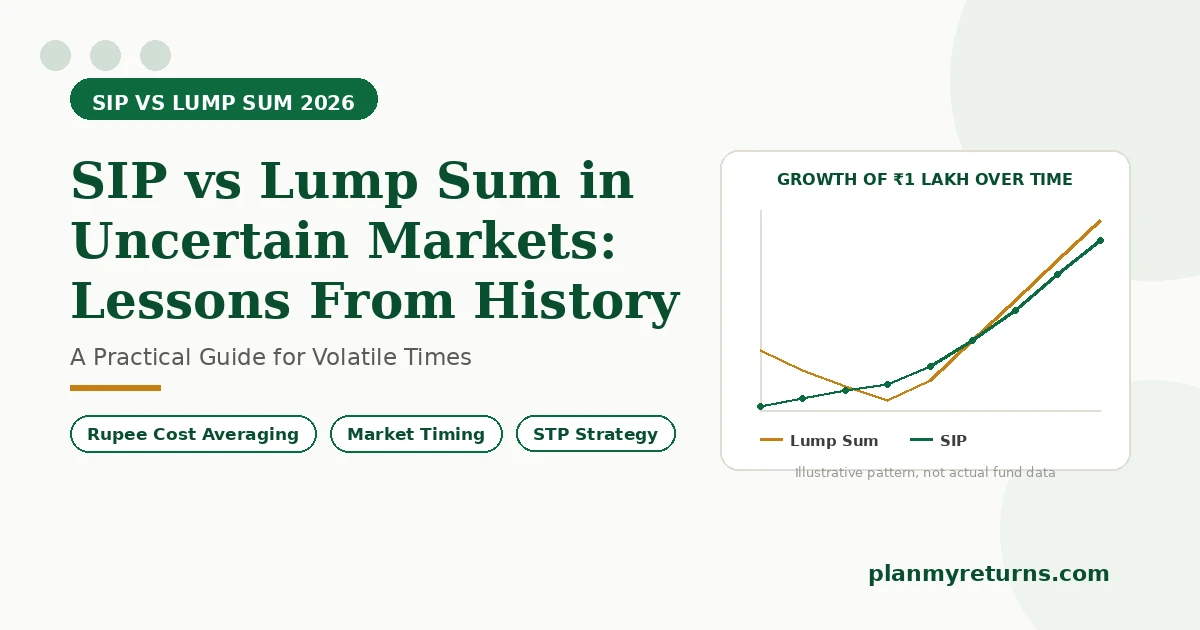
Across long-term studies of both Indian and global equity markets, the pattern is fairly consistent: in periods where markets trend upward over most of the investment horizon, a lump sum invested at the start tends to outperform a SIP into the same market, simply because more capital is compounding for longer. In periods marked by sharp corrections followed by recovery, such as the 2008 global financial crisis or the 2020 pandemic crash, investors who continued a SIP through the downturn benefited from buying more units at lower prices during the worst months, which cushioned their overall outcome.
The practical takeaway is not that one strategy is objectively superior. It is that lump sum tends to reward investors who invest early and stay invested through volatility, while SIP tends to reward investors who might otherwise have hesitated, delayed, or panicked during a downturn. History rewards the discipline each approach demands, more than the mechanism itself.
Important: Past performance in any market cycle does not guarantee how the next cycle will unfold. Treat historical comparisons as a guide to how each strategy tends to behave, not as a prediction of returns for your specific investment period.
Why “Uncertain Markets” Change the Calculation
The SIP versus lump sum debate becomes sharper precisely when markets feel uncertain, because that is exactly when the psychological cost of a lump sum decision rises. Investing a large sum right before a downturn is statistically no worse than investing it right before a rally, since neither outcome is knowable in advance. But it feels far worse in hindsight, and that asymmetry in regret is what drives many investors toward SIP or a staggered approach during uncertain periods.
The Cash-on-the-Sidelines Trap
A well documented behavioral pattern is that investors who decide to “wait for the right time” to invest a lump sum often end up waiting far longer than intended, sometimes missing significant market gains while sitting in cash. Uncertainty rarely resolves on a clear schedule, and by the time it feels safe to invest, markets have frequently already moved. A SIP sidesteps this trap entirely, since it does not require you to identify a good entry point at all.
A Practical Middle Ground: Systematic Transfer Plans
Park the Lump Sum in a Low-Volatility Fund
Instead of holding a windfall in a savings account, park it in a liquid or low-duration debt fund where it earns a modest return while you decide how to deploy it into equities.
Set Up a Systematic Transfer Plan
An STP automatically transfers a fixed amount from your liquid fund into an equity fund at regular intervals, effectively creating a SIP-like entry into the market while your remaining balance keeps earning some return instead of sitting idle in cash.
Choose a Transfer Period That Matches Your Comfort
A shorter transfer period behaves closer to a lump sum, while a longer one behaves closer to a pure SIP. There is no universally correct duration; it depends on how much short-term volatility you are comfortable absorbing.
Not sure which route fits your numbers? Compare the projected outcome of investing as SIP versus lump sum with your own amount and time horizon.
Try the SIP vs Lump Sum CalculatorWhen Lump Sum Tends to Make More Sense
- You have a long time horizon, typically 7-10 years or more, that can absorb short-term volatility
- Markets have already corrected meaningfully and valuations look more reasonable than they did recently
- You are confident you will not panic-sell if the market falls shortly after you invest
- The money is genuinely surplus and not needed for a near-term goal
When SIP or a Staggered Approach Tends to Make More Sense
- You are investing regular income rather than a one-time windfall
- Markets have run up sharply and valuations look stretched
- You are new to equity investing and have not yet experienced a full market cycle
- You know from past behavior that a sudden drop after a large investment would tempt you to exit early
Common Mistakes to Avoid
- Stopping a SIP specifically because the market has fallen, which undoes the core benefit of rupee cost averaging
- Waiting indefinitely for a “better” entry point for a lump sum, and ending up invested in cash for years
- Comparing SIP and lump sum returns using a single short period instead of multiple market cycles
- Treating the decision as permanent, when a combination like STP can be adjusted as your comfort with volatility changes
- Ignoring your own time horizon and treating this as a purely mathematical decision rather than a behavioral one
Decision Checklist Before You Choose
- Confirm whether this is a one-time windfall or a recurring amount from income, since that alone often decides the mechanism
- Confirm your time horizon; shorter horizons generally favor a more staggered approach regardless of market conditions
- Confirm how you reacted the last time your investments fell in value, since past behavior is a reasonable predictor of future behavior
- Confirm whether an STP could give you a practical middle ground instead of an all-or-nothing choice
- Run both scenarios through a calculator using your actual numbers before deciding
Frequently Asked Questions
Conclusion
The SIP versus lump sum question is less about which mechanism produces higher returns in isolation, and more about which one you can actually stick with through a full market cycle. Lump sum has the mathematical edge in markets that keep rising, but only if you stay invested through the drops along the way. SIP trades some of that potential upside for a smoother ride and a structural defense against bad timing and panic selling. For most uncertain markets, a blended approach, like an initial partial lump sum followed by an STP, offers a reasonable way to participate in the market without betting everything on a single day’s entry price.
Model your own numbers with the SIP vs Lump Sum Calculator, project your long-term corpus with the SIP Calculator or Lumpsum Calculator, and check how your overall allocation fits together using the Asset Allocation Calculator.