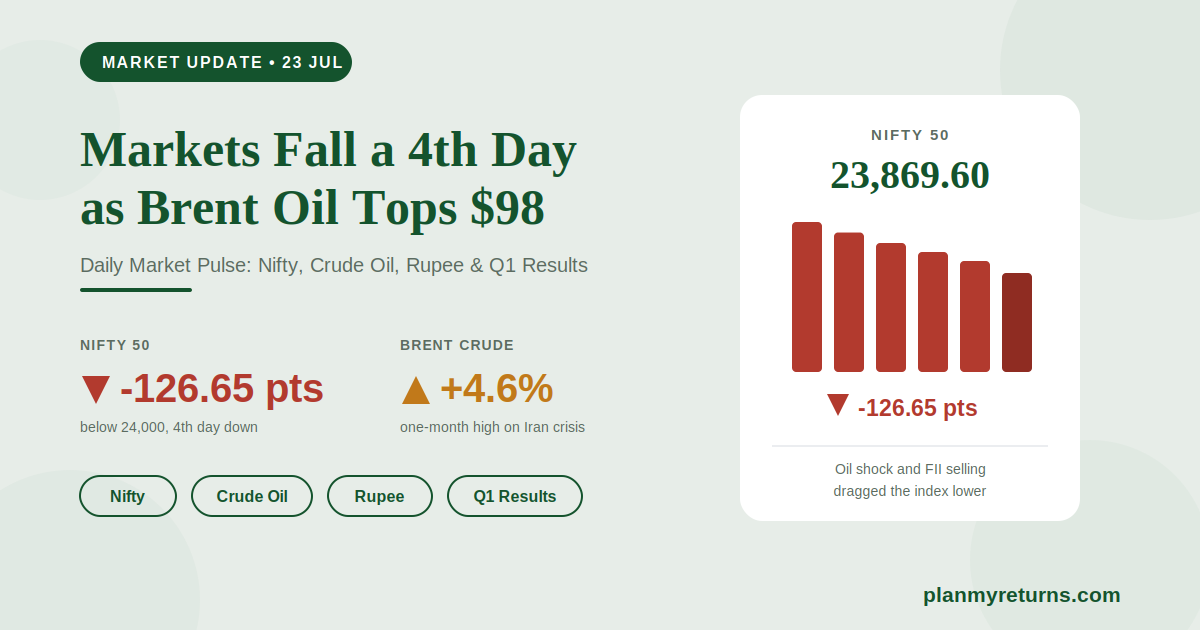
Today’s Overview: Markets fell for a fourth straight day. The Sensex lost 363.66 points (-0.47%) to 76,391.39 and the Nifty 50 slipped 126.65 points (-0.53%) to 23,869.60, below 24,000. The trigger: Brent crude jumped to about $98 a barrel on an escalating US-Iran conflict. The Rupee sat near a record low as foreign investors kept selling.
Today’s Top Finance Stories
1. Markets Fall for a Fourth Day as an Oil Shock Hits Sentiment
What happened: The Sensex dropped -363.66 points (-0.47%) to 76,391.39, and the Nifty 50 fell -126.65 points (-0.53%) to 23,869.60, ending below the 24,000 mark. Bank Nifty declined about -0.8%. Broader markets were hit harder, with the Nifty MidCap down -0.99% and the SmallCap down -1.01%. Realty, Oil & Gas and Chemical stocks fell the most, while Auto and Media held up better.
Why does it matter: This was a “risk-off” day, meaning investors moved away from riskier assets like shares. The reason was simple: a sharp rise in oil prices raises costs for companies and consumers, so buyers stepped back. Four down days in a row shows sentiment has genuinely weakened, not just wobbled.
Key Takeaway: When oil spikes, Indian markets often fall together. A broad, multi-day decline usually points to one big worry, and right now that worry is crude.
2. Brent Crude Tops $98 as the US-Iran Conflict Escalates
What happened: Brent crude, the global oil benchmark, jumped about +4.6% to roughly $98 a barrel, its highest in over a month. Prices surged after reports of attacks on oil tankers near Saudi Arabia and fresh threats around the Strait of Hormuz, the narrow sea lane that carries a large share of the world’s oil. The US and Iran traded new threats, deepening the conflict.
Why does it matter: India buys most of its oil from abroad, so a jump in crude quickly raises the country’s import bill, pressures the Rupee and threatens higher inflation. Costlier oil touches fuel, transport and the price of everyday goods, which is why one number on a screen in London affects budgets in India.
Key Takeaway: Oil is India’s biggest imported worry. When crude climbs on conflict, the ripple reaches the Rupee, inflation and your fuel bill within days.
3. Rupee Sits Near a Record Low as Foreign Investors Keep Selling
What happened: The Rupee traded near a record low of about 96.57 per US Dollar, pressured by the surge in oil and by foreign selling. Foreign Institutional Investors (FIIs), the big overseas funds that trade Indian shares, sold equities worth around Rs 819 crore in a single session, draining some demand from large-cap stocks.
Why does it matter: A weaker Rupee makes imports, from oil to gadgets to studying abroad, more expensive. When foreign investors sell and pull money out, they also convert Rupees back to Dollars, which pushes the Rupee down further. Oil and currency are feeding each other right now.
Key Takeaway: A record-low Rupee plus foreign selling is a warning light. Both make imported goods costlier and can keep pressure on the market.
4. Infosys Profit Rises 12%, but IT Stays Under a Cloud
What happened: IT major Infosys, reporting after the market closed, posted a June-quarter net profit of Rs 7,769 crore, up +12.25% from a year earlier but down -8.6% compared with the previous quarter. Because the results came after hours, the share reaction will show up in the next session. Investors were focused on the company’s full-year guidance and its progress on AI.
Why does it matter: Infosys is a bellwether, a stock seen as a health check for the whole IT sector. Software shares had already slipped, tracking an overnight pullback in US technology stocks over worries about heavy AI spending. Strong yearly profit growth is reassuring, but the sequential dip and cautious mood keep IT under pressure.
Key Takeaway: Year-on-year growth shows the long trend; quarter-on-quarter shows the recent one. A stock can grow over a year yet still cool off from the prior quarter.
5. IndiGo Swings to a Surprise Loss on a Weak Rupee and Costly Fuel
What happened: InterGlobe Aviation, which runs IndiGo, reported a June-quarter net loss of Rs 237.6 crore, a sharp swing from a profit of Rs 2,176.3 crore a year earlier. This was despite revenue rising +20% to Rs 24,584 crore. The airline was hurt by the weaker Rupee (which raises the cost of its Dollar-based obligations) and by higher fuel prices. Results came after the close.
Why does it matter: Airlines pay for aircraft, leases and fuel largely in Dollars, so a falling Rupee hits them hard even when more people are flying. It is a clear example of how the currency and oil themes of the day flow straight into a company’s bottom line.
Key Takeaway: Rising sales do not guarantee profit. Costs in Dollars, like fuel and leases, can turn a growing airline’s quarter into a loss when the Rupee falls.
6. Gold and Silver Fall Even as Markets Turn Cautious
What happened: Normally seen as safe havens in a crisis, gold and silver both fell today. MCX gold dropped -1.13% to about Rs 1,44,031 per 10 grams, and silver slid -2.06% to around Rs 2,22,329 per kilogram. Traders sold precious metals even as shares fell, weighing the surge in energy prices and moves in the US Dollar.
Why does it matter: A “safe haven” is an asset people usually buy when they are nervous. It is a useful reminder that safe havens do not rise every single time markets drop. On some days, other forces, like currency swings and profit-booking, pull them the other way.
Key Takeaway: Gold is not a guaranteed shield on every down day. Its price also answers to the Dollar, interest rates and simple profit-taking.
Today’s Q1 Results
A simple summary of the major June-quarter (Q1 FY27) results reported around today’s session. Infosys and IndiGo reported after market hours, so their share moves will land in the next session.
Infosys
Net profit of Rs 7,769 crore, up +12.25% year-on-year but down -8.6% quarter-on-quarter. The market’s attention was on the company’s full-year revenue guidance and deal wins rather than the headline profit.
InterGlobe Aviation (IndiGo)
A net loss of Rs 237.6 crore, against a profit of Rs 2,176.3 crore a year ago, even as revenue rose +20% to Rs 24,584 crore. The swing was driven mainly by the weaker Rupee on its Dollar-based costs and by higher fuel prices.
Cipla
A strong quarter for the drugmaker, with net profit of Rs 789 crore, up about +42% over the prior quarter, and revenue of roughly Rs 7,119 crore, up +8.84%. It was one of the brighter results of the day.
Dr Reddy’s Laboratories
A muted June quarter that fell short of expectations. The stock dropped as much as -7% to a 52-week low during the session as investors reacted to the soft numbers and a supply-related caution.
Hindustan Petroleum (HPCL)
The state-run fuel retailer reported its first quarterly loss since 2022. High crude prices squeezed its refining margins (the gap between what it pays for crude and what it earns from selling fuel), and the stock fell around -5%.
Market Snapshot
Equity figures are official closing levels for 23 July 2026. The Bank Nifty level is an approximate close pending final confirmation; its direction (down around 0.8%) is confirmed. Gold and silver are MCX day-session figures. Crude, currency, crypto and fuel rates trade round the clock or vary by city, so confirm them closer to 7 PM IST. Petrol and diesel are Mumbai retail rates and differ by state taxes.
Top 5 Gainers & Losers Nifty 50, 23 July 2026 (midday reading)
▲ Top Gainers
- Eternal (Zomato) +3.74%
Led the pack, bucking the weak market mood.
- Bajaj Auto +2.35%
Auto stocks were among the few bright spots.
- Mahindra & Mahindra +1.99%
Gained as the auto pack held firm.
- Eicher Motors +1.97%
Rose on continued strength in two-wheelers.
- Hindalco +1.09%
A rare metals gainer on the day.
▼ Top Losers
- Dr Reddy’s Laboratories -2.59%
Slid on a weak set of quarterly numbers.
- Nestle India -1.93%
FMCG names came under selling pressure.
- Adani Enterprises -1.06%
Group stocks tracked the broad decline.
- Tata Steel -0.81%
Metals eased on growth worries.
- Bharti Airtel -0.76%
Heavyweight telecom weighed on the index.
Percentages above are from the 23 July midday snapshot. By the closing bell the order had shifted: SBI Life, Bajaj Auto, M&M and TCS were among the top gainers, while Adani Enterprises, Nestle India, Shriram Finance and Adani Ports (down about 2%) led the losers.
Gross Refining Margin (GRM)
Meaning: The gross refining margin is the profit an oil refiner makes on each barrel: the value of the fuels it sells (petrol, diesel) minus the cost of the crude oil it buys. When crude prices jump faster than fuel selling prices, this margin shrinks and refiners can even lose money.
Example: HPCL reported its first quarterly loss since 2022 today. Crude oil shot up, but it could not raise pump prices to match, so its refining margin was squeezed. That is the GRM at work.
Next Session to Watch
- How Infosys and IndiGo shares react to their results in the 24 July session.
- Brent crude and any fresh US-Iran developments, the market’s main driver right now.
- Whether the Rupee steadies near 96.57 or slips to a new record low.
- Any signs of RBI action to support the Rupee.
- More Q1 FY27 earnings due through the week.
- Foreign investor flows, after another day of net selling.
Oil near $98 and a record-low Rupee both feed into the prices you pay. See how.
Put today’s themes to work on PlanMyReturns: measure rising prices with our inflation calculator, plan a costlier overseas education, or check a gold loan as prices swing.
Explore All CalculatorsThis article is for general information only and is not investment advice. Read our full disclaimer.