

Your First Salary: The Complete Money Plan Every New Professional Needs is designed to help new professionals understand their income, build a strong financial foundation, and avoid common mistakes.
Your first salary is more than a paycheck. It is the starting point of your financial life. Understand your in-hand income, create a flexible budget, build a safety cushion, begin investing through SIPs, get essential insurance, plan taxes early, and set long-term goals with clarity. This guide walks you through everything you need to build a strong financial future.
Understanding your take-home pay
CTC creates confusion for nearly every new professional. It includes salary components, allowances, employer contributions, and benefits. The amount that reaches your bank account is lower because of deductions such as EPF, professional tax, and TDS. If you plan based on CTC, you will overspend without realizing it.

A simple example helps:
| Component | Annual | Monthly |
|---|---|---|
| CTC | ₹6,00,000 | ₹50,000 |
| Employer PF included in CTC | ₹43,200 | ₹3,600 |
| Employee EPF deduction | ₹43,200 | ₹3,600 |
| TDS + Professional tax | — | ₹2,800 to ₹4,000 |
| Estimated in-hand | — | ₹40,000 to ₹42,000 |
Knowing your true spending power is the foundation of financial planning. You can estimate your expected take-home pay more accurately using the Income Tax Calculator, TDS Calculator, and Standard Deduction Calculator on PlanMyReturns.
Create a simple budget that fits your life

Budgeting is not about restricting yourself. It is a planning tool that helps you spend confidently without guilt. Start by listing fixed expenses such as rent, commuting costs, phone bills, EMIs, and insurance premiums. These usually account for half your income.
Your flexible expenses include groceries, dining out, shopping, entertainment, and personal care. These can be adjusted based on your month and lifestyle.
A helpful starting point is the 50 30 20 approach.
• 50 percent for needs
• 30 percent for wants
• 20 percent for savings and investing
If you live in a high-rent city, needs may take 60 percent of your income. In that case reduce wants for a while but protect your savings rate.
Lifestyle inflation is common when you start earning. It feels tempting to upgrade your phone, wardrobe, or weekend plans. Follow a three month delay rule. If you want a non-essential item, wait three months. If you still want it and it fits your budget without touching your savings, buy it.
A ten minute weekly review keeps your budget on track. Open your bank statement every Sunday and see where your spending drifted. Awareness alone reduces unnecessary spending.
Build an emergency fund you can rely on
Your emergency fund is a financial safety net. It protects you from unexpected medical expenses, sudden job loss, urgent house repairs, or family emergencies. Without it, a single event can force you into loans or credit card debt.
Aim for six months of expenses, but do not wait for a large amount to get started. A practical target for your first year is ₹50,000 to ₹1,00,000. This amount covers most immediate risks and gives you emotional security.
An emergency fund should be safe, stable, and accessible. A mix of savings accounts and short-term deposits works well. You can calculate your exact requirement using the Emergency Fund Calculator.
Start investing early and let compounding work for you
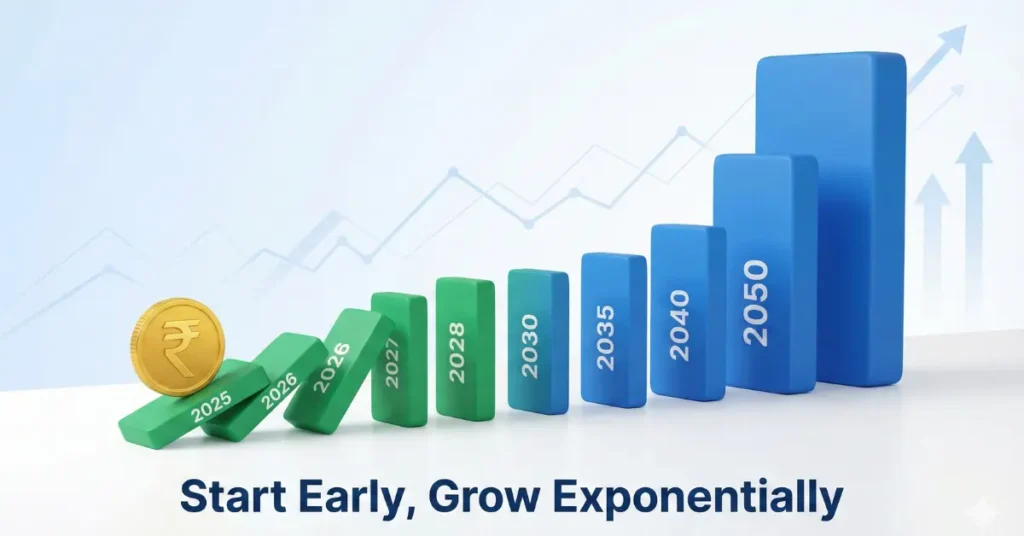
Your greatest financial strength in your twenties is time. Even small investments grow significantly when given enough years. Starting early matters far more than starting big.
Long-term investing is easiest through SIPs in equity mutual funds. SIPs build discipline, help average your purchase cost, and remove the pressure of timing the market.
A small comparison shows the power of early investing:
| Starting age | Monthly SIP | Value at age 50 |
|---|---|---|
| 23 | ₹5,000 | About ₹1.76 crore |
| 30 | ₹5,000 | About ₹0.88 crore |
Both invest the same monthly amount. The only difference is time.
Break your goals into categories.
• Short term goals need stability.
• Medium term goals benefit from a mix of debt and equity.
• Long term goals are best supported by equity.
To plan investments and test different scenarios, use tools like the SIP Calculator, Lumpsum Calculator, ELSS Calculator, PPF Calculator, NPS Calculator, SWP Calculator, and Asset Allocation Calculator on PlanMyReturns. These tools help you understand how much to invest and what returns to expect.
Insurance essentials for young earners
Insurance protects your progress more than your wealth. Health insurance is the first priority. Employer health cover is helpful but not enough. It ends if you leave your job and often comes with limits. Buy an individual health policy early so you lock in a low premium and begin building continuity benefits.
Term insurance is needed once someone depends on your income or you take a major loan. A simple rule is 10 to 15 times your annual income as cover. Avoid policies that mix insurance and investment. They offer low coverage and low returns.
You can evaluate your future needs more clearly using the Retirement Calculator and the Net Worth Calculator.
Plan your taxes realistically
Taxes affect all your financial decisions, so understanding them early saves stress later. Choose between old and new regimes based on which gives you lower tax after considering deductions and exemptions.
Most mistakes happen in March when people rush into tax-saving investments they do not understand. Instead of waiting, plan your tax-saving steps in April and spread them across the year.
ELSS funds, PPF, and NPS are useful long-term tax saving instruments. Your choice depends on how long you want to lock your money and how much volatility you are comfortable with.
To estimate taxes accurately, use PlanMyReturns tools like the Income Tax Calculator, HRA Exemption Calculator, and Capital Gains Calculator
Build strong banking and credit habits early
Your credit score will matter when you apply for a home loan, car loan, or even a credit card upgrade. The easiest way to build a good score is to use a credit card for regular expenses and pay the full amount every month.
Never carry forward dues or rely on minimum payments. Credit cards are convenient but expensive if misused. Set auto debit for the full outstanding so payments never get delayed.
Automate all recurring payments. This includes SIPs, insurance premiums, rent transfers, phone bills, and EMIs. Keep at least 1 month of essential expenses in your savings account to ensure all auto-debits succeed.
When you need loans in the future, the following calculators will help:
• Personal Loan Calculator
• Loan Eligibility Calculator
• Home Loan EMI Calculator
• Car Loan Calculator
• Loan Prepayment Calculator
• Education Loan Calculator
• Gold Loan Calculator
These tools show what you can afford and how EMIs fit into your budget.
Create a long-term financial roadmap
Good financial planning means understanding what you want your future to look like. List your major goals for the next 10 to 20 years. Common goals include higher education, marriage, travel, buying a house, starting a business, and retiring early.
Estimate the cost of each goal today. Apply inflation to understand the future cost. Then calculate how much you need to invest monthly to reach that amount. Review your goals every six months and update them as your life changes.
PlanMyReturns offers dedicated tools for different goals, such as the Dream Home Calculator, Education Planning Calculator, Vacation Planning Calculator, Retirement Calculator, and Inflation Calculator. These tools bring clarity to long-term planning and help you stay consistent.
Common traps that first-time earners fall into
• Overspending in the first months and assuming salary growth will cover it
• Copying friends’ investment choices without understanding goals
• Buying ULIPs and endowment plans for tax savings
• Stopping SIPs when markets fall
• Ignoring inflation and the rising cost of living
• Planning based on CTC instead of in-hand salary
Avoiding these habits alone puts you ahead of most new earners.
Checklist and essential tools
Do these in your first three months
- Understand your accurate in-hand pay
- Set up a simple monthly budget
- Automate saving at least 20 percent of your salary
- Build a mini emergency fund of ₹50,000 to ₹1,00,000
- Start your first SIP
- Buy individual health insurance
- Enable auto-debit for regular bills
Most useful PlanMyReturns calculators for beginners
• Emergency Fund Calculator
• SIP Calculator
• Lumpsum Calculator
• Income Tax Calculator
• Retirement Calculator
• Dream Home Calculator
• Education Planning Calculator
These help you convert ideas into numbers and numbers into decisions.
Saving 20 to 30 percent is a strong start. Focus on building your emergency fund first and then increase investing as your income grows.
Six months of expenses is ideal. Begin with what is practical for your first year. Even ₹50,000 to ₹1,00,000 creates a safety cushion you can rely on.
Most beginners find mutual funds through SIPs easier and safer. Direct stocks require more learning and carry higher risk.
Renting gives you flexibility while your career and location preference evolve. Buying too early creates financial pressure.
Employer coverage is temporary and depends on your job status. A personal health policy ensures continued protection.