A simple, plain-language look at three popular retirement savings options in India: PPF, EPF and NPS. No confusing words. Just clear answers, current interest rates, and a free calculator to see which one builds the biggest corpus for you.
You want to save for retirement, but you’re not sure where to put your money. PPF, EPF and NPS all sound similar. All three are backed by the government. All three help you save tax. But they work in different ways, and they don’t grow your money at the same speed.
This guide explains each one in plain words. You’ll also find a free calculator below to see how much each one could grow to, based on your own numbers.
Short Answer: If you are a salaried employee, EPF usually builds the biggest corpus, since your employer adds money too. If you want a fully safe, guaranteed option, PPF is the best choice. If you can handle some risk and want the highest long-term growth, NPS has usually grown the most over 20 to 30 years, thanks to its stock market exposure.
- PPF and EPF give a fixed, guaranteed return. There is no risk. The government decides the rate.
- NPS can grow faster because part of your money goes into the stock market. But it can also grow slower in a bad year.
- EPF often wins for salaried people because the employer also contributes, on top of your own share.
- PPF and EPF interest is completely tax-free. NPS gives tax-free withdrawal on only 60% of the final amount.
- You are not forced to pick just one. Most people can use all three together.
- The right choice depends on your job type, how much risk you’re okay with, and how many years you have left.
What Do PPF, EPF and NPS Actually Mean?
These three names get thrown around a lot, often without any explanation. Let’s fix that first.
Side-by-Side Comparison
| What You’re Comparing | PPF | EPF | NPS |
|---|---|---|---|
| Who can open it | Anyone | Salaried employees only | Anyone |
| Current interest / return | 7.1% per year, fixed | 8.25% per year, fixed | 9-12% per year, market-linked |
| Is the return guaranteed? | Yes, fully | Yes, fully | No, it can go up or down |
| Who contributes | Only you | You and your employer | Only you (unless employer opts in) |
| Lock-in period | 15 years | Until retirement or job exit | Until age 60 |
| Tax on withdrawal | Fully tax-free | Fully tax-free, if rules are followed | 60% tax-free, 40% used for a taxed pension |
Which One Actually Grows Bigger?
This depends on three things: how much goes in, what interest rate it earns, and how many years it grows. EPF often wins for salaried people for one simple reason: your employer puts in a matching amount, so more money is growing from the start.
Between just the interest rates, NPS has the highest potential because part of it sits in the stock market. Over 20 to 30 years, this has usually meant a bigger corpus than PPF or EPF alone. But this growth is not guaranteed. A few bad years in the market can pull the average down.
Something Worth Knowing: Because EPF adds your employer’s contribution on top of yours, even though its rate is only slightly higher than NPS’s typical range, the actual rupee amount in your account often grows faster in the early years. This is why many salaried people end up with a bigger EPF corpus than they expect.
See All Three Side By Side
Enter how much you can save each month and for how long. Compare the three corpus amounts instantly.
This is a simple estimate to help you plan. It is not exact financial advice. PPF and EPF figures use the fixed rate you entered. NPS is only a projection based on past trends and is not guaranteed. This tool does not include the employer’s EPF contribution separately; add that to your monthly amount if you want to include it.
Want a deeper PPF vs NPS breakdown? Open the full Comparison Calculator →
When Each Option Makes The Most Sense
Choose PPF if you want zero risk
PPF is the safest of the three. It works well if you are self-employed and don’t have access to EPF, or if you simply want one part of your savings to be fully guaranteed, no matter what the market does.
Choose EPF if you are salaried
If you have a salaried job, EPF is usually already working for you in the background. The employer match makes this one of the most efficient ways to build a retirement corpus, since you’re getting extra money added for free.
Choose NPS if you want higher long-term growth
NPS suits people with a long time left before retirement, who are okay with some ups and downs along the way. Over two or three decades, this risk has usually been rewarded with a bigger final corpus than PPF alone.
A Simple, Real Example
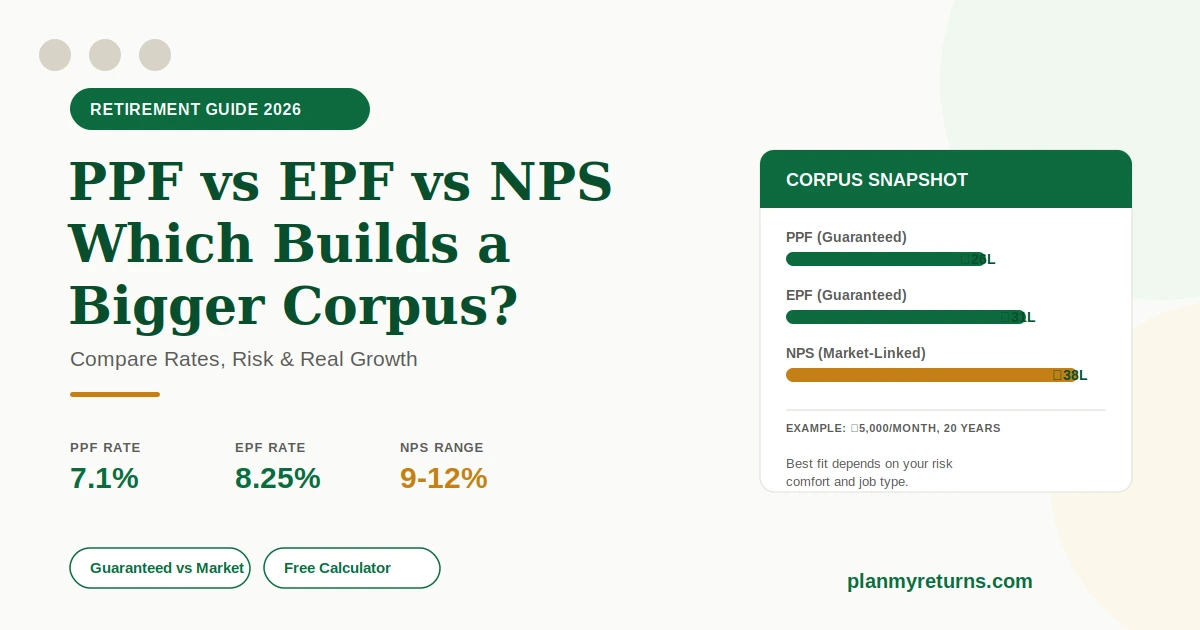
Say you invest ₹5,000 every month for 20 years. Here’s roughly what each option could grow to, using their typical rates.
NPS shows the biggest number here, but remember, it’s the only one of the three that isn’t guaranteed. EPF actually grows even faster in real life once you add the employer’s separate contribution on top.
Why Not Use All Three Together?
You don’t have to choose only one. Most salaried people already have EPF running automatically. On top of that, you can open a PPF account for a safe, tax-free part of your savings, and an NPS account for extra long-term growth. Spreading your money across all three gives you safety, tax savings and growth potential at the same time.
Want to see PPF and NPS compared in more detail? Our dedicated tool breaks it down year by year.
Try PPF vs NPS CalculatorFive Easy Steps To Decide
| Step | What To Do |
|---|---|
| 1 | Check if you’re salaried. If yes, your EPF is likely already active |
| 2 | Decide how many years you have until retirement |
| 3 | Ask yourself how comfortable you are with market ups and downs |
| 4 | Use our Retirement Calculator to check your target corpus |
| 5 | Split new savings across PPF, EPF and NPS based on your comfort with risk |
Please Note: This guide is meant to help you understand the topic, not to tell you exactly what to do. Interest rates change every year, and NPS returns depend on the market. It’s a good idea to talk to a qualified financial advisor before making a big decision.
Which is better, PPF, EPF or NPS?
There is no single winner for everyone. EPF usually builds the biggest corpus for salaried employees because both you and your employer contribute. PPF is the safest choice if you are self-employed or want a fully guaranteed, tax-free return. NPS has the potential to grow the most over 20-30 years because part of it is invested in the stock market, but it carries market risk.
Can I invest in PPF, EPF and NPS all at the same time?
Yes, most salaried people can have all three. EPF is usually automatic through your employer. You can open a PPF account separately at a bank or post office. You can also open an NPS account on your own, in addition to EPF and PPF.
Which scheme gives tax-free returns?
PPF and EPF both give completely tax-free interest and maturity amount under current rules, as long as you follow the withdrawal rules. NPS gives partial tax benefits. Up to 60% of the NPS corpus can be withdrawn tax-free at retirement, but the remaining 40% must buy an annuity, and the pension you receive from that annuity is taxed.
What is the current interest rate for PPF, EPF and NPS?
As of FY 2026-27, PPF offers 7.1% per year, fixed by the government every quarter. EPF offers 8.25% per year, fixed by the EPFO once a year. NPS does not have a fixed rate since it is market-linked, but it has historically returned between 9% and 12% per year depending on how your money is invested.
Is NPS riskier than PPF and EPF?
Yes. PPF and EPF give a fixed, guaranteed return set by the government. NPS invests part of your money in the stock market and part in bonds, so its returns move up and down with the market. Over a very long period, like 20 to 30 years, this risk has usually paid off with a higher return, but there is no guarantee.
Which one should a self-employed person choose?
A self-employed person cannot use EPF, since it requires an employer. The choice is usually between PPF, for a fully safe and tax-free option, and NPS, for higher long-term growth potential with some market risk. Many self-employed people choose to use both together.