A simple guide to a common money question: should you pay off your home loan early, or invest that same money in a SIP? No confusing words. Just plain answers, a real example, and a free calculator to check your own numbers.
Say you get a bonus at work. Or your salary goes up. Now you have some extra money each month. What should you do with it? Pay off your home loan faster? Or put it into a SIP and let it grow?
Most people just guess. They pick one option without checking the numbers. This guide explains both sides in simple words. You will also find a free calculator below to test your own numbers.
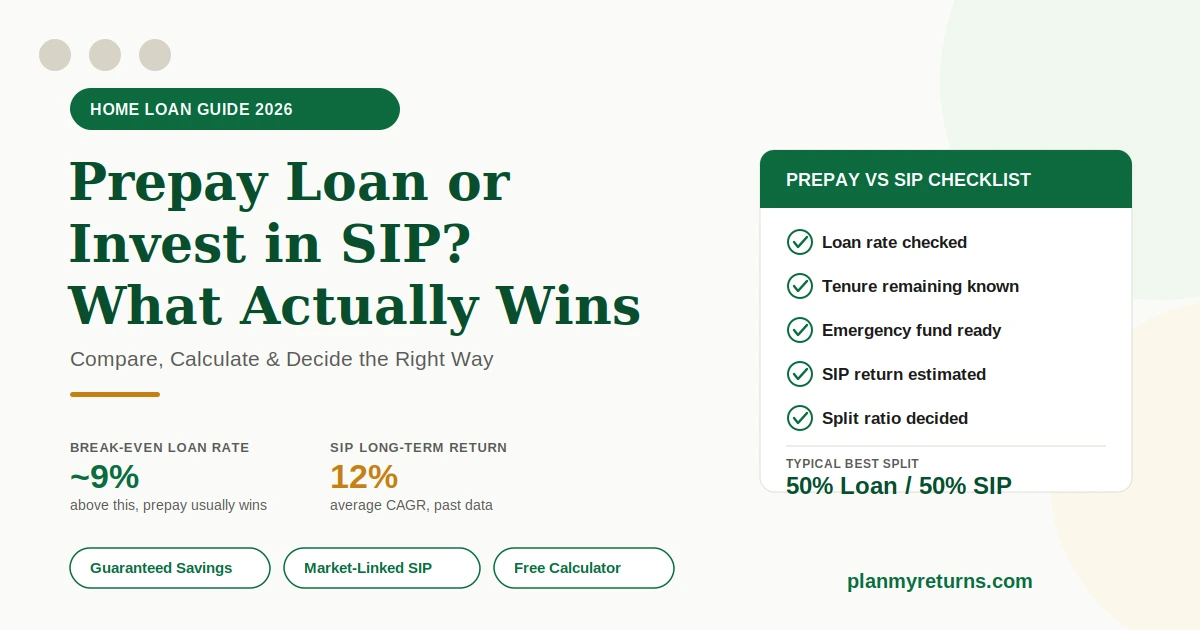
Short Answer: If your home loan interest rate is above 9%, paying it off early is usually the smart move. It is a safe, sure saving. If your rate is below 8% and you can wait 10 years or more, a SIP has usually grown more money in the past. Between 8% and 9%, it depends on how much risk you are okay with.
- Paying off your loan early is 100% safe. There is no risk. You save exactly what the interest rate says.
- A SIP can grow faster, but it is not guaranteed. The stock market can go up or down.
- Loan rate above 9%? Paying early usually wins. Loan rate below 8%? SIP usually wins over many years.
- New tax rules removed most of the tax benefit on home loan interest. This makes paying early a bit more attractive now.
- Paying extra money in your first few loan years saves much more than paying the same amount later.
- You do not have to choose only one. Splitting your money between both is a safe, popular choice.
What Do These Two Words Actually Mean?
Before we go further, let’s explain two simple words in plain language.
The Simple Difference Between The Two
Paying off your loan early gives you a return you can count on. That return is the same as your loan’s interest rate. There is no guessing involved. Every rupee you pay early stops earning interest for the bank right away.
A SIP works in a different way. Your money goes into the stock market through a mutual fund. It might grow a lot. It might grow a little. It could even go down for a while. But over many years, stock markets have usually grown more than most home loan rates.
| What You’re Comparing | Paying Off Loan Early | SIP Investment |
|---|---|---|
| Is the return guaranteed? | Yes, always | No, it can go up or down |
| Typical yearly return | Same as your loan rate (8-10%) | Around 11-13% over many years, in the past |
| Any risk involved? | None | Yes, market can fall |
| Can you get the money back fast? | No, it’s locked into your loan | Yes, usually within a few days |
| How it feels | Less stress, loan ends sooner | A separate pot of money that can grow |
How Do You Know Which One Wins?
Here’s a simple way to think about it. Compare two numbers:
Number 1: Your home loan interest rate.
Number 2: The return you expect from your SIP.
If SIP Return > Loan Rate, staying invested usually wins.
For example, say your loan rate is 8.5%. Say your SIP is expected to grow at 12% a year. Over a long time, the SIP side looks better on paper. But remember, that 12% is not guaranteed. Your loan saving of 8.5% is always guaranteed.
Tax Update You Should Know: Earlier, people could save tax on the interest they paid for a home loan. Under the new tax rules, most people can no longer claim this saving on a home they live in. This means keeping the loan running is not as tax-friendly as before. It slightly favors paying off the loan early.
Try It Yourself: Which One Wins For You?
Fill in your loan details below and press the button. No sign-up needed. It’s free.
This is a simple estimate to help you plan. It is not exact financial advice. Loan savings shown here are guaranteed. SIP growth shown here is just a guess based on past trends, and it is not guaranteed.
When Paying Off Your Loan Early Is The Better Choice
Your loan interest rate is high
Some loans have interest rates above 9%. At this level, it is hard to find a safe way to earn more than that. Paying off the loan early is the smarter, safer choice here.
You are still in the early years of your loan
In the first few years, most of your EMI goes toward interest, not the actual loan amount. Paying extra now saves a lot more than paying the same extra amount later.
You just want less stress
Some people simply feel better with no loan hanging over them. That feeling has real value too. It does not show up in any calculator, but it still matters.
When Investing In SIP Is The Better Choice
Your loan interest rate is low
Some older loans still have rates below 8%. At this level, SIPs have usually grown more money over 10 years or longer, based on past market history.
You still have 10 or more years left
The longer you stay invested, the less short-term market drops matter. Over 15 or 20 years, your money gets more time to grow and recover from bad years.
You don’t have other savings yet
If you don’t have savings for emergencies or retirement, build those first. Paying off your loan while ignoring these other needs can leave you in a tight spot later. Use our Emergency Fund Calculator to check if you’re covered.
A Simple, Real Example
Let’s say you have a home loan of ₹50 lakh, at 8.5% interest, with 20 years left. You get a bonus of ₹5 lakh. Here’s what happens with each choice.
Choice B shows a bigger number on paper. But it comes with real risk. Fifteen years is a long time, and markets can surprise you. Choice A gives you a smaller number, but you can count on it fully.
Why Not Just Do Both?
You don’t have to pick just one side. Many money experts suggest splitting your extra money. Use part of it to pay off your loan. Use the other part to invest in SIP. This way, you get some guaranteed saving and some chance of extra growth.
A common way to split is 50-50. Some people pay more toward the loan in the early years. Then they slowly shift more money into SIP as the loan gets smaller. You can adjust this over time based on your comfort level.
Want the exact numbers for your own loan? Our dedicated comparison tool does this calculation for you.
Try Prepay vs Invest CalculatorFive Easy Steps To Decide
Follow these steps. They take about ten minutes. They will help you decide without any guesswork. If you don’t know your exact EMI yet, start with our Home Loan EMI Calculator.
| Step | What To Do |
|---|---|
| 1 | Check your current loan interest rate |
| 2 | Check how many years are left on your loan |
| 3 | Make sure you already have savings for emergencies and retirement |
| 4 | Compare your loan rate to what you expect from a SIP |
| 5 | Choose to pay off the loan, invest in SIP, or split between both |
Please Note: This guide is meant to help you understand the topic, not to tell you exactly what to do. Your own situation, like your job stability and other debts, matters too. It’s a good idea to talk to a qualified financial advisor before making a big decision.
Is it better to pay off my home loan early or invest in SIP?
It depends on your loan interest rate. If your home loan rate is above 9%, paying it off early usually wins. If your rate is below 8% and you can stay invested for a long time, SIP has historically grown more money.
What is the break-even point between prepayment and SIP?
Break-even simply means the point where both choices give you roughly the same benefit. If your loan rate and your expected SIP return are close to each other, neither option clearly wins, and your comfort with risk should decide.
Do I still get tax benefits if I pay off my home loan early?
Paying off your loan early means you pay less interest, so you get a smaller tax deduction on that interest. Under the new tax rules, most people cannot claim this deduction anyway, so this is less of a factor than before.
Should I stop my SIP to pay off my home loan faster?
No, this is usually not a good idea. Stopping a SIP breaks the habit of regular investing and you lose out on growth. It is better to use new extra money, like a bonus, for prepayment instead.
How much money can I save by paying off my loan early?
Paying off even a small part of your loan in the first few years can save a lot of interest. This is because in the early years, most of your EMI goes toward interest, not the actual loan amount.
Can I do both prepayment and SIP at the same time?
Yes, and many experts suggest this. You can split your extra money between paying off the loan and investing in SIP. This way you get some guaranteed savings and some chance of higher growth.