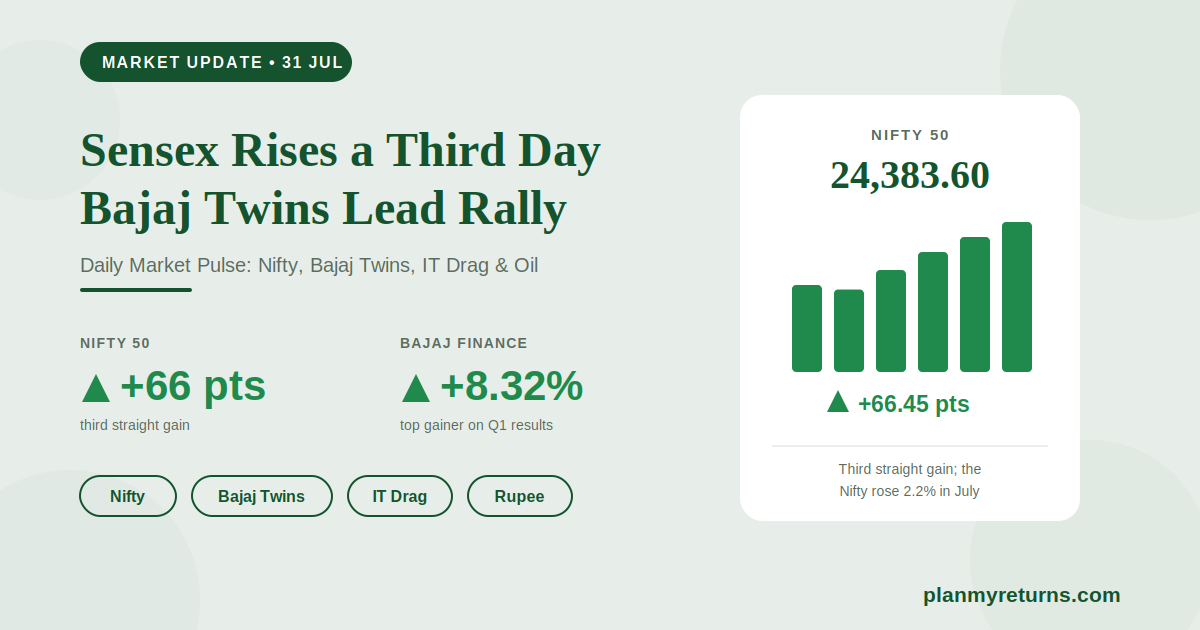
Today’s Overview: Markets rose a third day running. The Sensex added 166 points (+0.21%) to 78,094 and the Nifty gained 66 points to 24,384. A surge in Bajaj Finance and Bajaj Finserv, plus firm auto stocks, offset heavy IT selling. Both indexes ended July with a second straight monthly gain.
Today’s Top Finance Stories
1. Why Did the Sensex Rise for a Third Straight Day, Capping a Winning July?
What happened: The Sensex rose +166.49 points (+0.21%) to 78,094.64 and the Nifty 50 gained +66.45 points (+0.27%) to 24,383.60. The Bank Nifty added +117.35 points (+0.21%) to 57,264.85. Broader markets rose too, with both the Nifty MidCap 100 and SmallCap 100 up +0.44%. For the month of July, the Nifty gained +2.2% and the Sensex +2.1%, a second straight monthly rise.
Why does it matter: Three up days in a row, and two winning months, point to steadying confidence after a rough patch. Strong company results and foreign buying are doing the heavy lifting. For a long-term investor, a calm, grinding advance like this is healthier than a sharp one-day spike, and it rewards those who stay invested through a steady SIP.
Key Takeaway: A quiet, steady climb over several days often reflects real confidence more than a single dramatic jump does.
2. Why Did Indian IT Stocks Fall Even as Global Tech Soared?
What happened: The Nifty IT index was the day’s worst sector, down -1.56%. TCS fell -2.72%, and Infosys, Wipro and Tech Mahindra also dropped. The twist is that global tech was booming: strong results from Amazon and Microsoft lifted markets worldwide. That very strength worried investors in Indian IT, who fear these firms need to speed up their artificial intelligence (AI) work to keep up.
Why does it matter: Indian IT companies mostly earn by providing software services to global clients. If US tech giants pull ahead on AI, Indian firms risk losing work unless they adapt fast. So good news abroad became bad news here. We explain this in plain terms in our full breakdown of why Indian IT fell while global tech rallied.
Key Takeaway: The same event can help one market and hurt another. A global AI boom can pressure Indian IT-services firms that must race to keep up.
3. Bajaj Finance and Bajaj Finserv: Why Did the “Bajaj Twins” Jump?
What happened: The two Bajaj financial companies led the market. Bajaj Finance surged +8.32% to Rs 1,141.20 after its June-quarter profit rose 28% and several brokerages raised their price targets. Its parent, Bajaj Finserv, jumped +6.27% to Rs 2,029.10 after reporting a 12% rise in profit. Jio Financial Services added +3.85%, lifting the whole financial-services sector +1.31%.
Why does it matter: Lenders like Bajaj Finance are a window into how confidently Indians are borrowing and spending. Strong profits and rising loan books suggest healthy demand across the economy. When brokerages raise targets after results, it often signals they expect that momentum to continue.
Key Takeaway: Strong results from big lenders are a good sign for consumer demand, and can lift the entire financial sector with them.
4. Why Did the Rupee Climb to a Two-Week High Near 95.30?
What happened: The rupee strengthened to about 95.30 per US Dollar, its best level in over two weeks. A lower USD/INR number means each Dollar costs fewer rupees, so the currency is getting stronger. The main driver was a slide in the US Dollar overnight, as global investors questioned how firmly the US Federal Reserve will act on inflation. Steady foreign buying of Indian shares also helped.
Why does it matter: A stronger rupee makes imports cheaper, from crude oil to gadgets to studying abroad, and it eases inflation pressure at home. It is a quiet tailwind for households and for import-heavy businesses.
Key Takeaway: When USD/INR falls, the rupee is strengthening. A weaker Dollar abroad often lifts the rupee and eases import costs at home.
5. Why Is Brent Crude Back Above $92, and What Does It Mean for India?
What happened: Brent crude, the global oil benchmark, traded around $92.16 a barrel, up +0.27%, and it rose strongly over the month. Prices are being held up by tensions in the Middle East, including worries about shipping through the Strait of Hormuz and the Bab el-Mandeb, two vital routes for the world’s oil.
Why does it matter: India imports most of the oil it uses, so costlier crude widens the import bill, pressures the rupee and adds to inflation. It also squeezes fuel-heavy industries like airlines, paints and logistics. Oil above $92 is something to watch closely in the weeks ahead.
Key Takeaway: Oil is India’s biggest import. When Brent stays high, the effects reach inflation, the rupee and your monthly budget.
6. Policy and Global Watch: What’s Next for the RBI, the Fed and Foreign Flows?
What happened: A quick scan of the big-picture triggers that move Indian markets. The Reserve Bank of India (RBI) holds its interest rate meeting in early August, and most economists expect it to keep rates unchanged. The US Federal Reserve held its rates this week with a cautious tone. On trade, there was no fresh news today; the India-US deal that set India’s tariff at 18% was agreed months ago and remains in place. Foreign investors (FIIs) bought about Rs 3,624 crore of Indian shares in the previous session, their third day of buying.
Why does it matter: These are the forces that shape the whole market, not just single stocks. Steady RBI rates keep loan and deposit costs stable, a settled US tariff removes a big uncertainty for exporters, and returning foreign money supports both shares and the rupee. We will flag any change in these the moment it happens.
Key Takeaway: Central bank meetings, trade policy and foreign flows drive the market’s big moves. It pays to keep one eye on all three.
Today’s Q1 Results
A simple summary of major June-quarter (Q1 FY27) results in focus today. Bajaj Finance is covered in our separate results breakdown.
Bajaj Finserv
The parent of Bajaj Finance and Bajaj Allianz reported a consolidated net profit of about Rs 3,132 crore, up +12% year-on-year, with total income rising about +19%. Strong showings across its lending and insurance arms drove the growth. The stock rose +6.27% as investors welcomed the broad-based gains.
Shree Cement
The cement maker reported a weaker quarter. Consolidated net profit fell -17.7% year-on-year to about Rs 529 crore, down from Rs 643 crore a year earlier, as higher costs weighed on margins. Results like this are a reminder that even in a rising market, individual companies can struggle when their input costs climb.
Market Snapshot
Equity figures are official closing levels for 31 July 2026. Gold, silver, crude and currency reflect rates reported through the evening; confirm these closer to 7 PM IST as they trade round the clock. Gold and silver are retail reference rates that vary by city.
Top Gainers & Losers Nifty 50, 31 July 2026
▲ Top Gainers
- Bajaj Finance +8.32%
Surged after a 28% jump in Q1 profit.
- Bajaj Finserv +6.27%
Rose on a 12% rise in quarterly profit.
- Jio Financial Services +3.85%
Gained with the broad financials rally.
- Mahindra & Mahindra +3.50%
Extended gains after strong earnings.
▼ Top Losers
- TCS -2.72%
Led the IT sell-off on AI competition fears.
- Eternal (Zomato) -2.64%
Fell on stock-specific profit-booking.
- Max Healthcare -2.34%
Slipped even as the Pharma index rose.
India VIX (Volatility Index)
Meaning: The India VIX, often called the “fear gauge,” measures how much sharp movement traders expect in the market over the next month. A low VIX suggests calm and confidence; a high VIX suggests fear and expected turbulence.
Example: Today the India VIX fell about 3.7% to 11.71, a low reading. That told investors the market expected calm days ahead, which helped support buying.
Next Session to Watch
- Markets are shut over the weekend. The next session is Monday, 3 August.
- The RBI’s interest rate decision, expected in the first week of August.
- Whether IT stocks keep falling on global AI competition worries.
- Brent crude, which is holding above $92 on Middle East tensions.
- More Q1 FY27 results still to come this earnings season.
- Whether foreign investors extend their run of buying into August.
A firmer rupee helps, but oil above $92 is a warning. See where your money stands.
Use PlanMyReturns to plan: grow steadily with a SIP, gauge rising prices with our inflation calculator, or check your returns on a fixed deposit.
Explore All CalculatorsThis article is for general information only and is not investment advice. Read our full disclaimer.