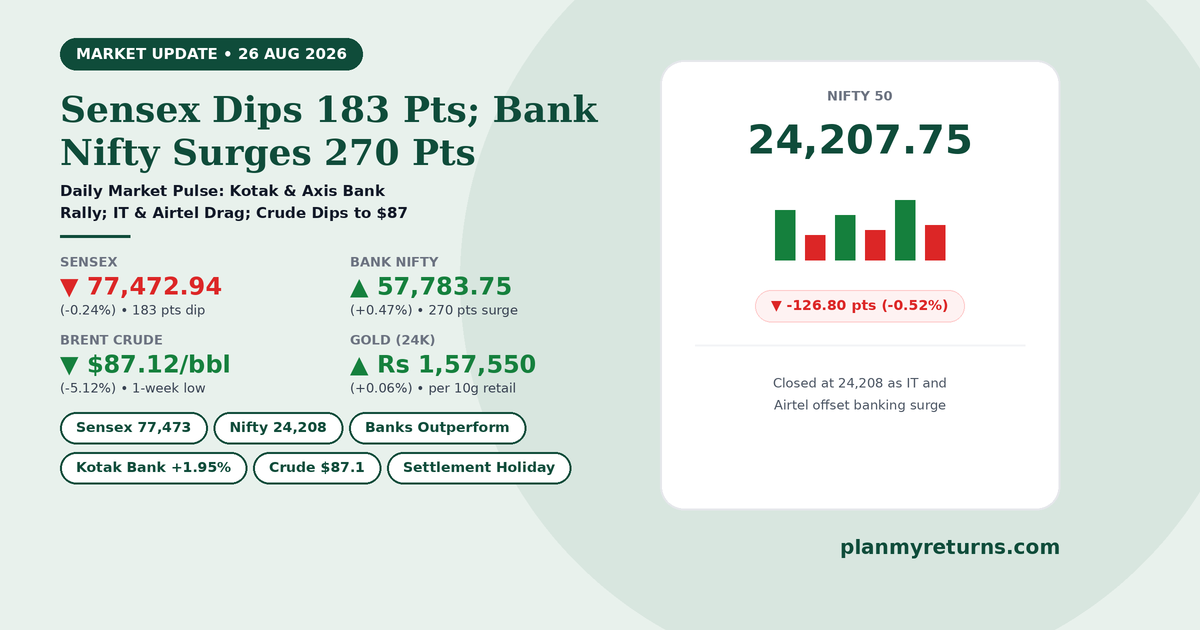
Today’s Overview: Indian stock markets closed lower on August 26, 2026, as sharp profit booking in IT frontliners and telecom heavyweights offset a 270-point surge in Bank Nifty. The BSE Sensex declined 183.15 points to 77,472.94, while Nifty 50 slipped 126.80 points to 24,207.75. A sharp 5% drop in crude oil supported sentiment.
Today’s Top Finance Stories
1. Why Did Sensex Fall 183 Points While Bank Nifty Surged to 57,784 on 26 August 2026?
What happened: Indian equity benchmarks experienced sharp sectoral divergence on Wednesday. The BSE Sensex fell -183.15 points (-0.24%) to settle at 77,472.94, while the Nifty 50 dropped -126.80 points (-0.52%) to 24,207.75. In contrast, Bank Nifty outperformed, surging +269.55 points (+0.47%) to 57,783.75.
Why does it matter: Heavy institutional selling in technology frontliners and telecom heavyweights dragged the headline index, while banking and metal shares attracted steady dip buying. Investors looking to average quality stock positions during sectoral churn can project calculations using a Stock Average Calculator or structure equity investments via a SIP Calculator.
Key Takeaway: Strong private banking inflows prevented a deeper market slide, maintaining Nifty 50 above its 24,200 support threshold.
2. What Drove Kotak Mahindra Bank and Private Banking Leaders to Rally Today?
What happened: Private sector lenders spearheaded market gains on 26 August, with Kotak Mahindra Bank rising +1.95% to ₹406.80 and Axis Bank gaining +1.65% to ₹1,248.50. State Bank of India (SBI) also added +0.95% to ₹928.40.
Why does it matter: Robust retail credit demand, expanding net interest margins, and asset quality stability restored strong institutional appetite across financial counters. Prospective homebuyers evaluating loan interest structures can project repayment terms using a Home Loan EMI Calculator.
Key Takeaway: Steady credit growth and strong balance sheet health continue to make private banking heavyweights top institutional allocations.
3. Policy and Global Watch: How Did Brent Crude Tumbling 5% to $87.12 Impact Domestic Equities?
What happened: International Brent crude oil prices plunged -5.12% to $87.12 per barrel on Wednesday, touching one-week lows as markets took comfort from targeted diplomatic sanctions rather than direct military escalation in West Asia. Supported by lower oil import bills, the Indian Rupee strengthened by 6 paise to 95.64 per US Dollar.
Why does it matter: Significant crude cooling reduces national import inflation and lowers raw material costs for paint, tyre, and transport companies. Individuals tracking household purchasing power against inflation can calculate trends with an Inflation Calculator.
Key Takeaway: Rapidly cooling energy costs improve medium-term domestic manufacturing margin outlooks and support sovereign currency stability.
4. Why Did Infosys, TCS, and Bharti Airtel Face Heavy Selling Pressure?
What happened: Telecom heavyweight Bharti Airtel dropped -2.35% to ₹1,908.00, while IT leaders Infosys fell -2.10% to ₹1,102.50 and TCS slipped -1.60% to ₹2,324.00, emerging as the top drags on the Nifty 50 on Wednesday.
Why does it matter: Global interest rate caution ahead of US personal consumption expenditures (PCE) inflation data and Nvidia earnings led institutional funds to trim exposure to IT and telecom frontliners. Long-term investors evaluating lump-sum allocations during sector pullbacks can project compounding returns using a Lumpsum Calculator.
Key Takeaway: Tech and telecom profit booking accounted for the bulk of headline benchmark declines despite financial strength.
5. How Did Metal Stocks and Tata Steel Continue Their Positive Outperformance?
What happened: Core industrial metal producers continued their winning streak on 26 August, with JSW Steel rising +1.40% to ₹1,012.00 and Tata Steel gaining +1.25% to ₹189.90, leading the Nifty Metal index higher.
Why does it matter: Resilient domestic infrastructure project awards and Chinese fiscal stimulus measures supported global commodity prices. Wealth builders planning long-term financial targets can calculate compound savings with a Step-Up SIP Calculator.
Key Takeaway: Domestic capital expenditure execution continues to drive steady outperformance across manufacturing and steel leaders.
News & Stock Updates
Macro, Regulatory & Economy Updates
- Settlement Holiday: Clearing houses observed a scheduled settlement holiday on August 26, 2026; trading operated normally while transactions will settle on Thursday, August 27.
- Crude Oil Plunge: Brent crude plummeted 5.12% to $87.12 per barrel on easing geopolitical supply concerns.
- Currency Market: Indian Rupee appreciated 6 paise to settle at 95.64 against the US Dollar as oil import dollar demand receded.
- Global Macro Signals: Global investors await US July PCE inflation figures and key tech earnings for interest rate guidance.
Corporate & Stock Action Buzzers
- Kotak Mahindra Bank: Jumped +1.95% to ₹406.80, leading private banks in Bank Nifty.
- Axis Bank: Advanced +1.65% to ₹1,248.50 on healthy credit disbursement numbers.
- JSW Steel & Tata Steel: Added +1.40% and +1.25% respectively on sustained steel demand.
- Bharti Airtel: Slipped -2.35% to ₹1,908 on institutional profit taking.
- Infosys: Dropped -2.10% to ₹1,102.50 amid IT export sector selling.
- Power Grid Corporation: Declined -1.85% to ₹263.00 on utility sector consolidation.
Market Snapshot
Equity figures are official closing levels for 26 August 2026. Gold and silver rates shown are indicative 24K retail reference rates (10g and 1kg). Note that retail gold and silver prices vary across cities (e.g., Mumbai, Delhi, Chennai, Hyderabad, Bengaluru) due to local taxes/octroi, transportation costs, and jeweller margins. Crude and currency reflect round-the-clock evening rates.
Top Gainers & Losers Nifty 50, 26 August 2026
▲ Top 5 Gainers
- Kotak Mahindra Bank +1.95%
₹406.80 | Led Nifty gainers on private banking strength.
- Axis Bank +1.65%
₹1,248.50 | Advanced on healthy loan disbursement momentum.
- JSW Steel +1.40%
₹1,012.00 | Rallied on steady steel pricing power.
- Tata Steel +1.25%
₹189.90 | Supported by global metal price recovery.
- State Bank of India +0.95%
₹928.40 | Steady buying across banking heavyweights.
▼ Top 5 Losers
- Bharti Airtel -2.35%
₹1,908.00 | Led Nifty decliners on institutional selling.
- Infosys -2.10%
₹1,102.50 | Dragged Nifty IT index lower.
- Power Grid Corporation -1.85%
₹263.00 | Utility sector consolidation.
- TCS -1.60%
₹2,324.00 | Profit booking across large-cap IT.
- Maruti Suzuki -1.45%
₹13,420.00 | Eased on selective auto profit taking.
Sector Rotation
Meaning: Sector Rotation is an active investment strategy where institutional capital is reallocated from one industry sector to another in anticipation of changing macroeconomic conditions or interest rate cycles.
Example: Institutional sector rotation moved funds from IT and telecom into banking and metals on 26 August 2026, lifting Bank Nifty by 270 points.
Frequently Asked Questions
Why did Sensex fall 183 points on 26 August 2026?
The BSE Sensex fell 183.15 points (-0.24%) to 77,472.94 and Nifty dropped 126.80 points (-0.52%) to 24,207.75 as selloffs in Bharti Airtel (-2.35%), Infosys (-2.10%), and TCS (-1.60%) offset a 270-point surge in Bank Nifty.
Why did crude oil tumble 5% to $87.12 today?
Brent crude fell 5.12% to $87.12 per barrel as global markets took comfort from targeted diplomatic sanctions rather than immediate military escalation in West Asia.
Which sector outperformed on Wednesday?
Bank Nifty (+0.47%) and Metals (JSW Steel +1.40%, Tata Steel +1.25%) outperformed the broader market, driven by Kotak Mahindra Bank (+1.95%) and Axis Bank (+1.65%).
Upcoming Market Catalysts to Watch
- Monthly F&O Expiry: August derivative contracts settlement on Thursday, August 27.
- Skyways Air Services IPO Allotment: Basis of allotment finalization following IPO closing.
- US PCE Inflation Data: July PCE price index release for global monetary policy signals.
Plan Your Financial Strategy with PlanMyReturns Tools
Explore free financial calculators to plan long-term investments, calculate loan EMIs, and optimize tax outflows:
- SIP Calculator: Calculate systematic investment returns for long-term wealth creation
- Stock Average Calculator: Calculate average share purchase costs during stock market consolidations
- Home Loan EMI Calculator: Estimate monthly installments and interest schedules on home loans
- Old vs New Tax Regime Calculator: Compare annual tax liabilities under both tax regimes
- Inflation Calculator: Estimate the impact of changing prices on household purchasing power
About PMR Pulse
PMR Pulse is PlanMyReturns’ daily educational market wrap designed to help beginner Indian investors understand why equity markets moved, how global events impact domestic finances, and how to make informed wealth creation decisions.
Disclaimer: Content on PMR Pulse is provided for general informational and educational purposes only and does not constitute financial or investment advice. Read our full disclaimer.