A clear breakdown from PlanMyReturns.com on the Union Cabinet’s decision to raise the EPFO wage ceiling from Rs. 15,000 to Rs. 25,000, and what it does to your monthly take-home salary, employer match, and retirement corpus.
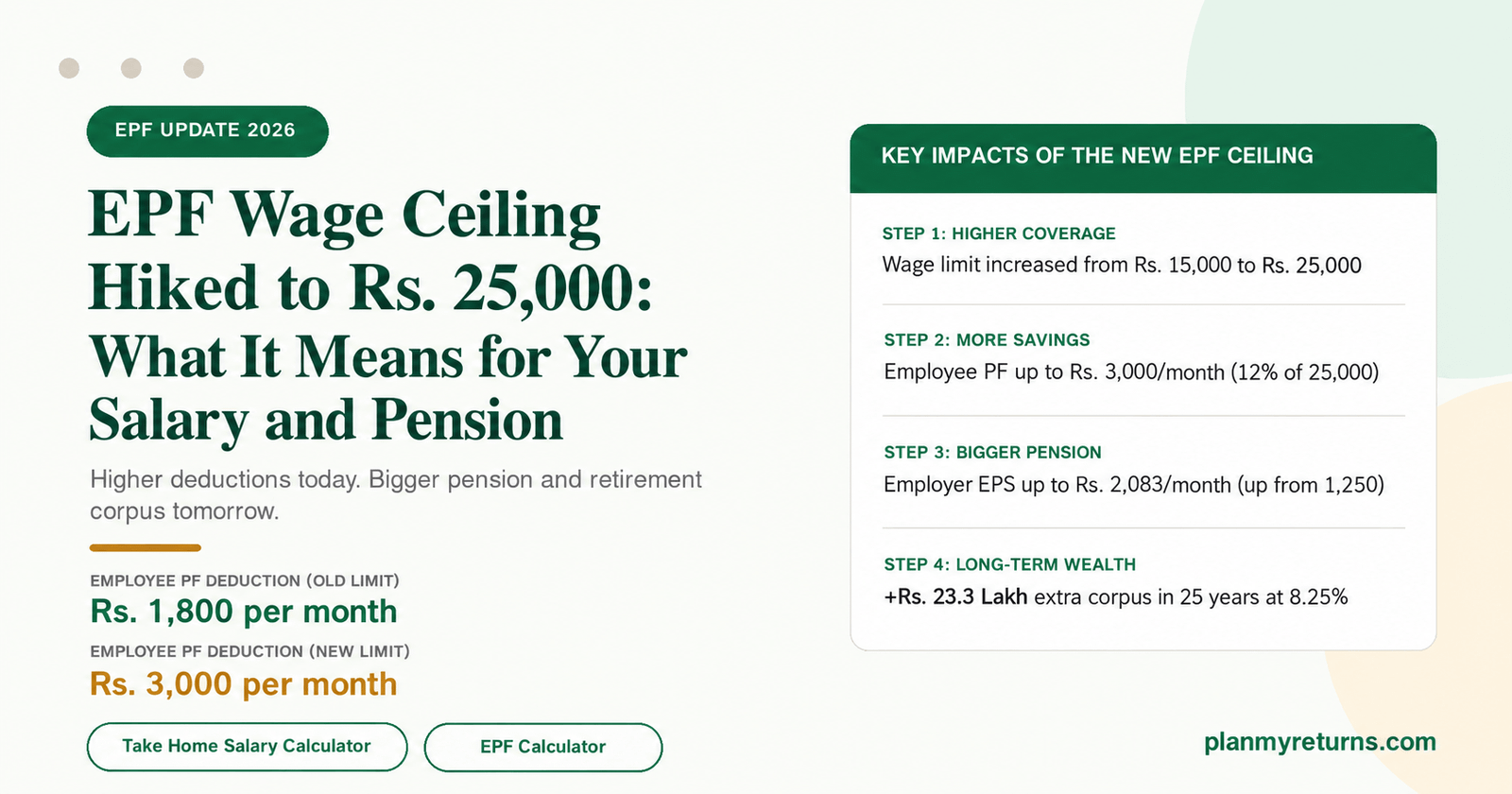
The Union Cabinet has approved increasing the statutory provident fund wage ceiling from Rs. 15,000 to Rs. 25,000 per month. This marks the first update to the Employees’ Provident Fund wage ceiling in twelve years, following the last revision in September 2014 when the threshold rose from Rs. 6,500 to Rs. 15,000.
If you are an employee, this change directly touches your next pay slip. If you are an employer, HR manager, or payroll specialist, it requires updating salary structures, payroll software, and monthly Electronic Challan cum Return (ECR) filings. Let us sit down and walk through your actual numbers together.
The Core Takeaway: Anyone with basic pay plus dearness allowance up to Rs. 25,000 per month must now be enrolled in the Employees’ Provident Fund (EPF), Employees’ Pension Scheme (EPS), and Employees’ Deposit-Linked Insurance (EDLI). Your monthly in-hand salary may decrease slightly because of higher mandatory savings, but your employer contributes more, and your retirement fund compounds faster at a guaranteed 8.25% interest rate.
- Mandatory threshold expanded: Companies must now enroll every employee earning up to Rs. 25,000 basic pay. Over 51 lakh formal workers will join social security for the first time.
- Employee PF contribution cap rises: Maximum statutory monthly deduction increases from Rs. 1,800 to Rs. 3,000 (12% of Rs. 25,000).
- Pension allocation increases: The employer’s 8.33% EPS share now goes up to Rs. 2,083 per month, compared to the earlier cap of Rs. 1,250. This creates a larger base for your pension.
- EDLI life insurance benefits widen: Because life cover under EDLI links directly to wages up to the ceiling, maximum insurance coverage rises automatically.
- Automatic job transfers are live: Your EPF balances now transfer automatically between employers through your Universal Account Number (UAN), removing physical transfer forms.
Core Terms You Need to Know
To understand how this compliance update affects your money, review these four fundamental terms:
Old vs New Ceiling: Pay Slip Comparison on Rs. 25,000 Basic
Look at what happens to a monthly pay slip for an employee earning Rs. 25,000 basic pay when the employer shifts from the old Rs. 15,000 cap to the new Rs. 25,000 ceiling:
| Component | Under Old Rs. 15,000 Ceiling | Under New Rs. 25,000 Ceiling | Monthly Change |
|---|---|---|---|
| Employee Basic + DA | Rs. 25,000 | Rs. 25,000 | No change |
| Employee PF Deduction (12%) | Rs. 1,800 (capped at 15K) | Rs. 3,000 (12% of 25K) | -Rs. 1,200 from take-home |
| Employer Share to EPS (8.33%) | Rs. 1,250 | Rs. 2,083 | +Rs. 833 added to pension fund |
| Employer Share to EPF (3.67%) | Rs. 550 | Rs. 917 | +Rs. 367 added to provident fund |
| Total Monthly PF Savings (Employee + Employer) | Rs. 2,350 in EPF + Rs. 1,250 in EPS | Rs. 3,917 in EPF + Rs. 2,083 in EPS | +Rs. 2,400 total monthly wealth addition |
| Monthly In-Hand Cash (if Employer PF in CTC) | Higher by Rs. 2,400 | Reduced by Rs. 2,400 | Check your exact pay on our Take Home Salary Calculator |
| Monthly In-Hand Cash (if Employer PF outside CTC) | Higher by Rs. 1,200 | Reduced by Rs. 1,200 | Check your exact pay on our Take Home Salary Calculator |
Audit your salary structure and compute your net take-home pay using our Take Home Salary Calculator and simulate your compound balance on our EPF Calculator.
The Compounding Impact on Your Retirement Corpus
While a monthly reduction of Rs. 1,200 to Rs. 2,400 in your take-home pay feels noticeable right now, look at what this money does over your working career when compounding at the government-ratified 8.25% interest rate:
That is an extra Rs. 15.22 lakh in pure provident fund savings, plus another Rs. 833 going every month into your pension pool. You can test your full retirement trajectory with our Retirement Calculator and see your path to wealth on our Crorepati Calculator.
EPF Wage Ceiling & Take-Home Salary Calculator
Enter your basic salary to see your exact deduction changes and project your 25-year retirement gains under the new Rs. 25,000 ceiling.
Calculations assume 8.25% annual compounding interest on monthly balances over 25 years. Employer EPS share is excluded from EPF corpus projection as it funds your defined monthly pension.
Run detailed multi-year EPF projections in our EPF Calculator → | Check complete salary slip breakdown in our Take Home Salary Calculator →
Employer & HR Compliance Checklist for 2026
For organizations operating in India, the revision from Rs. 15,000 to Rs. 25,000 requires five operational actions:
Audit Existing Payroll Master Data
Identify all employees drawing basic pay plus DA between Rs. 15,001 and Rs. 25,000 who were previously treated as exempt or non-members. These employees must be onboarded into the EPFO portal with their UAN generated or linked.
Update Payroll Software Rules & CTC Templates
Update statutory deduction formulas across HRMS platforms. If your employment contracts specify employer PF as part of CTC, communicate the revised in-hand breakdown clearly to employees before releasing the next month pay slips.
Revise Monthly ECR Filings
Ensure that monthly Electronic Challan cum Return (ECR) uploads reflect contributions calculated on wages up to Rs. 25,000. Timely filing before the 15th of each month prevents interest penalties under Section 7Q and damages under Section 14B.
Adjust EDLI Insurance & Administrative Charges
Employers pay 0.5% towards EDLI and 0.5% towards EPF administration costs. With the wage ceiling lifted to Rs. 25,000, administrative and insurance remittances adjust upwards to Rs. 125 each per eligible employee per month.
Digital EPFO Upgrades in 2026: Automatic Transfers and UPI Claims
Alongside the wage ceiling revision, the EPFO has rolled out three major system upgrades that make managing your funds much simpler:
| Feature | How It Worked Earlier | How It Works Now in 2026 |
|---|---|---|
| Job Switch PF Transfer | Employees had to file an online Form 13 claim or submit physical signatures | Automatic seamless transfer across member IDs via UAN and verified Aadhaar |
| Emergency Withdrawal Access | 7 to 15 days bank NEFT processing time | Direct UPI transfer access for illness and education claims within 72 hours |
| KYC Verification | Manual employer digital signature approvals required for minor detail changes | Automated bank account and demographic verification using UIDAI API |
| Annual Passbook Updates | Passbook interest credited with several months delay | Real-time monthly ledger updates with quarterly interest provisioning |
Tax Reminder on High EPF Deposits: Under Indian tax rules, annual employee contributions to EPF and Voluntary Provident Fund (VPF) exceeding Rs. 2,50,000 attract tax on the accrued interest. If your employer does not contribute to your PF (such as government employees), the tax-free limit is Rs. 5,00,000. For most employees contributing under the Rs. 25,000 monthly ceiling (Rs. 36,000 annually), 100% of your interest remains completely tax-free. Model your income tax under both regimes using our Old vs New Tax Regime Calculator.
Want to plan your retirement and salary deductions with precision? Explore over 45 free tools for salary, investments, taxes, and retirement.
Explore All Calculators on PlanMyReturns.comCommon Mistakes to Avoid With Your PF Account
| Mistake | Why It Hurts Your Wealth | What You Should Do Instead |
|---|---|---|
| Withdrawing PF on Job Switch | Tempting lump sum withdrawal breaks the 8.25% compounding engine and triggers tax if service is under 5 years | Let your UAN auto-transfer the balance to your new company. Keep your money compounding |
| Unlinked UAN and Aadhaar | Stalls automatic transfers, blocks withdrawal requests, and rejects employer ECR credits | Log in to the EPFO Member Unified Portal and ensure your Aadhaar and bank details are active and verified |
| Treating EPF as an Emergency Fund | Frequent non-refundable partial withdrawals deplete your core retirement security | Build a separate 3 to 6 month cash reserve using our Emergency Fund Calculator |
| Ignoring Gratuity Entitlement | Employees changing jobs before 5 years lose out on statutory gratuity payouts | Check your eligible gratuity payout on our Gratuity Calculator |
Please Note: This guide provides information on statutory labor laws and retirement savings frameworks in India. Employers should consult their labor law advisors or legal counsel for establishment-specific compliance advice. Employees can verify their individual member passbook details directly on the official EPFO Member Portal.
What is the new EPFO statutory wage ceiling in India?
The statutory wage ceiling has been increased from Rs. 15,000 per month to Rs. 25,000 per month. This is the first revision since September 2014, when the limit was raised from Rs. 6,500 to Rs. 15,000. It makes EPF, EPS, and EDLI coverage mandatory for all employees with monthly basic pay plus dearness allowance up to Rs. 25,000.
Will my take-home salary decrease because of the new EPF ceiling?
If your basic salary is between Rs. 15,001 and Rs. 25,000, and your employer previously capped your PF deduction at Rs. 15,000, your monthly employee PF contribution increases from Rs. 1,800 to 12 percent of your actual basic (up to Rs. 3,000). If your employer includes their matching PF contribution inside your Cost to Company (CTC), your monthly take-home pay could drop by up to Rs. 2,400. That deduction goes directly into your high-yield retirement account.
How does the Rs. 25,000 wage ceiling affect my EPS pension?
Under the earlier Rs. 15,000 ceiling, the maximum monthly employer contribution going into the Employees’ Pension Scheme (EPS) was capped at Rs. 1,250 (8.33 percent of Rs. 15,000). Under the new Rs. 25,000 ceiling, the monthly EPS contribution rises to Rs. 2,083. This higher contribution base increases the pensionable salary used to compute your monthly lifelong pension upon retirement.
Does the wage ceiling hike apply to employees already earning above Rs. 25,000 basic?
If you already contribute 12 percent on your full actual basic pay (for example, Rs. 40,000 or Rs. 60,000), your monthly deductions and take-home pay remain unchanged. If your employer previously restricted PF contributions strictly to the statutory ceiling of Rs. 15,000, your contributions will now automatically adjust up to the new statutory ceiling of Rs. 25,000.
What is the current EPF interest rate for FY 2025-26?
The government has ratified the EPF interest rate at 8.25 percent per annum. This interest compounds annually and remains one of the highest sovereign-backed, fixed-income returns in India. It is completely tax-free for annual employee contributions up to Rs. 2.5 lakh.
How does automatic PF transfer work when switching jobs in 2026?
EPFO now executes automatic transfer of provident fund balances when you change jobs through your Universal Account Number (UAN). As long as your UAN is linked to your Aadhaar and verified by your new employer during onboarding, your previous member ID balances transfer automatically without filing a physical Form 13 or online claim request.