
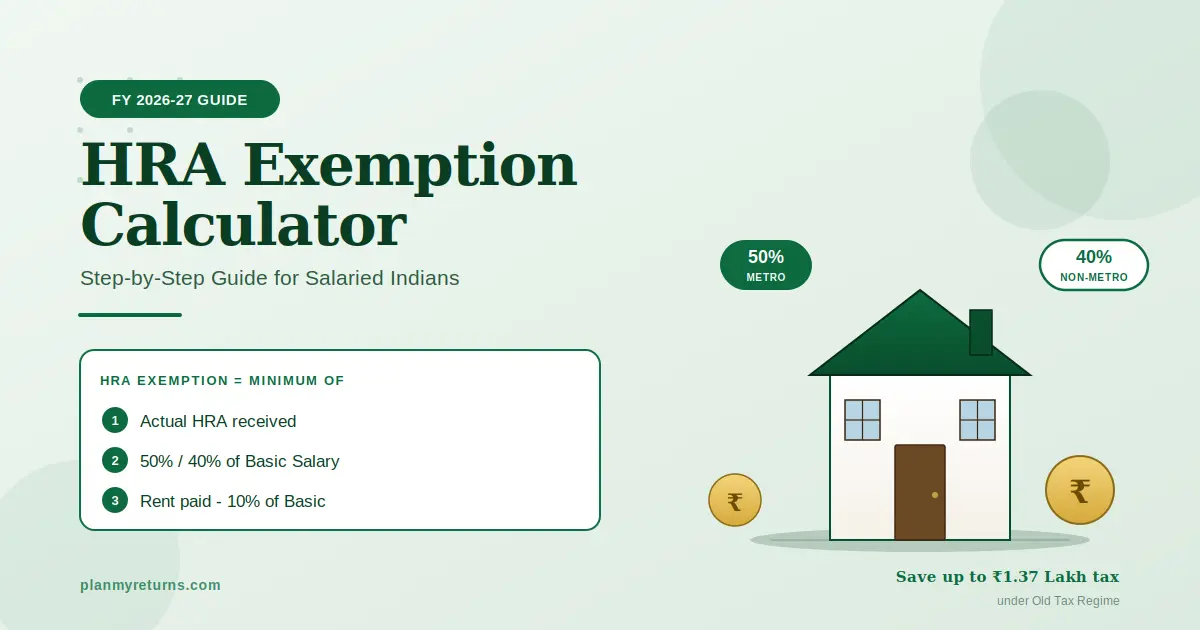
A complete step-by-step guide to HRA exemption calculation in India for FY 2026-27. Learn the 3-part HRA formula, metro vs non-metro rules, rent receipt requirements, and real examples with exact tax savings numbers.
HRA (House Rent Allowance) exemption under Section 10(13A) of the Income Tax Act, 1961 allows salaried employees to reduce their taxable income by the rent they pay. For FY 2026-27, HRA exemption is calculated as the minimum of three specific values. Most salaried Indians get this calculation wrong, either over-claiming and facing tax notices, or under-claiming and losing thousands in tax savings.
This guide breaks down exactly how HRA exemption works, step by step, with real calculation examples across salary levels and cities. By the end, you will know precisely how much of your HRA is tax-free and how to maximize it within legal limits.
Important: HRA exemption is only available under the old tax regime. If you have opted for the new tax regime (default since FY 2024-25), HRA exemption is not available to you. Before choosing your regime, use the Income Tax Calculator to compare both options.
The HRA Exemption Formula: 3-Part Rule
HRA exemption is the minimum (lowest) of these three amounts. This is the core rule that governs every HRA calculation in India:
2. 50% of Basic Salary (Metro) OR 40% (Non-Metro)
3. Actual Rent Paid minus 10% of Basic Salary
The lowest of these three values becomes your tax-free HRA. Anything above that is added to your taxable income. This is why two employees with identical salaries can get different HRA exemptions based on their rent, city, and HRA component.
Skip the manual math. Calculate your exact HRA exemption in seconds.
Open HRA Calculator →Metro vs Non-Metro: Which Cities Qualify?
The Income Tax Act defines only 4 cities as “metro” for HRA purposes. This classification has not changed despite multiple Union Budgets and continues to apply for FY 2026-27.
Common confusion: Gurgaon and Noida are NOT metros for HRA purposes. Despite being part of Delhi NCR, they are classified as non-metro at 40%. Only Delhi itself qualifies as metro. This is the single most common HRA calculation mistake we see every filing season.
Step-by-Step HRA Calculation: Follow This Exactly
Here is the exact 4-step process to calculate your HRA exemption for any salary, city, or rent combination.
Gather Your Numbers
Before calculating, you need four inputs from your salary slip and rent agreement:
Basic Salary: The “Basic” component on your payslip (not CTC, not gross salary). For government employees, add Dearness Allowance (DA) if it forms part of retirement benefits.
HRA Received: The exact HRA component paid to you monthly or annually. Check your payslip.
Actual Rent Paid: The total rent you pay annually to your landlord.
City Classification: Metro (Mumbai, Delhi, Kolkata, Chennai) or Non-Metro (everywhere else).
Calculate 50% or 40% of Basic Salary
If you live in a metro, multiply your annual basic salary by 50%. If non-metro, multiply by 40%. This is your first comparison value.
Metro calculation: ₹6,00,000 × 50% = ₹3,00,000
Non-metro calculation: ₹6,00,000 × 40% = ₹2,40,000
Calculate Rent Paid Minus 10% of Basic
Take the actual rent you pay for the year, then subtract 10% of your annual basic salary. The result is your second comparison value.
10% of basic (₹6,00,000) = ₹60,000
Rent minus 10% of basic = ₹2,40,000 – ₹60,000 = ₹1,80,000
If your rent is less than 10% of basic salary, this value becomes zero or negative, and your HRA exemption becomes zero. Very low rent means very little HRA benefit.
Take the Minimum of All Three Values
Compare the three values: actual HRA received, 50%/40% of basic salary, and rent minus 10% of basic. The lowest number is your tax-free HRA exemption.
1. Actual HRA = ₹2,40,000
2. 50% of basic = ₹3,00,000
3. Rent minus 10% basic = ₹1,80,000
HRA Exemption = ₹1,80,000 (the lowest)
Everything above ₹1,80,000 from the HRA received is added back to your taxable income. In this case, ₹60,000 (₹2,40,000 HRA received minus ₹1,80,000 exempt) becomes taxable.
HRA Calculation Examples: Real Scenarios for 2026
Let us work through three realistic examples covering different salary levels and cities. These scenarios will help you match your own situation.
Example 1: Rahul, Software Engineer in Bengaluru
Profile: Rahul, 27, works at an IT company in Bengaluru. Annual basic salary ₹6,00,000 (₹50,000/month). HRA component ₹2,40,000/year. He pays ₹18,000/month (₹2,16,000/year) for his 1BHK in Koramangala.
Taxable HRA = ₹2,40,000 – ₹1,56,000 = ₹84,000
Tax saved (20% slab) = ₹1,56,000 × 20% + 4% cess = ₹32,448
Example 2: Priya, Marketing Manager in Mumbai
Profile: Priya, 32, lives in Andheri, Mumbai. Annual basic salary ₹10,00,000 (₹83,333/month). HRA ₹5,00,000/year. She pays ₹45,000/month (₹5,40,000/year) for a 2BHK apartment.
Taxable HRA = ₹5,00,000 – ₹4,40,000 = ₹60,000
Tax saved (30% slab) = ₹4,40,000 × 30% + 4% cess = ₹1,37,280
Example 3: Arjun, Finance Executive in Hyderabad
Profile: Arjun, 29, works in Gachibowli, Hyderabad. Annual basic ₹8,00,000 (₹66,667/month). HRA ₹3,20,000/year. Rent paid ₹15,000/month (₹1,80,000/year) for a shared 2BHK.
Taxable HRA = ₹3,20,000 – ₹1,00,000 = ₹2,20,000
Tax saved (20% slab) = ₹1,00,000 × 20% + 4% cess = ₹20,800
Observation: Arjun is leaving money on the table. His low rent (₹15,000 in Gachibowli is on the low side) caps his HRA exemption. If he moved to a ₹25,000/month place, his HRA exemption would jump to ₹2,20,000 and tax savings to ₹45,760. Always calculate before you rent.
Documents Required to Claim HRA Exemption
Without proper documentation, your HRA claim can be rejected by your employer during Form 16 preparation or flagged by the Income Tax Department during assessment. Keep these documents ready:
HRA + Home Loan: Can You Claim Both?
Yes, you can claim HRA exemption and home loan interest deduction under Section 24(b) together, but only in specific scenarios. This is one of the most misunderstood areas of income tax.
You can claim both if any of these conditions apply:
Scenario 1: Your owned house is in a different city. You work in Bengaluru, rent an apartment there, and own a house in your hometown like Jaipur. HRA exemption for Bengaluru rent + home loan interest deduction for the Jaipur property. Both are fully claimable.
Scenario 2: Your owned house is rented out. You own a house in Delhi but rent it to a tenant. You live in rented accommodation elsewhere in Delhi or another city. HRA on your rented home + Section 24(b) for the home loan interest on the Delhi property.
Scenario 3: Under-construction property. You own an under-construction flat but currently live on rent. HRA exemption applies normally. Home loan interest is deductible only after possession (pre-construction interest claimed in 5 equal installments).
You cannot claim both if you own a house in the same city where you work and it is self-occupied. The tax department considers renting another place in the same city while owning self-occupied property as an avoidance tactic.
Calculate your home loan EMI and interest component.
Open Home Loan EMI Calculator →Paying Rent to Parents: Is It Allowed?
Yes, paying rent to your parents to claim HRA exemption is completely legal under Indian tax law, provided it is a genuine arrangement. The Income Tax Department has confirmed this in multiple tribunal rulings over the years.
However, there are strict conditions:
Condition 1: Your parents must own the property. The house must be registered in their name (or co-owned with them) to qualify as a genuine rental arrangement.
Condition 2: Transfer rent via bank. Monthly NEFT, UPI, or cheque transfer to parents’ bank account. Cash payments to parents are red flags during assessment.
Condition 3: Parents must declare rental income. Your parents must show the rent received as “Income from House Property” in their own tax return. If your parents are in a lower tax slab than you, the overall family tax liability decreases.
Condition 4: Proper rent receipts. Treat it like any other rental. Issue rent receipts monthly, sign a rent agreement, and maintain records.
Warning: Paying rent to your spouse does NOT qualify. Courts have ruled that rent paid to a spouse is not an arm’s-length transaction and cannot be claimed as HRA. Same applies to paying rent to someone whose income you partially control.
5 Common HRA Mistakes That Trigger Tax Notices
Mistake 1: Claiming HRA without actual rent payment. Submitting fake rent receipts while living with parents (without actually paying them) is tax fraud. The ITD now cross-checks landlord PAN, AIS (Annual Information Statement), and bank transfers. Fake claims lead to penalty up to 200% of tax evaded.
Mistake 2: Missing landlord’s PAN for rent above ₹1 lakh. If your annual rent exceeds ₹1,00,000 (₹8,334/month), submitting landlord’s PAN is mandatory. Missing PAN means your entire HRA claim gets disallowed, not just a portion.
Mistake 3: Treating Gurgaon or Noida as metro. These cities are classified as non-metro (40%), despite being in Delhi NCR. Only Delhi proper qualifies as metro. Using 50% instead of 40% leads to rejected claims and potential penalty.
Mistake 4: Not linking HRA with 80C deductions. HRA exemption reduces your taxable income, which may push you into a lower tax bracket. This affects how much you need to invest under Section 80C. Always compute HRA first, then plan 80C investments.
Mistake 5: Forgetting to claim HRA during partial years. If you moved cities mid-year or changed jobs, calculate HRA separately for each period with different basic/HRA components. Employees often claim the annual figure without splitting, leading to incorrect exemption.
HRA Exemption Under Old vs New Tax Regime
Budget 2020 introduced the new tax regime with lower slabs but removed most deductions including HRA. For FY 2026-27, here is how HRA factors into your regime choice:
As a rough thumb rule, if your combined HRA exemption + 80C + home loan interest exceeds ₹4,00,000 per year, the old regime usually saves more tax. Below that, the new regime’s lower slabs often win. But always compute both scenarios exactly.
Which tax regime saves you more money in 2026?
Compare old vs new regime side by side with your exact numbers.
Plan Your Complete Tax Strategy
HRA is just one piece of your tax planning. Combine it smartly with other deductions to maximize savings. Use these calculators on PlanMyReturns to build a complete picture of your tax liability.
Calculate your exact HRA exemption instantly with the HRA Exemption Calculator. Plan your ₹1.5 lakh 80C investments using the PPF Calculator or ELSS Calculator. Evaluate the standard deduction impact with the Standard Deduction Calculator. Calculate your TDS on rent paid above ₹50,000/month using the TDS Calculator. And check your final take home pay across both regimes with the Take Home Salary Calculator.
Explore all free tax and financial calculators at PlanMyReturns Calculators. Every calculation follows transparent methodology and assumptions you can verify.
Frequently Asked Questions: HRA Exemption