Why the new tax regime’s ₹12.75 lakh effective tax-free limit changes how salaried employees should approach their FY 2026-27 investment declaration, and what actually changed now that Form 12BB has been replaced by Form 124.
What’s current for FY 2026-27: Form 12BB, the familiar investment declaration you submitted to your employer every year, has been replaced by Form 124 under the Income Tax Rules, 2026, effective from 1 April 2026. The purpose is unchanged, but the structure, and a new landlord-relationship disclosure for HRA claims, are new. TDS on salary is now computed under a renumbered provision of the Income-tax Act, 2025, though the underlying mechanics remain the same.
If your payroll team just sent out the FY 2026-27 investment declaration form, do not fill it out the way you always have. For a large share of salaried employees, the old ritual of gathering rent receipts, LIC premium statements, and 80C proofs every January no longer changes their tax bill at all, because the new regime already makes income up to roughly Rs 12.75 lakh tax-free without any of that paperwork.
This guide explains where the Rs 12.75 lakh figure comes from, why it matters for your declaration decision, what changed when Form 12BB became Form 124, and how to avoid over-declaring for a benefit you will never actually receive.
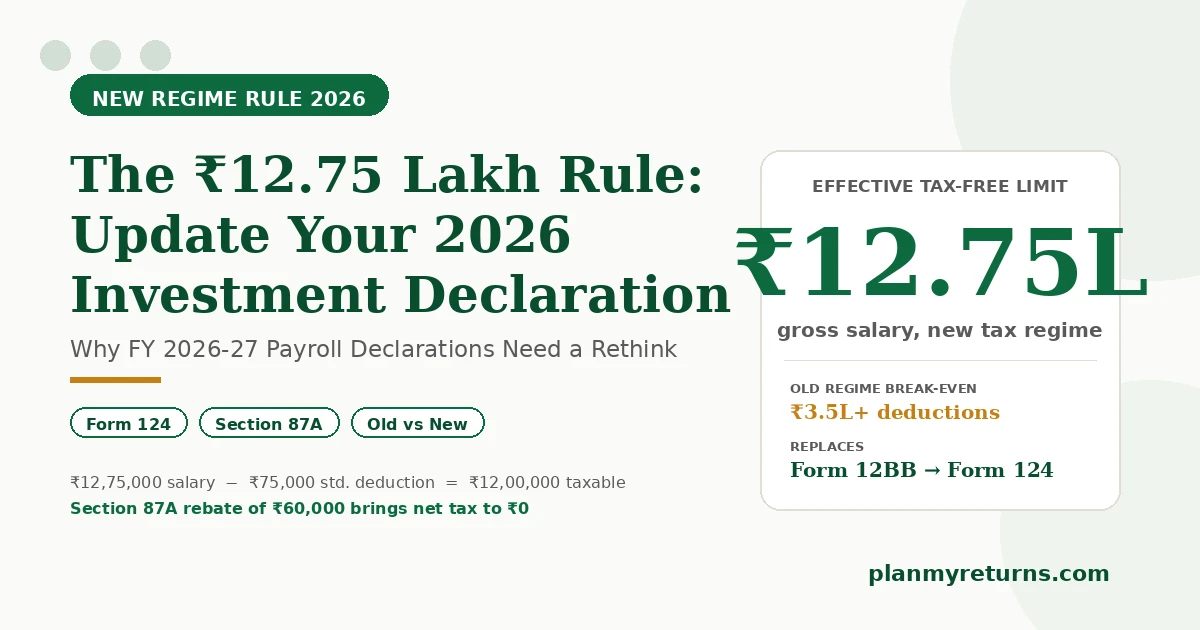
Quick Answer: Under the new tax regime, a salaried employee’s gross salary up to about Rs 12.75 lakh is effectively tax-free once the Rs 75,000 standard deduction and the Section 87A rebate are applied. If your total genuine old-regime deductions do not comfortably exceed this benefit, filling out a detailed investment declaration achieves nothing, and can even work against you if it delays your payroll processing.
Where the ₹12.75 Lakh Figure Actually Comes From
The number is not a single exemption limit; it is the sum of two separate benefits stacking together under the new regime.
Important: This works because the rebate is available up to exactly Rs 12 lakh of taxable income. One rupee above that threshold, and the entire slab-based tax on your income becomes payable, not just the tax on the excess. This is why the Rs 12.75 lakh figure is treated as a hard boundary rather than a soft guideline in payroll planning.
Why Your Investment Declaration Habits Need to Change
For years, the default assumption in most payroll departments was that employees would claim every deduction they could to reduce tax. That logic assumed the old regime, where every rupee of HRA, Section 80C investment, or home loan interest directly lowered taxable income. Under the new regime, none of that arithmetic applies, and yet many employees still submit a full investment declaration out of habit.
The practical effect is wasted effort on both sides. Employees spend January chasing rent receipts and premium certificates for a regime that will not use them. Payroll and HR teams process, verify, and store proof documents that have zero impact on the final TDS calculation.
When a Declaration Still Makes Sense
If your genuine, provable deductions clearly exceed the new regime’s effective benefit, for example high HRA in a metro city combined with home loan interest and full Section 80C usage, the old regime can still work out cheaper even above Rs 12.75 lakh of salary. The break-even point typically sits around Rs 3.5 to Rs 4 lakh of total deductions, but it shifts with your exact income level, so the right move is to calculate both scenarios rather than assume.
Not sure if switching regimes would actually help you? Compare your real numbers before you fill out any declaration form.
Try the Old vs New Tax Regime CalculatorForm 12BB to Form 124: What Actually Changed
| Aspect | Form 12BB (up to FY 2025-26) | Form 124 (FY 2026-27 onward) |
|---|---|---|
| Governing rule | Rule 26C, Income Tax Rules | Income Tax Rules, 2026 |
| Structure | Single section for all claims | Two-part structure separating regime choice from deduction claims |
| HRA disclosure | Rent, landlord name, address, PAN if applicable | Adds landlord relationship details alongside existing fields |
| Coverage | HRA, LTA, home loan interest, Chapter VI-A deductions | Same coverage, updated terminology and layout |
| Applicability | All employees claiming deductions | Relevant only if you elect the old regime |
Step-by-Step: Handling Your FY 2026-27 Declaration Correctly
Estimate Your Tax Under Both Regimes First
Use your expected annual salary, along with a realistic estimate of HRA, Section 80C investments, and home loan interest, to compute tax under both regimes. Do this before you touch the declaration form, since the result decides whether the rest of this process even applies to you.
Declare Your Regime Choice Early
Inform your employer of your regime choice at the start of the year so TDS is computed correctly from the first payslip. If you do nothing, most employers will apply the new regime by default, since it is now the statutory default.
Fill Form 124 Only If You Chose the Old Regime
If your calculation in Step 1 favours the old regime, complete Form 124 with your projected HRA, Section 80C, 80D, and home loan interest figures. If the new regime wins, you generally do not need to submit this form beyond confirming your regime choice.
Submit Actual Proofs Within the Window
If you opted for the old regime, gather and submit actual proof documents, rent receipts, premium receipts, and loan interest certificates, within your employer’s proof submission window. Missing this window means your employer will not factor in the claims for the remaining months of TDS, even though you can still claim them in your ITR later.
Reconcile at ITR Filing Time
Whatever your employer used for TDS, you can still choose your final regime independently when filing your ITR, as long as you are a salaried employee without business income. Use this as your final safety net if your circumstances changed during the year.
Common Mistakes to Avoid
- Submitting a full old-regime declaration purely out of habit, without checking whether it actually reduces tax below Rs 12.75 lakh salary
- Assuming the old regime automatically applies if you say nothing, when the statutory default is now the new regime
- Overstating HRA, Section 80C, or other claims to look better on paper, which risks penalty under misreporting provisions and increasingly gets cross-checked against AIS data
- Missing the January-February proof submission window and then being surprised by lower take-home pay for the rest of the year
- Forgetting that the Section 87A rebate does not cover capital gains, so investment income outside salary can still create a tax liability
Decision Checklist Before You Submit Your Declaration
- Confirm your expected gross salary for FY 2026-27 and check if it falls at or below roughly Rs 12.75 lakh
- List your genuine, provable deductions: HRA, Section 80C, 80D, home loan interest, and NPS
- Run both regime calculations using your actual numbers, not assumptions
- If the old regime wins, confirm you can gather every required proof document before the submission deadline
- If the new regime wins, confirm your employer has your regime choice on record so TDS is computed correctly from month one
- Revisit the decision if your salary, city, or deduction eligibility changes significantly during the year
Frequently Asked Questions
Conclusion
The Rs 12.75 lakh figure is not a marketing line, it is the practical outcome of the standard deduction and Section 87A rebate working together under the new regime. For most salaried employees below that number, the annual investment declaration ritual has lost its purpose. The smarter move for FY 2026-27 is to run the numbers first, and only fill out Form 124 in detail if the old regime genuinely wins for your situation.
Check where you stand using the Old vs New Tax Regime Calculator and the Income Tax Calculator. If HRA is your biggest old-regime deduction, verify the exempt amount with the HRA Exemption Calculator before deciding whether it is worth declaring at all.