A complete data-backed comparison of SIP vs Lumpsum mutual fund investing for Indian investors in 2026. Real Nifty 50 returns, sample calculations, scenarios for different investor profiles, and the verdict on which strategy actually wins.
Most personal finance content tells you SIP is always better than lumpsum. That is a half-truth. The math actually favors lumpsum in 65 to 70% of long-term scenarios because money invested earlier stays invested longer. So why does almost every advisor still recommend SIP? Because for 95% of Indian retail investors, behavior matters more than math.
This guide cuts through the marketing fluff. We compare SIP and Lumpsum using actual Nifty 50 data over the last 20 years, show you when each strategy wins, give you sample calculations for different investment amounts, and recommend a clear path based on your situation. By the end of this article, you will know exactly which approach fits your financial life in 2026.
Important: This is not advice to invest. Mutual fund returns are subject to market risk. Past performance does not guarantee future returns. Always read the scheme information document before investing. Use the SIP Calculator and Lumpsum Calculator to model your own numbers.
What is SIP and What is Lumpsum?
SIP (Systematic Investment Plan) means investing a fixed amount into a mutual fund every month on a chosen date. ₹5,000 every 5th of the month. ₹15,000 every 1st of the month. The amount, fund, and date are pre-decided. The bank auto-debits and invests on schedule.
Lumpsum means investing a single large amount into a mutual fund at one go. ₹2 lakh in one transaction. ₹10 lakh in one transaction. No recurring schedule. The full amount enters the market on day one and stays there until you redeem.
Both methods can be used in the same mutual fund. In fact, the same scheme accepts both. The difference is purely in how you put money in. The fund itself does not care whether your ₹12 lakh came monthly over a year or in one shot.
Systematic Investment Plan
- Fixed amount every month
- Auto-debit, zero effort after setup
- Rupee cost averaging benefit
- Builds discipline automatically
- Lower entry barrier (₹500/mo)
- Best for regular salary income
One-Time Investment
- Full amount invested at once
- Maximum compounding time
- Requires market timing skill
- Higher short-term volatility
- Needs surplus capital
- Best for windfall or bonus
The Math: SIP vs Lumpsum with Real Numbers
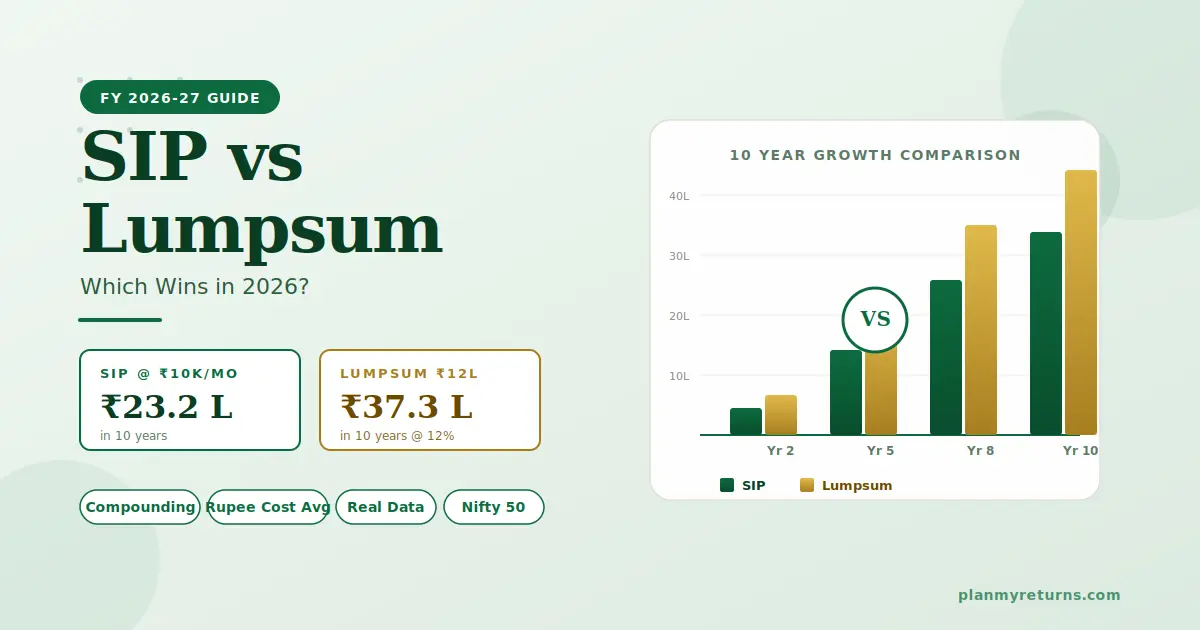
Let us run the numbers. Assume both investors put in ₹12 lakh into the same equity fund over the same 10-year period. Investor A does a SIP of ₹10,000 per month for 10 years (total: ₹12 lakh). Investor B invests ₹12 lakh as lumpsum on day 1. Expected return: 12% CAGR.
The lumpsum investor ends up with ₹14 lakh more, despite investing the same total amount. Why? Because the full ₹12 lakh started compounding from day one, while the SIP investor’s first installment only had 10 years to compound but the last installment compounded for just 1 month.
So lumpsum wins, right? On paper, yes. In real life, here is the catch: the lumpsum investor needs ₹12 lakh of surplus capital sitting idle on day one. Most salaried Indians do not have that. And the SIP investor faces zero timing risk because they bought at all market levels over 10 years.
Run your own SIP vs Lumpsum scenario.
Try different amounts, durations, and expected returns.
Real Nifty 50 Data: Last 20 Years
Let us stop using assumed returns and look at what actually happened. Below is what happened if you started a 10-year investment in Nifty 50 index fund at different points over the last 20 years.
The clear pattern: Lumpsum wins when markets are flat or rising consistently. SIP wins when markets crash early and recover later (like 2008-09 financial crisis or 2020 COVID crash). Since markets rise more often than they crash long-term, lumpsum mathematically wins more often.
But here is the behavioral reality. The Jan 2008 lumpsum investor saw their ₹12 lakh become ₹6 lakh by March 2009. Most retail investors panic-sell at that point and never see the recovery. The SIP investor kept buying through the crash and benefited massively from it. That is why advisors recommend SIP. Not for math. For mental peace.
Note: Returns shown above are illustrative based on historical Nifty 50 movements. Actual mutual fund returns will vary by fund, expense ratio, and exit load.
When SIP Wins: The Right Profile
Rohit, 28, IT Engineer, Hyderabad
Profile: Earns ₹85,000/month take-home. Has ₹50,000 in savings. Wants to start mutual fund investing.
Why SIP wins for Rohit: He does not have a ₹10 lakh surplus. His investing ability comes from monthly salary. SIP fits his cashflow naturally. He sets up ₹15,000/month SIP, forgets about it, and lets it run for 15 years. Estimated corpus at 12% CAGR: ₹75 lakh.
Action plan: ₹10,000 SIP in a flexicap fund + ₹3,000 SIP in a midcap fund + ₹2,000 SIP in an ELSS fund (for 80C tax saving). Calculate his exact projected corpus using the SIP Calculator.
Anjali, 32, First-time investor
Profile: Has ₹3 lakh sitting in savings account. Worried about market crash. Cannot decide when to invest.
Why SIP wins for Anjali: The act of waiting itself is killing her returns. ₹3 lakh in savings earns 3% (₹9,000/year). The same amount in equity fund SIP could earn 12% (₹36,000/year). Even if the market crashes after she starts, SIP averages her cost. She cannot lose by starting now.
Action plan: ₹25,000/month SIP for 12 months. This deploys her ₹3 lakh systematically. After that, continue at ₹10,000/month from ongoing income.
When Lumpsum Wins: The Right Profile
Vikram, 38, Senior Manager, Mumbai
Profile: Got ₹8 lakh annual bonus. Already has SIPs running. Has ₹4 lakh emergency fund. No urgent expense.
Why lumpsum wins for Vikram: He has surplus that has nothing else to do. Parking it in savings account is wealth destruction. His existing SIPs cover his discipline. The ₹8 lakh deserves maximum compounding time. Lumpsum entry into a diversified equity fund maximizes long-term returns.
Action plan: Lumpsum ₹8 lakh into a flexicap fund. Lock for 7+ years. Estimated value at 12% CAGR in 10 years: ₹24.85 lakh. Use the Lumpsum Calculator to model his exact returns.
Suresh & Meera, 52 & 49, Bengaluru
Profile: Sold an old apartment for ₹65 lakh. After capital gains tax, have ₹52 lakh net. Goal: retirement income in 8 years.
Why STP (hybrid) wins for them: Pure lumpsum of ₹52 lakh has high timing risk. Pure SIP wastes the money sitting idle. STP (Systematic Transfer Plan) is the answer. Park the ₹52 lakh in a liquid fund earning ~7%, transfer ₹2 lakh/month into an equity fund over 26 months. Best of both worlds.
Action plan: ₹52 lakh in liquid fund + STP ₹2L/month into a balanced advantage fund. Liquid fund earns interest while transfer happens. Reduces timing risk while still benefiting from equity exposure. Plan their retirement corpus using the Retirement Calculator.
The Decision Framework: Which Fits You?
Stop overthinking. Use this 4-question test:
Question 1: Do you have a regular monthly income? If yes (salaried, business with stable cash flow), SIP is your default choice. Build it from your monthly cashflow.
Question 2: Do you have a one-time surplus that has no other use? If yes (bonus, inheritance, property sale, FD maturity), lumpsum or STP is the right approach.
Question 3: Is your time horizon 7+ years? If yes, both methods work because long horizon flattens out timing risk. If no (under 5 years), avoid pure lumpsum in equity. Use STP or stay in debt.
Question 4: Can you stomach a 30 to 40% temporary drop in your investment value? If yes, lumpsum suits you. If no, SIP is mentally easier because losses feel smaller in monthly chunks.
For 80% of Indian retail investors, SIP is the right answer. Not because the math favors it, but because human behavior favors it. Discipline beats brilliance.
For the remaining 20% with surplus capital and emotional control, lumpsum or STP works better. They get more compounding time and lower opportunity cost.
The hybrid winner: Run a regular SIP and add lumpsum during deep market corrections (Nifty falls 20%+). This combines automated discipline with opportunistic deployment.
STP: The Smart Middle Path Most Indians Miss
STP (Systematic Transfer Plan) is the underrated hero of mutual fund investing. It is essentially a SIP using your existing lumpsum. You park your full amount in a liquid or ultra-short debt fund and transfer a fixed amount to an equity fund every month.
How it works in practice. You have ₹6 lakh to invest. Step 1: Put the full ₹6 lakh in a liquid fund (earns ~7%). Step 2: Set up an STP of ₹50,000/month from the liquid fund into an equity fund. Step 3: After 12 months, your full ₹6 lakh is in equity. During those 12 months, the unmoved portion earned debt fund returns.
Why STP beats both pure SIP and pure lumpsum for big surplus:
Versus pure lumpsum: STP reduces timing risk by averaging entry over 6 to 24 months. If the market crashes 2 months in, you still have most of your money in safe debt earning 7% while you continue buying equity at lower prices.
Versus pure SIP from a savings account: STP earns ~7% in liquid fund versus 3% in savings account during the transfer period. On ₹6 lakh, this difference is ₹24,000 per year.
Versus parking in FD: Liquid fund returns are similar to FD but with much higher liquidity. You can stop or modify the STP any time without penalty.
Common SIP vs Lumpsum Mistakes Indians Make
Mistake 1: Stopping SIP during market crashes. The crash is exactly when SIP buys you cheap units that turn into massive gains during recovery. Investors who stopped SIPs in March 2020 missed the biggest equity rally in Indian history.
Mistake 2: Doing lumpsum at market peaks. When everyone is talking about stocks, when markets hit all-time highs, when news is full of “millionaire investors,” that is the worst time for fresh lumpsum entry. Wait for STP or boring averaging.
Mistake 3: SIP without goal mapping. Random ₹5,000 SIPs with no purpose lead to early withdrawals. Tag every SIP to a specific goal: child education, home down payment, retirement. Use the Education Planning Calculator or Dream Home Calculator to set targets.
Mistake 4: Lumpsum without emergency fund. Investing your entire savings as lumpsum without keeping 6 months of expenses aside is financial suicide. Set up your Emergency Fund first.
Mistake 5: Ignoring step-up SIP. A flat ₹10,000/month SIP for 20 years is good. A step-up SIP that increases by 10% every year is great. ₹10,000 SIP @ 12% for 20 years = ₹91 lakh. Step-up version of the same = ₹1.42 crore. The increase costs you almost nothing because your salary grows too.
Sample Portfolios for Different Profiles
These are illustrative allocations only. Actual fund selection should be based on your risk profile, goals, and time horizon. Always consult a SEBI-registered investment advisor for personalized advice.
Find out exactly how much you need to invest.
Use SIP and Lumpsum calculators side by side.
Plan Your Complete Investment Journey
SIP vs Lumpsum is just one decision. Your full financial plan needs goal-mapping, tax planning, and risk management. Use these calculators on PlanMyReturns to build your complete plan.
Start by calculating how much corpus you need for retirement using the Retirement Calculator. Plan your child’s education fund with the Education Planning Calculator. Save tax on your equity gains using the Capital Gains Calculator. Run a step-up SIP for ELSS tax saving with the ELSS Calculator. Aim for crorepati status using the Crorepati Calculator. Plan your post-retirement income with the SWP Calculator.
Explore all free financial calculators at PlanMyReturns Calculators. Every calculation follows transparent methodology and assumptions you can verify.
Frequently Asked Questions: SIP vs Lumpsum