A complete guide to calculating your Employees’ Provident Fund retirement corpus for FY 2026-27 with current 8.25% interest rate, contribution rules, withdrawal options, and step-by-step examples for different salary levels.
The EPF (Employees’ Provident Fund) is India’s largest retirement savings scheme with over 7 crore active subscribers. If you are a salaried employee in any organization with 20+ employees, 12% of your basic salary plus dearness allowance gets automatically deducted every month and parked in your EPF account at 8.25% per annum. Your employer matches this contribution, building a powerful retirement corpus over decades.
But here is what most people get wrong about EPF. They check their balance once a year and ignore it. They have no idea how much they will have at retirement. They miss tax-saving opportunities. They withdraw it during job changes when they should have transferred it.
This guide shows you exactly how to calculate your EPF retirement corpus, what factors affect it, and how to maximize this often-ignored wealth-building tool for FY 2026-27.
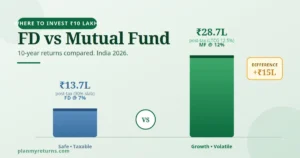
Why EPF deserves more attention: EPF gives you 8.25% guaranteed tax-free returns (FY 2025-26 rate). Compare that to a 7% bank FD where post-tax returns drop to 4.9% in the 30% slab. Over 30 years, this difference compounds into crores.
How EPF Works: The Basic Structure
Every month, two contributions go into your EPF account:
Key insight: When you check your EPF balance, you only see your contribution (12%) plus the employer’s EPF portion (3.67%). The remaining 8.33% goes to EPS (Employees’ Pension Scheme), which gives you a monthly pension after age 58, not a lump sum.
For example, if your basic salary is ₹50,000 (no DA), your monthly EPF deposit is ₹6,000 (your share) + ₹1,835 (employer’s EPF share) = ₹7,835. This earns 8.25% interest, compounded annually.
Calculate your exact EPF retirement corpus in seconds.
Enter your basic salary, age, and retirement age to see your projected wealth.
4 Real Scenarios: How EPF Builds Your Wealth
Fresh Graduate Starting at Age 23
Rohit, 23, joins his first IT job in Hyderabad with a basic salary of ₹30,000. His monthly EPF contribution starts at ₹3,600 (employee) + ₹1,101 (employer EPF) = ₹4,701.
Assuming 5% annual salary growth and the 8.25% EPF rate continues, by age 58 his EPF corpus will be approximately ₹1.85 crore, completely tax-free. He invested only around ₹46 lakh from his pocket. The remaining ₹1.39 crore is pure compound interest from EPF.
Lesson: Starting EPF early matters more than the amount. Time is the biggest multiplier in compound interest.
Mid-Career Switch at Age 35
Priya, 35, switches from a startup to a large MNC. Her new basic salary is ₹75,000. She has ₹15 lakh already accumulated in her old EPF from 10 years of service.
Critical decision: Should she withdraw the ₹15 lakh or transfer it to the new employer? Always transfer it. If she withdraws, she pays tax on it (since her service is broken between two employers under different UANs only if the UAN is not transferred). If she transfers, the ₹15 lakh continues earning 8.25% tax-free for 23 more years.
By keeping the old EPF and adding fresh contributions of ₹11,750/month (combined), her age-58 corpus will be approximately ₹3.2 crore. Withdrawing would lose her about ₹95 lakh in compound growth.
High-Earner Tax Implications
Vikram, 32, is a senior product manager with ₹2,50,000 basic salary in Bengaluru. His annual EPF contribution is ₹30,000 × 12 = ₹3,60,000.
Tax catch: Since his annual EPF contribution exceeds ₹2,50,000 (the threshold under Budget 2021), interest earned on the excess ₹1,10,000 is taxable. The interest on the first ₹2,50,000 remains tax-free.
This does not mean EPF stops being attractive. Even with partial taxation, the post-tax effective return is around 5.8% in the 30% slab, still better than a tax saver FD’s post-tax return of 4.9%. Calculate your exact post-tax EPF returns using the EPF Calculator.
VPF: Boosting Your EPF Contribution
Anjali, 30, basic salary ₹60,000, wants to invest more for retirement. Instead of a tax saver FD or PPF, she opts for VPF (Voluntary Provident Fund), an additional contribution to her EPF account.
She voluntarily contributes an extra ₹10,000/month above her mandatory ₹7,200. Her total EPF contribution becomes ₹17,200/month + employer’s ₹2,202 = ₹19,402/month.
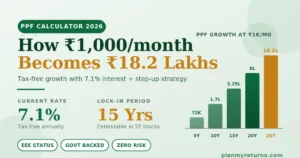
Why VPF beats PPF: Same EEE tax status, but VPF earns 8.25% vs PPF’s 7.1%. Plus, no ₹1.5 lakh annual cap on VPF (PPF has this limit). However, the ₹2.5 lakh tax-free interest threshold applies to combined EPF + VPF.
Her VPF alone over 28 years will add approximately ₹1.3 crore to her retirement corpus.
See exactly how much VPF can boost your retirement corpus.
Compare EPF-only vs EPF+VPF projections side by side.
EPF vs Other Retirement Options Compared
Compare your projections across schemes. Use the PPF Calculator, NPS Calculator, and EPF Calculator together to plan your complete retirement portfolio.
EPF Withdrawal Rules: When and How Much
One of EPF’s biggest advantages is partial withdrawal flexibility. You do not have to wait until age 58 for emergencies.
Critical warning: Withdrawing EPF before completing 5 continuous years of service makes the entire amount taxable. Employer contribution and interest get added to your salary income. Even your 80C tax savings from prior years get reversed. Always transfer EPF to your new employer instead of withdrawing.
5 EPF Mistakes That Cost You Lakhs
Mistake 1: Not transferring EPF when changing jobs. Most employees withdraw EPF when switching jobs. Big mistake. Withdrawal before 5 years is taxable, and you lose decades of compounding. Always file Form 13 to transfer EPF using your UAN.
Mistake 2: Ignoring UAN linking. Your Universal Account Number connects all your EPF accounts across employers. Without UAN linking, you cannot transfer balance, withdraw online, or check balance via SMS. Activate it on the EPFO portal immediately.
Mistake 3: Not adding nominees. Without nominees registered on your UAN, your family will face legal hassles claiming your EPF after your death. Add nominees online through the e-nomination feature on the EPFO Member Portal.
Mistake 4: Choosing CTC structure that minimizes basic salary. Companies sometimes structure CTC with low basic and high allowances to reduce their EPF liability. This means lower retirement corpus for you. Negotiate for higher basic during job offers.
Mistake 5: Skipping VPF when possible. If you have surplus money after expenses and 80C limits, VPF earns 8.25% tax-free. Better than most safe options. Compare it with the Take Home Salary Calculator to check the impact on your monthly cash flow.
How to Check Your EPF Balance
EPFO offers four easy ways to check your balance and download passbook:
Plan Your Complete Retirement Strategy
EPF is the foundation of your retirement plan, not the entire plan. To retire comfortably, you need EPF + PPF + Equity (NPS or mutual fund SIP) working together. Use these calculators on PlanMyReturns to build your full retirement portfolio.
First, project your EPF corpus using the EPF Calculator. Then estimate how much more you need with the Retirement Calculator. Bridge the gap with a monthly SIP using the SIP Calculator. Add a guaranteed component via the PPF Calculator. And get the extra ₹50,000 tax benefit through the NPS Calculator.
Explore all free financial calculators at PlanMyReturns Calculators. Every calculation follows transparent methodology and assumptions you can verify.
Frequently Asked Questions: EPF Calculator 2026