A personal walkthrough from PlanMyReturns.com to guide you through your first salary slip, early tax choices, and first investments without the usual mistakes.
Get the Printable Companion Playbook
Download our complete, beautifully formatted 4-page PDF guide to keep on your desk or review with your family.
Download First Salary Playbook (PDF) →Congratulations on landing your job. Seeing that first salary text message feels great. Then you open your pay slip and wonder why only Rs. 44,038 showed up in your bank account when your offer letter said Rs. 50,000 a month (Rs. 6 LPA CTC).
Do not panic. Nobody took your money without reason. Sit with me for ten minutes, and let us look at where the missing Rs. 6,000 went together so you can make smart decisions right from month one.
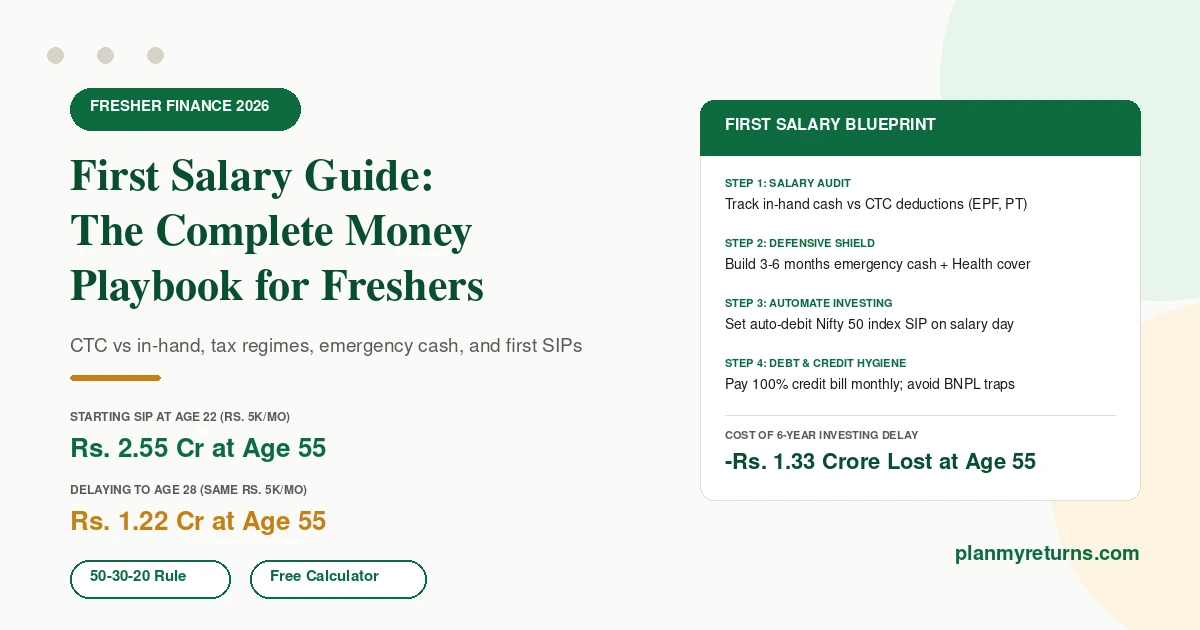
Our Core Golden Rule: Follow the order of financial defense before offense. Step 1: Audit your real in-hand salary cash. Step 2: Build a 3-month cash buffer in a high-yield account. Step 3: Secure an independent personal health cover. Step 4: Automate a monthly index fund SIP on salary day. Never buy insurance policies disguised as investment plans.
- Your in-hand salary is usually 75% to 85% of your CTC offer. Always budget using actual bank credits, not offer letter figures.
- Stick with the New Tax Regime if you earn under Rs. 10 lakh to Rs. 12 lakh. Income up to Rs. 7.75 lakh carries zero income tax.
- Build a 3 to 6 month emergency fund in liquid cash before investing a single rupee in the stock market.
- Buy personal health insurance now. Do not rely solely on your company cover, which terminates if you switch jobs or face layoffs.
- If you have zero financial dependents, skip term life insurance entirely until you have family members relying on your income.
- Starting a Rs. 5,000 monthly SIP at age 22 yields Rs. 2.55 Crore by age 55 at 12%. Waiting until age 28 yields only Rs. 1.22 Crore on the exact same monthly contribution.
- Pay 100% of your credit card bill every single month. Never pay the minimum due or carry balances at 40% interest.
Core Concepts Every Fresher Must Understand
Before allocating money, get clear on the core terms that govern your monthly pay and early wealth.
Decoding Your First Pay Slip: A Real Rs. 6 LPA CTC Example
Here is what an actual monthly pay slip looks like for an entry-level software engineer or corporate analyst with a Rs. 6,00,000 CTC package (Rs. 50,000 monthly gross):
| Component | Monthly Amount | Category | What This Means for You (PlanMyReturns Tools) |
|---|---|---|---|
| Basic Salary (40% of CTC) | Rs. 20,000 | Earnings | Your core pay. Used to calculate EPF, Gratuity, and HRA limits. |
| House Rent Allowance (HRA) | Rs. 10,000 | Earnings | If you pay rent for a PG or flat, this saves tax in the Old Regime. |
| Special / Flexible Allowance | Rs. 15,238 | Earnings | Fully taxable cash used by employers to balance your total CTC. |
| Employee EPF Share (12%) | -Rs. 2,400 | Deduction | Your retirement fund earning 8.25%. Track it with our EPF Calculator. |
| Employer EPF Share (12%) | -Rs. 2,400 | Deduction | Your employer matches your EPF, but they count it inside your CTC. |
| Gratuity Reserve (4.81%) | -Rs. 962 | Deduction | Retirement bonus payable after 5 years. Check our Gratuity Calculator. |
| Professional Tax (PT) | -Rs. 200 | Deduction | Standard state tax. You cannot avoid this in major employment states. |
| Income Tax (TDS) | Rs. 0 | Deduction | Zero tax under the New Tax Regime if earning below Rs. 7.75 lakh. |
| Actual Monthly In-Hand Cash | Rs. 44,038 | Bank Credit | Your real spendable cash. Audit yours on the Take Home Salary Calculator. |
Notice that nearly Rs. 6,000 disappears every month before your salary hits your account. Check your exact take-home pay using our Take Home Salary Calculator and calculate retirement growth with our EPF Calculator.
The Old vs New Tax Regime Decision for Freshers
Every fresher must submit a tax declaration form to their employer within the first 30 days of joining. The decision is straightforward:
Do not lock your early savings into 3-year ELSS funds or 15-year PPF accounts just to save tax if you earn under Rs. 7.75 lakh, because your tax liability is already zero. Compare both regimes for your specific numbers with our Old vs New Tax Regime Calculator.
The 4-Step Financial Defense Checklist
Build Your 3-Month Emergency Fund First
Before buying stocks or mutual funds, calculate your bare minimum monthly survival cost: rent, groceries, basic bills, and travel. Multiply that by three. If your monthly expenses are Rs. 25,000, your target buffer is Rs. 75,000. Keep this cash in a sweep-in fixed deposit or a separate bank account. Calculate your exact buffer with our Emergency Fund Calculator.
Buy Personal Health Insurance Immediately
Most freshers assume their corporate employer medical card is sufficient. If you get laid off or quit to take a sabbatical, your employer health cover vanishes immediately. Buying a personal Rs. 10 lakh to Rs. 15 lakh base health cover at age 22 costs very little per year, carries zero waiting period issues later, and protects you against sudden hospital bills.
Skip Term Insurance Unless You Have Dependents
If your parents are financially secure and nobody depends on your monthly income, do not buy life insurance yet. If your parents took loans for your education or rely on you for household expenses, buy a pure term insurance policy equal to 15 times your annual income. Check coverage requirements with our Term Insurance Calculator. Never buy ULIPs or endowment plans pitched by bank staff.
Automate One Nifty 50 Index SIP on Salary Day
Do not wait until the end of the month to invest what is left over, because nothing will be left over. Set an automatic monthly SIP mandate for the 2nd or 3rd of each month, right after salary credit. Direct that money into a broad Nifty 50 index mutual fund with a direct growth plan.
First Salary Budget & Wealth Planner
Enter your monthly in-hand salary to calculate an ideal 50-30-20 budget split and see your projected wealth from early investing.
Wealth projection assumes 30% of your salary is invested monthly into an equity index fund compounding at 12% annualized returns until age 55. Mutual fund investments are subject to market risks.
Model custom monthly SIP growth in the SIP Calculator → | See your road to 1 Crore in the Crorepati Calculator →
The True Cost of Waiting: Age 22 vs Age 28
Many young earners say: “I will enjoy my salary for five or six years, and start investing seriously when I turn 28.” Look at what that 6-year delay actually costs you on a modest Rs. 5,000 monthly SIP compounding at 12% until age 55:
Person B saved only Rs. 3.6 lakh less in out-of-pocket deposits, but ended up with Rs. 1.33 Crore less wealth at retirement. Time in the market matters far more than timing the market. Test different goals with our Crorepati Calculator.
Credit Cards and CIBIL Score Hygiene
A credit card is a powerful tool to establish a high credit score, provided you follow two rules:
| Rule | The Mistake Freshers Make | What You Must Do Instead |
|---|---|---|
| 1. Total Bill Payment | Paying the “Minimum Amount Due” shown on statement | Always pay the full “Total Amount Due” before due date. Minimum due charges 36% to 42% annual interest |
| 2. Credit Utilization Ratio | Maxing out the entire credit limit on gadgets or travel | Keep monthly spends under 30% of your total credit limit to maintain a CIBIL score above 750 |
| 3. BNPL Schemes | Treating Buy Now Pay Later apps as free money | Avoid no-cost EMI splurges that report multiple small loan lines to credit bureaus |
| 4. Card Upgrades | Paying high annual fees on lifestyle cards you do not need | Stick to lifetime-free cards or entry-level cashback cards with zero maintenance fees |
Upgrading Your SIP as Salary Grows: When you receive your first appraisal or switch jobs, avoid doubling your rent or buying luxury items immediately. Use a Step-Up SIP to raise your monthly investment by 10% each year. A Rs. 5,000 monthly SIP stepped up by 10% annually grows to Rs. 4.42 Crore over 30 years compared to Rs. 1.76 Crore for a flat SIP. Run the numbers in our SIP Calculator and track your net worth progress with our Net Worth Calculator.
Ready to take full control of your finances? Explore over 45 free calculators for salary, investments, taxes, and retirement.
Explore All Calculators on PlanMyReturns.comThe 3 Biggest Traps to Avoid in Your First Year
| Financial Trap | Why It Hurts You | Better Alternative |
|---|---|---|
| Buying a Vehicle on Heavy EMI | Depreciating asset that locks up 20% to 30% of your monthly cash flow right after probation | Use public transport or rideshares for year one until your emergency fund is complete |
| Bank Staff Selling Mixed Policies | Bank relationship managers sell ULIPs or guaranteed endowment plans with high commissions | Keep insurance and investments completely separate. Buy pure term and index funds |
| Lifestyle Creep Without Tracking | Upgrading dining, gadgets, and housing to match every salary increment | Save at least 50% of every bonus or salary increment before expanding lifestyle costs |
Please Note: This guide provides financial education for young working professionals in India and does not constitute registered financial advisory services. Mutual fund investments carry market risks. Always verify scheme offer documents and consult a SEBI-registered investment advisor for tailored personal planning.
Why is my in-hand salary lower than my CTC offer letter?
Cost to Company (CTC) includes expenses your employer incurs on your behalf that never reach your bank account directly. This includes the employer’s 12 percent EPF contribution, gratuity provisioning (roughly 4.81 percent of basic pay), annual performance bonuses, and group insurance premiums. Your monthly in-hand salary subtracts both the employee and employer deductions, plus professional tax and income tax TDS.
Which tax regime should a fresher choose in India?
Most freshers earning up to Rs. 10 lakh to Rs. 12 lakh per year benefit more from the New Tax Regime. Under current rules, income up to Rs. 7.75 lakh (including the Rs. 75,000 standard deduction) is completely tax-free due to the Section 87A rebate. Choosing the new regime means you do not have to lock your early savings into 80C insurance policies or ELSS just to avoid tax.
How much money should a fresher keep in an emergency fund?
Set aside three to six months of your actual basic living expenses, including rent, food, transport, and family support commitments. Keep this money in a separate high-interest savings account, a sweep-in fixed deposit, or a liquid mutual fund. Never invest emergency money into equity stocks or lock it into long-term schemes.
Do I need term life insurance if I am single with no dependents?
No. Pure term life insurance is designed to replace your income for people who rely on your earnings to survive. If your parents are financially independent and you have no spouse, children, or joint loans, you do not need term insurance yet. You only need personal health insurance. Buy term insurance later when someone becomes financially dependent on your salary.
Where should a beginner invest their first mutual fund SIP?
Start with a simple, low-cost Nifty 50 index fund or a large-cap index fund through an automatic monthly SIP. Avoid thematic or sectoral funds that chase recent hype. An index fund spreads your money across India’s top 50 companies with very low expense ratios, giving you solid long-term equity growth without stock-picking stress.
Should freshers get a credit card?
Yes, taking one entry-level lifetime-free credit card helps build your credit score (CIBIL), which reduces loan interest rates when you buy a house or car later. Follow two non-negotiable rules: always pay the entire Total Amount Due before the due date (never pay the minimum amount), and keep your monthly card spends below 30 percent of your total credit limit.