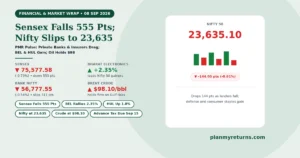
Today’s Overview: Indian stock markets took a breather after four days of gains, as investors cashed in profits on real estate and bank shares. While worries over US-Iran conflict pushed crude oil up +2.9% to $86/barrel, foreign investors kept buying Indian shares (+₹2,446 Cr). Strong profit reports from Bharti Airtel (+37%) and ONGC (+112%) helped cushion the fall before the RBI interest rate decision.
Today’s Top Finance Stories
1. Why Did the Sensex Rise 152 Points While Nifty Ended Flat on 5 August 2026?
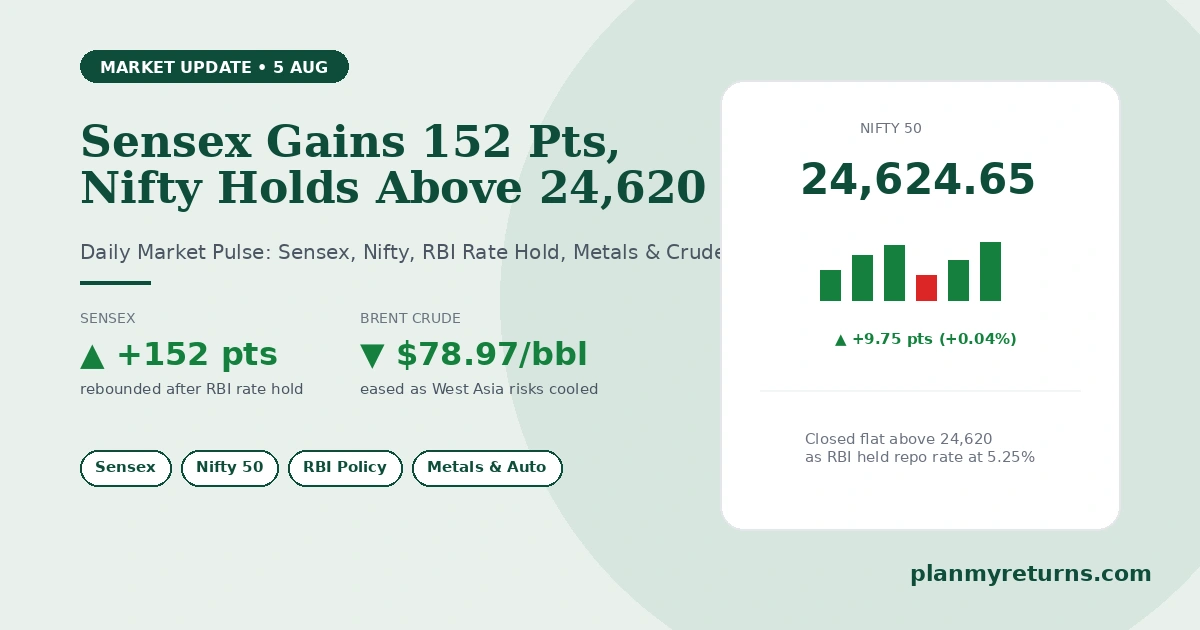
What happened: Indian stock market benchmarks recovered from early morning dips on Wednesday. The BSE Sensex rose +152.05 points (+0.19%) to close at 78,581.00, while the Nifty 50 closed mildly positive, gaining +9.75 points (+0.04%) to finish at 24,624.65. Sectoral gains in metals and auto offset mild profit-taking in IT and private banks.
Why does it matter: Markets stabilized following Tuesday’s brief pull-back. Investors who track portfolio growth can use a SIP Calculator or calculate portfolio rebalancing with our Stock Average Calculator during steady market consolidation.
Key Takeaway: Mild market gains after central bank announcements indicate steady investor confidence and healthy sector rotation.
2. How Does the RBI Repo Rate Hold Impact Home Loans and Fixed Deposits?
What happened: The Reserve Bank of India Monetary Policy Committee (MPC) unanimously decided to keep the benchmark repo rate unchanged at 5.25% for the fifth consecutive meeting. RBI Governor highlighted that domestic growth remains resilient while retail inflation continues to cool toward target levels.
Why does it matter: A status quo on repo rates ensures borrowing costs remain predictable. Existing home loan borrowers with floating interest rates will see steady EMIs. Homebuyers can check EMI schedules using a Home Loan EMI Calculator, while fixed-deposit investors can compare guaranteed yields with a .
Key Takeaway: Unchanged RBI interest rates protect borrowers from unexpected EMI hikes while keeping fixed deposit interest rates stable.
3. Why Did Crude Oil Fall Below $80/barrel, and How Did It Boost the Rupee?
What happened: Global benchmark Brent crude oil prices dropped -0.49% to trade at $78.97 per barrel, sliding below the critical $80 mark as Middle East geopolitical tensions cooled slightly. Easing oil prices boosted domestic currency sentiment, strengthening the Indian Rupee by +0.35% to 95.07 against the US Dollar.
Why does it matter: Lower international crude prices directly reduce India’s import bill and lessen fuel cost pressures on domestic logistics, paints, and airlines. Readers can assess the long-term impact of cooling prices on household budgets using an Inflation Calculator.
Key Takeaway: Cheaper crude oil helps strengthen the Indian Rupee and lowers risk pressures on domestic inflation.
4. Why Did Metal and Auto Stocks Rally While IT Shares Slumped?
What happened: Sector rotation was evident on 5 August. Nifty Metal rallied +1.50% led by Hindalco Industries and JSW Steel, while Nifty Auto gained +1.27% on strong festive sales volume forecasts from Hero MotoCorp. Conversely, IT stocks slipped -0.16% led lower by TCS and HCL Technologies.
Why does it matter: Metals gained from firming global industrial demand, while automobile makers benefited from cooling input commodity costs. Auto buyers evaluating vehicle financing can check monthly costs using a Car Loan Calculator.
Key Takeaway: Money flowing out of defensive IT stocks into cyclical metals and auto shares reflects healthy sector rotation in the stock market.
5. Policy and Global Watch: US Trade Statements, FII Buying and Tax Bill
What happened: Foreign Institutional Investors (FIIs) remained strong net buyers in Indian cash equities on 5 August, extending their net buying streak for a seventh straight session with purchases exceeding +₹1,800 crore. Globally, European markets touched multi-week highs following optimistic trade comments from the Trump administration, while Asian equities traded mixed.
Why does it matter: Sustained foreign capital inflows highlight global investor confidence in India’s macroeconomic stability. Individual taxpayers reviewing their annual tax planning can compare deductions under both regimes using the Old vs New Tax Regime Calculator.
Key Takeaway: Seven consecutive days of foreign institutional buying demonstrate solid global confidence in Indian markets.
6. Q1 Earnings Spotlight: Why Did Bombay Stock Exchange (BSE) Net Profit Jump 66%?
What happened: Financial market exchange BSE Limited posted outstanding Q1 FY27 results on 5 August. Consolidated net profit surged +66% YoY to ₹873 crore, driven by a 63% revenue growth to ₹1,707 crore following record trading volumes across cash and equity derivative segments.
Why does it matter: Strong profitability across financial exchange platforms reflects record retail participation in mutual fund SIPs and equity trading. Investors planning one-time investments can project long-term wealth using a Lumpsum Calculator.
Key Takeaway: Record financial exchange revenue underscores expanding retail investor participation across Indian capital markets.
Market Snapshot
Equity figures are official closing levels for 5 August 2026. Gold and silver rates shown are indicative 24K retail reference rates (10g and 1kg). Note that retail gold and silver prices vary across cities (e.g., Mumbai, Delhi, Chennai, Hyderabad, Bengaluru) due to local taxes/octroi, transportation costs, and jeweller margins. Crude and currency reflect round-the-clock evening rates.
Top Gainers & Losers Nifty 50, 5 August 2026
▲ Top 5 Gainers
- Hindalco Industries +3.20%
Led Nifty gainers on non-ferrous metals buying.
- Shriram Finance +2.85%
Rose on strong commercial vehicle loan demand.
- Hero MotoCorp +2.40%
Gained on positive festive season sales expectations.
- Grasim Industries +2.10%
Rebounded sharply following Tuesday’s pull-back.
- NTPC +1.85%
Advanced on steady power sector buying.
▼ Top 5 Losers
- TCS -1.95%
Dragged down IT stocks on global tech profit-booking.
- Apollo Hospitals -1.80%
Slipped on mild profit-taking after earlier rally.
- HCL Technologies -1.60%
Eased alongside wider IT index weakness.
- HDFC Bank -1.25%
Weighed on Bank Nifty ahead of policy commentary.
- Tech Mahindra -1.10%
Slipped in line with broader IT sector consolidation.
Monetary Policy Committee (MPC)
Meaning: The Monetary Policy Committee (MPC) is a six-member committee of the Reserve Bank of India responsible for setting benchmark interest rates (repo rate) to maintain price stability and economic growth.
Example: The RBI Monetary Policy Committee voted to keep the repo rate unchanged at 5.25% on 5 August 2026, keeping home loan EMIs steady.
Plan Your Financial Strategy with PlanMyReturns Tools
Explore free financial calculators to plan long-term investments, calculate loan EMIs, and optimize tax outflows:
- Home Loan EMI Calculator: Estimate monthly installments following the RBI repo rate decision
- FD vs RD Comparison Calculator: Compare fixed deposit returns against recurring deposits
- SIP Calculator: Calculate systematic investment returns for long-term wealth creation
- Old vs New Tax Regime Calculator: Compare annual tax liabilities under both tax systems
- Inflation Calculator: Estimate the impact of changing prices on household purchasing power
About PMR Pulse
PMR Pulse is PlanMyReturns’ daily educational market wrap designed to help beginner Indian investors understand why equity markets moved, how global events impact domestic finances, and how to make informed wealth creation decisions.
Disclaimer: Content on PMR Pulse is provided for general informational and educational purposes only and does not constitute financial or investment advice. Read our full disclaimer.