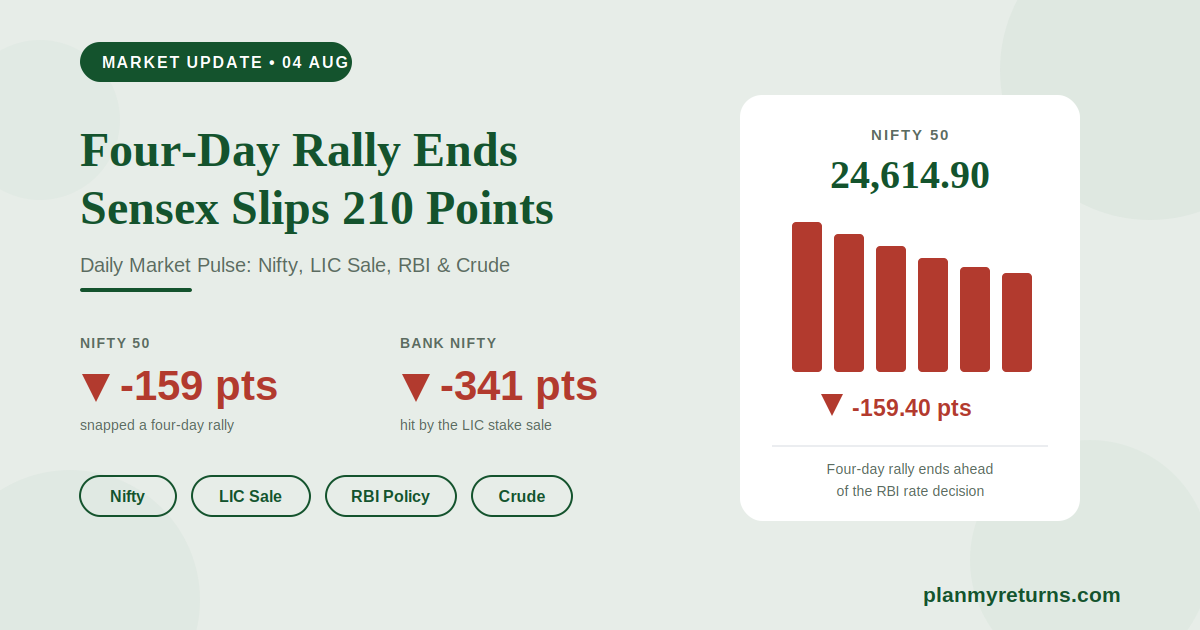
Today’s Overview: Markets fell after four days of gains. The Sensex slipped 210 points (-0.27%) to 78,428 and the Nifty lost 159 points (-0.64%) to 24,615. A new closing mechanism caused sharp swings, the government’s LIC stake sale hit financials, and nerves rose before the RBI rate decision. Metals were the only sector to gain.
Today’s Top Finance Stories
1. Why Did the Sensex and Nifty Snap Their Four-Day Winning Streak?
What happened: The Sensex fell -210.08 points (-0.27%) to 78,428.95 and the Nifty 50 dropped -159.40 points (-0.64%) to 24,614.90. The Bank Nifty fell -340.75 points (-0.58%) to 57,907.20. It was the first fall after four straight up days. A striking 15 of 16 major sectors ended lower, with only metals rising.
Why does it matter: After a strong run, some pullback is normal as traders lock in profits. But today’s fall had specific triggers: a new market mechanism, a big government share sale, and nerves before the RBI’s rate decision. When a broad rally pauses, it often just means the market is catching its breath, not turning sour.
Key Takeaway: A single down day after a strong rally is usually healthy profit-booking, not a change in the market’s direction.
2. What Is the New Closing Auction Session (CAS), and Why Did It Rattle the Nifty?
What happened: This week the stock exchanges introduced a new Closing Auction Session for stocks that have futures and options contracts. Instead of the old method, a 20-minute auction starting at 3:15 PM now decides the closing prices. The change caused sharp, unusual swings, especially in the Nifty. In fact, Monday’s big late rally was partly driven by this new system, and some of that reversed today.
Why does it matter: A closing auction is a short window where buy and sell orders are matched to set a fair closing price. It is meant to improve price discovery, which is how the market finds the “right” price. New systems often cause a few volatile days as traders adjust. For long-term investors, these are temporary technical wobbles, not a reason to worry.
Key Takeaway: When exchanges change how prices are set, expect a few choppy sessions. The volatility usually settles as traders get used to the new rules.
3. Why Did LIC Shares Fall After the Government’s Stake Sale?
What happened: The government announced it would sell up to a 6.5% stake in Life Insurance Corporation (LIC), the country’s largest insurer, at a discount of about 10.9% to Monday’s closing price. LIC shares dropped sharply, and the selling spread to other financial and insurance names, dragging the whole financial-services sector -0.52% lower.
Why does it matter: When the government sells part of a company it owns, this is called disinvestment. Offering the shares at a discount tempts buyers, but it also pushes the market price down in the short term, because more shares are suddenly available. It is a common reason a big, stable stock can fall on a single day for reasons unrelated to its business.
Key Takeaway: A discounted government stake sale usually drags a stock down briefly, even when the underlying business is unchanged.
4. Why Did Realty and FMCG Stocks Lead the Fall?
What happened: Real-estate stocks were the day’s weakest, with the Nifty Realty index down -2.39%, led lower by DLF after soft pre-sales figures. Consumer-goods stocks also fell, with the FMCG index down -0.88%. Dabur dropped after India’s food regulator told it to stop selling certain products carrying unverified “100%” claims. Metals bucked the trend, with the Nifty Metal index up +0.91%, led by Hindalco.
Why does it matter: Two different forces were at work. Realty fell on weak business numbers and profit-booking, while Dabur fell on a regulatory order. It is a reminder that a company’s shares can move on rules and regulators, not just on sales and profits.
Key Takeaway: Regulatory action can move a stock as much as its earnings. It pays to watch both the business and the rulebook.
5. Why Did Brent Crude Rebound, and What Does It Mean for India?
What happened: Brent crude, the global oil benchmark, rebounded about +2.9% to around $86.20 a barrel, recovering after a sharp fall the previous session. The bounce came on renewed worries about shipping near the Strait of Hormuz, a vital route for the world’s oil. Energy stocks in India ended -0.31% lower.
Why does it matter: India imports most of the oil it uses, so costlier crude widens the import bill, pressures the rupee and adds to inflation. It also squeezes fuel-heavy industries like airlines, paints and logistics. A rebound in oil is a nudge to watch prices closely in the weeks ahead.
Key Takeaway: Oil is India’s biggest import. Even a one-day rebound in crude can weigh on the rupee, inflation and fuel-dependent sectors.
6. Policy and Global Watch: The RBI Decision, a New Tax Bill and Foreign Buying
What happened: A scan of the big-picture triggers. The Reserve Bank of India (RBI) is meeting this week and is widely expected to keep its key repo rate unchanged at 5.25% while it watches inflation, oil prices and the monsoon. On policy, the government has proposed a new Taxation and Other Laws (Amendment) Bill aimed at attracting global capital and boosting manufacturing. Foreign investors (FIIs) stayed net buyers of Indian shares for a sixth straight session. Globally, European markets touched record highs, while Asian markets were mixed.
Why does it matter: These forces shape the whole market. Steady RBI rates keep your home loan EMI and deposit rates stable, a friendlier tax law can pull in foreign money over time, and steady foreign buying supports both shares and the rupee. We will flag any change the moment it happens.
Key Takeaway: Central bank decisions, tax policy and foreign flows drive the market’s big moves. Keep one eye on all three.
Market Snapshot
Equity figures are official closing levels for 4 August 2026. Gold, silver, crude and currency reflect rates reported through the evening; confirm these closer to 7 PM IST as they trade round the clock. Gold and silver are retail reference rates that vary by city.
Top Gainers & Losers Nifty 50, 4 August 2026
▲ Top Gainers
- Apollo Hospitals +2.61%
Led the Nifty on renewed healthcare buying.
- Hindalco Industries +2.52%
Powered the metals sector, the day’s only gainer.
- Trent +1.89%
Rose on buying in retail and consumption stocks.
▼ Top Losers
- Grasim Industries -3.74%
Biggest faller on profit-booking after a sharp rise.
- HDFC Life -3.10%
Fell with the wider insurance sell-off.
- Bajaj Auto -2.16%
Dropped as profit-booking hit auto stocks.
Repo Rate
Meaning: The repo rate is the interest rate at which the Reserve Bank of India lends money to banks. It is the RBI’s main tool to control inflation. When the repo rate goes up, loans get costlier; when it comes down, borrowing gets cheaper.
Example: The RBI is expected to hold the repo rate at 5.25% this week. If it does, your home loan EMI and fixed-deposit rates are likely to stay roughly where they are.
Next Session to Watch
- The RBI’s interest rate decision, due this week, and its tone on inflation.
- Whether the new closing auction keeps causing volatility or settles down.
- How LIC shares trade as the government’s stake sale proceeds.
- Brent crude, which rebounded above $86 on Middle East tensions.
- The HSBC manufacturing PMI and key US economic data due this week.
- Whether foreign investors extend their buying streak.
With the RBI set to decide on rates, see what it means for your loans and savings.
Plan with PlanMyReturns: work out your home loan EMI, check returns on a fixed deposit, or gauge rising prices with our inflation calculator.
Explore All CalculatorsThis article is for general information only and is not investment advice. Read our full disclaimer.