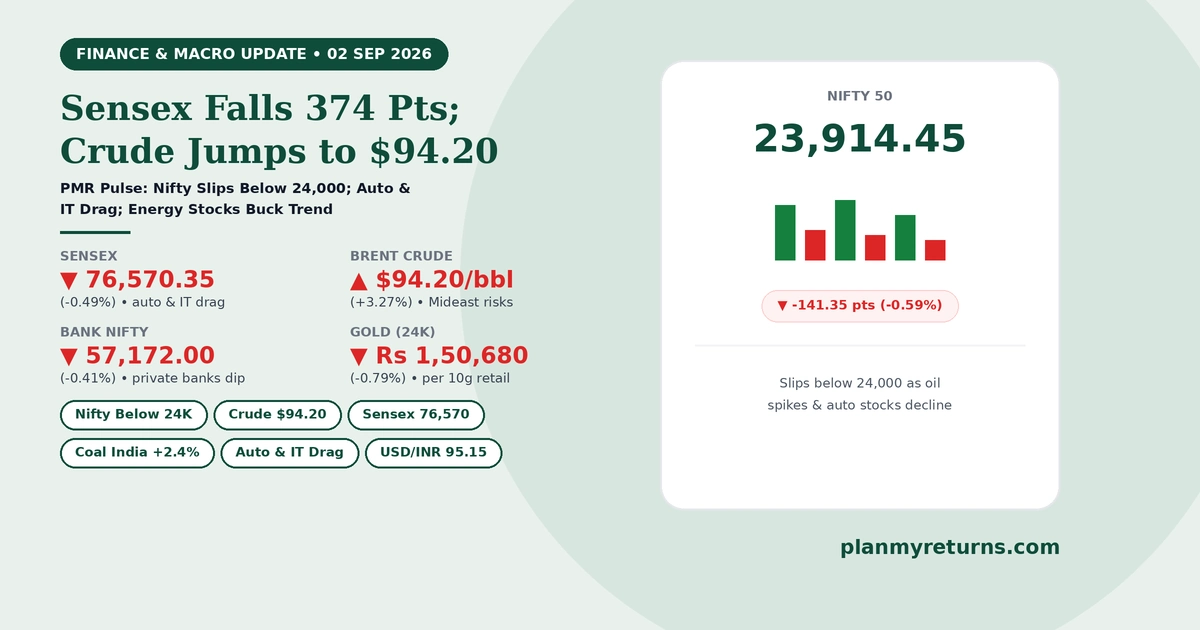
Today’s Overview: Indian stock markets closed lower on September 2, 2026, as Brent crude surging towards $94.20/barrel amid escalating Middle East hostilities triggered heavy selling in auto, paint, and IT stocks. The BSE Sensex fell 373.93 points to 76,570.35, while Nifty 50 slipped 141.35 points to 23,914.45. State-run energy producers Coal India and NTPC bucked the decline.
Today’s Top Finance & Economy Stories
1. Why Did Sensex Fall 374 Points and Nifty Slip Below 24,000 on 2 September 2026?
What happened: Indian benchmark equity indices faced renewed selling pressure on Wednesday as escalating geopolitical tensions in West Asia and sharp crude oil spikes rattled investor sentiment. The BSE Sensex dropped -373.93 points (-0.49%) to close at 76,570.35, while the Nifty 50 surrendered the psychological 24,000 level, falling -141.35 points (-0.59%) to settle at 23,914.45. Bank Nifty also declined -237.60 points (-0.41%) to 57,172.00.
Why does it matter: Higher international energy prices and post-monthly-dispatch profit booking across automotive and software exporters pushed headline indices below key technical support zones. Investors seeking to cost-average portfolio holdings during market corrections can project calculations with a Stock Average Calculator or maintain systematic equity discipline via a SIP Calculator.
Key Takeaway: Surging geopolitical energy risks dragged Nifty 50 below 24,000, testing technical support levels near 23,850.
2. How Does Brent Crude Surging Towards $94.20/barrel Impact Indian Stocks and Inflation?
What happened: International Brent crude oil prices spiked +3.27% to $94.20 per barrel on 2 September following reports of renewed military strikes and commercial tanker security alerts in the Middle East. The Indian Rupee traded soft near 95.15 against the US Dollar as oil refiners stepped up foreign exchange purchases.
Why does it matter: India imports more than 85% of its crude oil requirements; elevated oil prices directly inflate import bills, widen the trade deficit, and compress operating margins for fuel-heavy consumer sectors like paints (Asian Paints fell -2.20%) and airlines (InterGlobe Aviation fell -1.80%). Households estimating the real impact of commodity price changes on living expenses can track projections using an Inflation Calculator.
Key Takeaway: Crude oil heading towards $95 per barrel presents an acute cost-inflation headwind for domestic industrial, paint, and aviation businesses.
3. Why Did Auto and Information Technology Shares Lead Market Losses Today?
What happened: Automotive and software shares led sectoral losses on 2 September: two-wheeler maker Eicher Motors tumbled -3.10% to ₹7,760.00 following profit taking post August dispatch figures. In IT, Wipro declined -2.45% and Infosys fell -1.95% to ₹1,064.00, pulling the Nifty IT index down 1.2%.
Why does it matter: After sharp post-sales rallies on Tuesday, institutional funds locked in short-term profits in auto counters, while global enterprise discretionary IT spending caution continued to weigh on tech exporters. Long-term investors evaluating lump-sum allocations during sector corrections can project compounding returns using a Lumpsum Calculator.
Key Takeaway: Post-monthly dispatch profit taking in auto leaders and valuation reassessments in IT exporters drove the benchmark drop.
4. What Drove Coal India, NTPC, and Energy Stocks to Buck the Downward Trend?
What happened: State-owned energy and mining heavyweights bucked market weakness on Wednesday: state miner Coal India surged +2.40% to ₹320.00 to top Nifty 50 gainers, power utility NTPC rose +1.85% to ₹392.50, and upstream oil producer ONGC gained +1.50% to ₹317.10. Metal leader Tata Steel also added +1.20%.
Why does it matter: Higher international energy benchmarks directly expand realization revenues for domestic fossil fuel extractors and integrated power generators. Wealth builders setting long-term investment goals can calculate projected corpus growth with a Step-Up SIP Calculator.
Key Takeaway: Upstream energy producers and power utilities provided essential counter-cyclical resistance against broader market declines.
5. Mutual Funds & Volatility: How Should Systematic Investors Approach Nifty Falling Below 24,000?
What happened: With the Nifty 50 declining below 24,000 to 23,914 on Wednesday, institutional investment advisors urged retail investors to avoid panic redemptions and continue regular monthly SIPs to benefit from rupee cost averaging at lower equity valuations.
Why does it matter: Historically, buying during market drawdowns lowers the average acquisition cost of equity mutual fund units, enhancing terminal wealth compounding when market cycles recover. Taxpayers evaluating tax-efficient annual savings can compare regime liabilities with an Old vs New Tax Regime Calculator.
Key Takeaway: Short-term index dips below key psychological levels provide long-term disciplined SIP investors with superior unit accumulation opportunities.
Comprehensive Finance, Policy & Market Updates
Macroeconomic & Global Energy Updates
- Global Crude Surge: Brent crude jumped 3.27% to $94.20 per barrel following Middle East commercial shipping disruption concerns.
- Currency Movement: Indian Rupee traded at 95.15 against the US Dollar as oil import dollar demand increased.
- Primary Market Listings: Tempsens Instruments (India) Ltd completed all allotment formalities ahead of its scheduled debut on BSE and NSE on September 3.
- Institutional Money Flows: Domestic Institutional Investors (DIIs) provided net buying support in the cash equity segment, cushioning Foreign Institutional Investor (FII) sales.
Corporate, Banking & Stock Buzzers
- Coal India & NTPC: Surged +2.40% and +1.85% respectively, leading Nifty 50 gainers on energy demand.
- ONGC & Tata Steel: Advanced +1.50% and +1.20% as industrial commodities attracted buying.
- Eicher Motors: Slipped -3.10% to ₹7,760, leading Nifty decliners on post-dispatch profit taking.
- Wipro & Infosys: Dropped -2.45% and -1.95% as Nifty IT fell 1.2%.
- Asian Paints: Fell -2.20% to ₹2,570 as crude oil surged towards $94.20/bbl.
- InterGlobe Aviation (IndiGo): Declined -1.80% on rising aviation turbine fuel costs.
Market & Macro Snapshot
Equity and macroeconomic figures reflect official releases as of 2 September 2026. Indicative 24K retail bullion reference rates: Gold ₹1,50,680/10g and Silver ₹2,38,500/1kg. Note that retail gold and silver prices vary across cities due to local taxes and jeweller margins. Crude and currency reflect round-the-clock rates.
Top Gainers & Losers Nifty 50, 2 September 2026
▲ Top 5 Gainers
- Coal India +2.40%
₹320.00 | Led Nifty gainers on rising thermal power demand.
- NTPC +1.85%
₹392.50 | State power utility bucked market weakness.
- ONGC +1.50%
₹317.10 | Upstream realization gains as crude tops $94.
- Tata Steel +1.20%
₹188.50 | Steady buying in core industrial metal makers.
- Hindalco Industries +0.95%
₹1,048.20 | Supported by global aluminium pricing power.
▼ Top 5 Losers
- Eicher Motors -3.10%
₹7,760.00 | Led Nifty decliners on post-sales profit booking.
- Wipro -2.45%
₹460.50 | IT exporters faced institutional selling.
- Asian Paints -2.20%
₹2,570.00 | Raw material margin worries as crude surges.
- Infosys -1.95%
₹1,064.00 | Slipped alongside software export peers.
- InterGlobe Aviation (IndiGo) -1.80%
₹5,070.00 | Aviation turbine fuel cost pressures.
Input Cost Pressure
Meaning: Input Cost Pressure refers to the squeeze on corporate profit margins that occurs when the prices of basic raw materials (such as crude oil, minerals, or electricity) increase sharply before companies can pass those higher costs on to end consumers.
Example: Brent crude surging to $94.20 per barrel created severe input cost pressure for paint and airline companies on 2 September 2026.
Frequently Asked Questions
Why did the Sensex and Nifty fall on 2 September 2026?
The BSE Sensex fell 373.93 points (-0.49%) to 76,570.35 and Nifty slipped 141.35 points (-0.59%) to 23,914.45 as Brent crude jumped towards $94.20/barrel amid Middle East hostilities, triggering heavy selling in auto, paint, and IT stocks.
Which sectors bucked the downward market trend today?
State-run energy and mining stocks outperformed, led by Coal India (+2.40%), NTPC (+1.85%), and ONGC (+1.50%), as higher global commodity prices boosted revenue realizations.
How does crude oil at $94.20 impact paints and airlines?
Crude oil derivatives make up over 50% of raw material costs for paint manufacturers like Asian Paints (-2.20%) and directly increase aviation turbine fuel (ATF) expenses for airlines like IndiGo (-1.80%), compressing profit margins.
Upcoming Market & Economic Catalysts to Watch
- India Services PMI: S&P Global India Services PMI data due on September 3.
- Tempsens Instruments Listing: Stock market listing on BSE and NSE scheduled for September 3.
- West Asia Geopolitical Developments: Monitoring shipping lanes in the Strait of Hormuz and global crude oil prices.
Plan Your Financial Strategy with PlanMyReturns Tools
Explore free financial calculators to plan long-term investments, calculate loan EMIs, and optimize tax outflows:
- SIP Calculator: Calculate systematic investment returns for long-term wealth creation
- Stock Average Calculator: Calculate average share purchase costs during stock market consolidations
- Home Loan EMI Calculator: Estimate monthly installments and interest schedules on home loans
- Old vs New Tax Regime Calculator: Compare annual tax liabilities under both tax regimes
- Inflation Calculator: Estimate the impact of changing prices on household purchasing power
About PMR Pulse
PMR Pulse is PlanMyReturns’ daily educational finance wrap designed to help beginner Indian investors understand macroeconomic indicators, government schemes, mutual funds, and market movements to make informed wealth creation decisions.
Disclaimer: Content on PMR Pulse is provided for general informational and educational purposes only and does not constitute financial or investment advice. Read our full disclaimer.