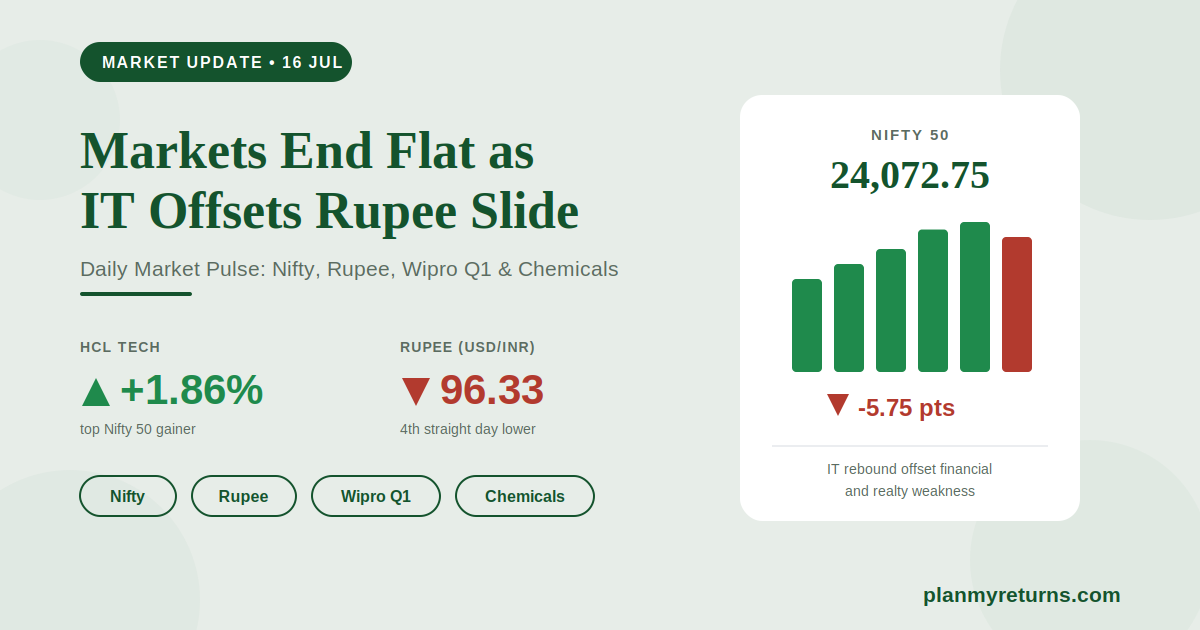
Today’s Overview: Markets ended flat. The Nifty 50 slipped 5.75 points (-0.02%) and the Sensex was almost unchanged, up 1.44 points. A rebound in IT stocks like HCL Tech and Wipro offset weak financials, banks and realty. The Rupee eased to a fresh low near 96.33, a fourth straight fall, as oil held above $85.
Today’s Top Finance Stories
1. Sensex, Nifty End Flat as an IT Rebound Offsets Weak Financials and Realty
What happened: The Sensex closed almost unchanged at 77,186.87, up a marginal +1.44 points (+0.00%), and the Nifty 50 dipped -5.75 points (-0.02%) to 24,072.75. Bank Nifty fell -0.30% to 57,582.25. IT, Auto, Consumer Durables and Chemicals ended higher, while Realty, Banks and Financial Services dragged. Broader markets were softer, with the Nifty Midcap 100 down -0.29% and the Smallcap 100 down -0.41%.
Why does it matter: A flat headline number can hide a lot of movement underneath. On a day like this, money simply rotated out of banks and property stocks and into technology, so the index barely moved even though individual sectors swung 1% or more either way.
Key Takeaway: A flat index is not always a quiet day. Check which sectors rose and fell to see where investors are actually shifting their money.
2. Rupee Slides to a Fresh Low Near 96.33, Its Fourth Straight Fall
What happened: The Rupee weakened about 8 paise to settle near 96.33 against the US Dollar, a fresh low and its fourth fall in a row. Elevated crude oil prices, renewed US-Iran tensions and continued foreign selling all pushed the currency lower. A higher USD/INR number means each Dollar now costs more Rupees, so the Rupee is getting weaker.
Why does it matter: A weaker Rupee makes everything India imports, from crude oil to electronics to foreign education, more expensive. That feeds through to prices at home, which is why a sliding Rupee often shows up later as higher inflation.
Key Takeaway: When USD/INR rises, the Rupee is weakening. A steady climb like this quietly raises the cost of imported goods and overseas expenses.
3. Government Lets Petrochemical Import Duties Return, Chemical Stocks Shine
What happened: A full customs duty exemption on around 40 critical petrochemical products, in place since April to ease supply during the West Asia crisis, expired on 15 July and was not extended. With normal import duties back from 16 July, domestic chemical makers face less competition from cheap imports. Chemicals were among the day’s best performing spaces.
Why does it matter: An import duty is a tax on goods brought in from abroad. When it returns, imported petrochemicals become costlier, so buyers turn to Indian producers instead. That is good for local chemical companies but can nudge up input costs for industries like plastics, packaging and textiles that use these materials.
Key Takeaway: A duty coming back helps domestic producers of that product, but often raises costs for the industries that buy it. Policy changes create winners and losers.
4. IT Stocks Lead the Market as Wipro and HCL Tech Rebound
What happened: Information technology was the standout sector. HCL Tech rose +1.86%, ending as the top Nifty 50 gainer, while Wipro added +1.74% and Tech Mahindra and Infosys also closed higher. Buyers stepped in on beaten-down IT names ahead of Wipro’s results, which were due after the closing bell.
Why does it matter: IT is one of India’s biggest export sectors, and it earns in Dollars. A weaker Rupee actually helps here, because the same Dollar revenue converts into more Rupees. That currency tailwind, plus bargain buying after a soft run, drove the rebound.
Key Takeaway: A falling Rupee hurts importers but helps exporters like IT firms. The same news can be a headwind for one sector and a tailwind for another.
5. Brent Crude Holds Near $85 as the US-Iran Truce Breaks Down
What happened: Brent crude, the global oil benchmark, held around $85 a barrel after a three-day rally. The interim US-Iran peace deal effectively collapsed, with both sides trading accusations and fresh threats to shipping through the Strait of Hormuz, a narrow sea route that carries a large share of the world’s oil.
Why does it matter: India imports most of the oil it uses, so costlier crude widens the import bill, pressures the Rupee and adds to inflation risk. For now, state fuel retailers have kept petrol and diesel prices steady, absorbing the pressure rather than passing it to pumps.
Key Takeaway: Oil is India’s single most important imported commodity. When crude climbs and stays there, the effects eventually reach the Rupee, prices and your monthly budget.
6. Global Cues: Asian Markets Slide, US Producer Prices Cool
What happened: Asian markets were weak. Japan’s Nikkei fell sharply and South Korea’s Kospi dropped after its central bank raised interest rates, warning about sticky inflation. Hong Kong and Taiwan bucked the trend on tech buying. In the US, softer June producer price data (a measure of factory-gate prices) eased some inflation worries overnight.
Why does it matter: Indian markets rarely move in isolation. Weak overnight cues from Asia and the US shape how foreign investors feel about risk, which in turn affects their buying and selling in India and adds to pressure on the Rupee.
Key Takeaway: Global markets set the mood before India even opens. Watching Asian and US moves helps explain why our indices behave the way they do.
Today’s Q1 Results
A simple summary of the major June-quarter (Q1 FY27) result announced around today’s session.
Wipro
Wipro announced its results after the market closed on 16 July, so the numbers were not part of today’s trading. Consolidated net profit was nearly flat at about Rs 3,356 crore, up only +0.6% year-on-year and down -4.7% from the previous quarter. Revenue rose +10.6% year-on-year to Rs 24,479 crore. The board declared an interim dividend of Rs 2 per share, record date 27 July, payable by 14 August. The profit and revenue fell just short of analyst estimates, and operating margin narrowed to about 16%, hit by salary hikes and fresh investments. Its effect on the stock will show up in the next session.
Market Snapshot
Equity and Bank Nifty figures are official closing levels for 16 July 2026. Gold, silver, crude, currency and crypto reflect rates reported through the evening; confirm crypto and commodity levels closer to 7 PM IST as these trade round the clock. Gold and silver day changes are shown qualitatively where an exact close was not confirmed. Petrol and diesel are Mumbai retail rates; check local rates in your city as these vary by state taxes.
Top 5 Gainers & Losers Nifty 50, 16 July 2026
▲ Top Gainers
- HCL Technologies +1.86%
Top Nifty 50 gainer, leading the day’s IT rebound.
- InterGlobe Aviation (IndiGo) +1.82%
Rose on stock-specific buying despite firm oil prices.
- Wipro +1.74%
Gained ahead of its after-market Q1 results.
- Maruti Suzuki +1.59%
Auto stocks held up as the sector traded higher.
- Bajaj Finance +1.49%
Bucked the wider financial-sector weakness.
▼ Top Losers
- Eternal (Zomato) -3.10%
The day’s biggest loser on the Nifty 50.
- SBI Life Insurance -2.27%
Insurance names led the financial-sector selling.
- Bajaj Finserv -1.06%
Tracked broader weakness in financial services.
- Bharat Electronics (BEL) -0.96%
Defence stocks eased as investors booked profits.
- HDFC Bank -0.86%
Banking heavyweights dragged the index lower.
Constant Currency (CC)
Meaning: Constant currency is a way of measuring a company’s growth after stripping out the effect of changing exchange rates. IT firms like Wipro earn a lot in Dollars, so a weaker or stronger Rupee can flatter or hurt the reported numbers. Constant currency shows the true underlying growth.
Example: If Wipro’s revenue looks up 10% in Rupees but only 1% in constant currency, most of that gain came from a weaker Rupee, not from selling more services. That is why analysts watch the constant currency figure closely.
Next Session to Watch
- How Wipro’s stock reacts to its Q1 results in the 17 July session.
- Whether the Rupee stabilises near 96.33 or slides further against the Dollar.
- Whether Brent crude holds around $85 or moves on fresh US-Iran developments.
- More Q1 FY27 earnings through the week as results season picks up pace.
- Whether foreign investors extend their selling or turn buyers again.
- Global cues from US markets and Asian trade overnight.
A weaker Rupee and firm oil quietly change your costs. See how.
Check the day’s themes on PlanMyReturns: gauge rising prices with our inflation calculator, plan a costlier overseas education, or work out tax on a dividend payout.
Explore All CalculatorsThis article is for general information only and is not investment advice. Read our full disclaimer.