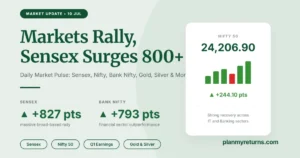
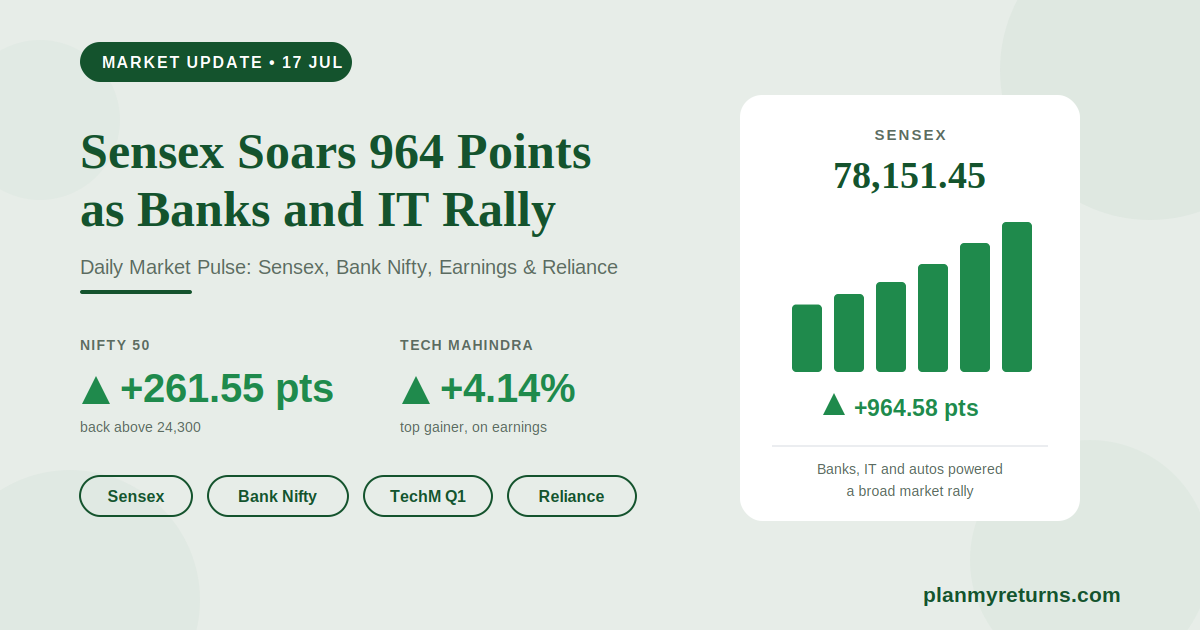
Today’s Overview: Markets rallied hard. The Sensex jumped +964.58 points (+1.25%) to 78,151.45 and the Nifty 50 rose +261.55 points (+1.09%) to 24,334.30. Private banks, IT and autos led the charge, helped by strong earnings and gains in Reliance ahead of its results. India climbed even as most global markets fell.
Today’s Top Finance Stories
1. Sensex Soars 964 Points as Banks, IT and Autos Drive a Broad Rally
What happened: The Sensex surged +964.58 points (+1.25%) to close at 78,151.45, and the Nifty 50 added +261.55 points (+1.09%) to 24,334.30. Bank Nifty outperformed, up +939.15 points (+1.63%) to 58,521.40. Private banks led with a +2.27% jump, followed by IT, realty and autos. Only pharma (-1.40%) and metals lagged. Broader midcaps and smallcaps ended slightly lower.
Why does it matter: This was a broad-based rally, not a narrow one. When the heavyweight banks, IT and auto sectors all rise together, the whole index gets a strong lift. Strong company earnings and buying in Reliance before its results added to the confidence.
Key Takeaway: A rally led by big sectors like banks and IT tends to be more durable than one driven by a single stock. Breadth matters.
2. Earnings Power the Movers: Tech Mahindra, Jio Financial and TCS Jump, Wipro Slips
What happened: Tech Mahindra was the top Nifty 50 gainer, rising +4.14% after a strong profit report. Jio Financial Services climbed +2.99% as its quarterly profit roughly doubled, and TCS added +2.95%. Wipro, which had reported a muted quarter a day earlier, fell -1.04%.
Why does it matter: Earnings season is the report card for companies. Results that beat expectations, like Tech Mahindra and Jio Financial, pull their stocks up, while a soft set of numbers, like Wipro, drags a stock down even in a rising market. This is why investors track quarterly results so closely.
Key Takeaway: In results season, the numbers do the talking. A single earnings report can move a stock sharply, up or down, regardless of the broader market.
3. Reliance Rises Ahead of Its Q1 Results, Due After the Close
What happened: Reliance Industries, India’s most valuable company, gained during the session as investors positioned ahead of its June-quarter results. The numbers were scheduled to be announced after the market closed on Friday, so their impact was not part of today’s move.
Why does it matter: Reliance is a heavyweight in both the Sensex and Nifty, so its results can sway the whole index. Because the announcement came after the close, we will cover the actual numbers and the market reaction in the next edition of PMR Pulse.
Key Takeaway: Results announced after market hours only affect prices in the next session. Watch how Reliance trades on Monday for the real reaction.
4. Rupee Steadies and Recovers to 96.28 After a Four-Day Slide
What happened: The Rupee firmed to about 96.28 against the US Dollar, recovering roughly 7 paise from the previous close near 96.35. It was the first gain after four straight falls, helped by the strong stock-market rally and foreign buying interest. A lower USD/INR number means each Dollar costs fewer Rupees, so the Rupee is a little stronger.
Why does it matter: A steadier Rupee eases the cost of imports like crude oil and overseas education. It also takes some pressure off inflation. One good day does not reverse a trend, but it is a welcome pause in the slide.
Key Takeaway: A falling USD/INR means a stronger Rupee. Strong equity inflows often support the currency, as seen today.
5. Oil Stays Firm Near $85 as the US-Iran Conflict Escalates
What happened: Brent crude rose +1.1% to about $85.34 a barrel after the US carried out a sixth straight night of airstrikes on Iranian targets, including the port of Bandar Abbas. Iran responded with missiles and renewed threats to close the Strait of Hormuz, a narrow shipping lane that carries a large share of the world’s oil.
Why does it matter: India buys most of its oil from abroad, so a sustained rise in crude adds to the import bill and feeds into inflation. For now, fuel retailers are holding petrol and diesel prices steady, but a longer conflict would test that.
Key Takeaway: Geopolitical flare-ups near major oil routes keep crude prices high, and India feels it through its import bill and pump prices.
6. Global Cues: Asian Markets Fall, but India Rallies On Its Own
What happened: Most Asian markets ended lower on Friday, weighed down by the escalating West Asia conflict and firm oil prices. Early signals for India were also muted. Yet Indian benchmarks broke away from the weak global mood and closed sharply higher on the back of local buying and strong earnings.
Why does it matter: Indian markets usually follow global cues, so a day when India rises while Asia falls stands out. It shows domestic factors, like company results and steady local investor buying, can sometimes matter more than the global backdrop.
Key Takeaway: When India moves opposite to global markets, it usually means strong domestic drivers are in charge, at least for that session.
7. IPO Watch: Caliber Mining Opens, SBI Funds Management Allotment Finalised
What happened: The Caliber Mining and Logistics IPO opened for subscription today, aiming to raise around Rs 450 crore. It is the third mainboard IPO to open this week. Separately, the SBI Funds Management IPO, which closed on 16 July, had its share allotment finalised on 17 July, so applicants can now check their status.
Why does it matter: An IPO, or initial public offering, is when a company sells shares to the public for the first time. A busy IPO calendar is often a sign of healthy market confidence. If you applied and shares are allotted, it helps to plan your average buy price before deciding what to do on listing day.
Key Takeaway: A steady stream of IPOs signals confidence, but each issue still needs its own homework on price, business and valuation.
Today’s Q1 Results
A simple summary of the major June-quarter (Q1 FY27) results that moved stocks in today’s session.
Tech Mahindra
Consolidated net profit rose +28.4% year-on-year to Rs 1,465 crore, and +8.2% higher than the previous quarter’s Rs 1,354 crore. The company sounded confident about demand. The stock ended the day’s top Nifty 50 gainer, up +4.14%.
Jio Financial Services
Quarterly net profit roughly doubled from a year earlier, on healthy growth across its lending and financial-services businesses. Investors cheered the numbers and the stock rose +2.99%.
CEAT
The tyre maker reported a -27% drop in standalone net profit to Rs 98 crore for the June quarter, hurt by higher input costs. Its shares fell sharply in response.
Wipro (recap)
After Thursday’s muted quarter, with profit nearly flat and margins under pressure, Wipro shares eased -1.04% today. The board had declared an interim dividend of Rs 2 per share, record date 27 July.
Market Snapshot
Equity and Bank Nifty figures are official closing levels for 17 July 2026. Gold and silver reflect the global spot move (about +0.3%); the Rupee values shown are approximate, so confirm exact domestic rates nearer 7 PM IST. Crypto and commodity prices trade round the clock, and petrol and diesel are Mumbai retail rates that vary by state and city.
Top 5 Gainers & Losers Nifty 50, 17 July 2026
▲ Top Gainers
- Tech Mahindra +4.14%
Top gainer after a 28% jump in quarterly profit.
- Kotak Mahindra Bank +3.77%
Rose as private banks led the market higher.
- Jio Financial Services +2.99%
Gained as its quarterly profit roughly doubled.
- Tata Consultancy Services +2.95%
Advanced with the broader IT sector rebound.
- ICICI Bank +2.52%
Added to the strength in banking heavyweights.
▼ Top Losers
- Hindalco Industries -1.49%
Metals lagged as the sector fell out of favour.
- Dr Reddy’s Laboratories -1.15%
Pharma was the day’s weakest sector.
- Wipro -1.04%
Eased a day after a muted quarterly result.
- Sun Pharmaceutical -0.83%
Tracked the wider weakness in pharma names.
- Apollo Hospitals -0.77%
Healthcare slipped as investors booked profits.
Decoupling
Meaning: Decoupling is when one market moves in a different direction from others it usually tracks. Indian stocks often follow global cues, so a day when they rise while Asian and global markets fall is called decoupling.
Example: On 17 July, most Asian markets fell on oil and conflict worries, but the Sensex still jumped nearly 965 points. That is decoupling: local strength, from earnings and domestic buying, outweighed the weak global mood.
Next Session to Watch
- Markets are shut on 18 and 19 July (weekend). The next session is Monday, 21 July.
- Reliance Industries’ Q1 results, announced after Friday’s close, and how the stock reacts on Monday.
- The full weekend flow of Q1 earnings, including JSW Steel, Federal Bank, Havells and Oberoi Realty.
- Caliber Mining IPO subscription demand and the SBI Funds Management listing.
- Oil and any fresh US-Iran or Strait of Hormuz developments over the weekend.
- Whether the Rupee holds its recovery near 96.28 or slips again.
A big rally day is a good moment to check your own plan.
See what today’s moves mean for you on PlanMyReturns: project your equity SIP returns, work out an IPO average price, or check how firm oil feeds inflation.
Explore All CalculatorsThis article is for general information only and is not investment advice. Read our full disclaimer.