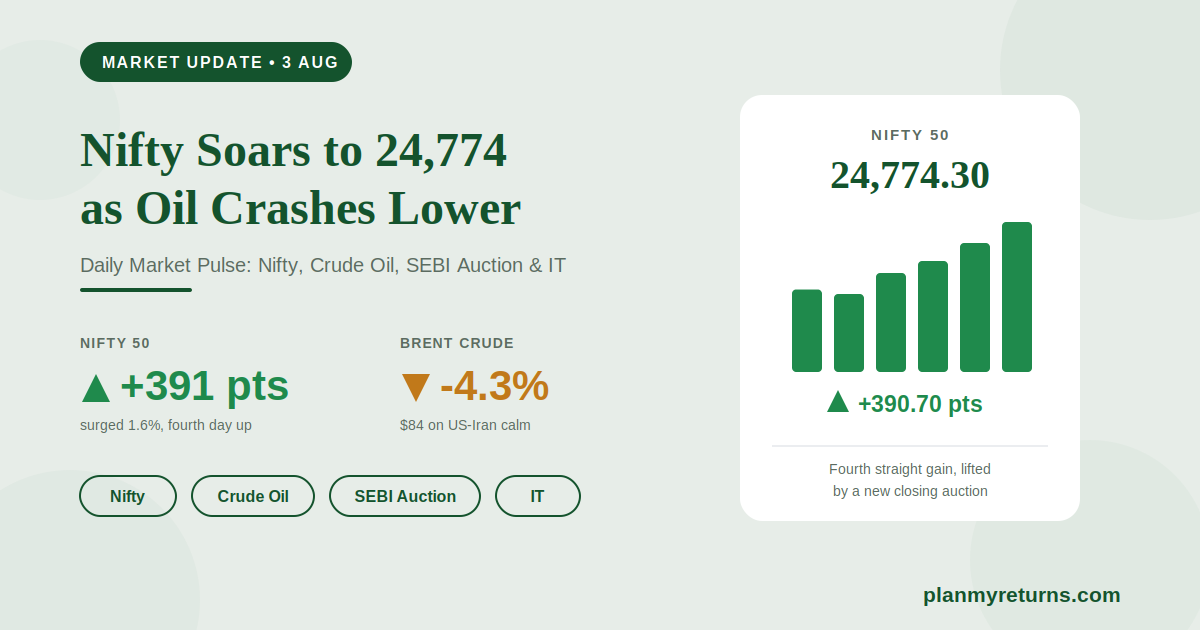
Today’s Overview: Markets surged a fourth day. The Sensex jumped 544 points (+0.70%) to 78,639 and the Nifty leapt 391 points (+1.60%) to 24,774, its gains amplified by a new SEBI closing auction. A sharp fall in crude oil, after the US stepped back from striking Iran, powered the rally. IT, banks and FMCG led, while only media stocks fell.
Today’s Top Finance Stories
1. Why Did the Sensex Jump 544 Points and the Nifty Surge 1.6% Today?
What happened: The Sensex rose +544.39 points (+0.70%) to 78,639.03, and the Nifty 50 jumped +390.70 points (+1.60%) to 24,774.30. The Bank Nifty led with a +983.10 point (+1.72%) surge to 58,247.95. Broader markets joined, with the Nifty MidCap 100 up +1.21%, and more than 180 stocks hit fresh 52-week highs. Notably, the Nifty rose much more than the Sensex, an unusual gap explained in Story 3.
Why does it matter: This was a broad, powerful rally, the fourth up day in a row. Falling oil, foreign buying and a firmer rupee all pulled in the same direction. When gains are this widespread, with so many stocks at new highs, it signals genuine, broad-based confidence rather than a narrow push by a few heavyweights.
Key Takeaway: A rally with wide participation and many 52-week highs is usually a healthier signal than a jump led by just a handful of big stocks.
2. Why Did Crude Oil Crash, and How Does It Help India?
What happened: Brent crude, the global oil benchmark, fell about 5% to around $84 a barrel. The trigger was a step back from conflict: the United States held off on fresh military strikes on Iran and signalled it was open to talks. That eased fears of oil supply being disrupted through key shipping routes, so traders quickly cut the “risk premium” built into prices.
Why does it matter: India imports most of the oil it uses, so cheaper crude is a big win. It shrinks the import bill, supports the rupee and eases inflation. It also helps fuel-heavy businesses like airlines, paints and logistics. This is a clear case of global political news working in India’s favour.
Key Takeaway: For an oil-importing country like India, a sharp drop in crude is one of the most powerful positive triggers a market can get.
3. What Is SEBI’s New Closing Auction Session, and Why Did Nifty and Sensex Diverge?
What happened: From today, the market regulator SEBI introduced a Closing Auction Session (CAS) for stocks in the futures and options (F&O) segment. Instead of using an average of late-day prices, the closing price is now set by a single special auction after 3:15 PM. On its first day, this pushed the Nifty up sharply into the close, so the Nifty rose +1.60% while the Sensex, which was not affected the same way, rose only +0.70%.
Why does it matter: A closing auction is meant to make the final price of the day fairer and harder to manipulate, which is good for investors over time. But on day one it created an unusually large gap between the two main indexes. It is a reminder that a market’s plumbing, the rules of how trades settle, can move the numbers, not just company news.
Key Takeaway: Sometimes an index moves because of a rule change, not the economy. Today’s Nifty-Sensex gap came from a new closing method, not a real 1.6% versus 0.7% difference in value.
4. Why Did IT Stocks Bounce Back So Strongly Today?
What happened: Information technology was the day’s best sector, with the Nifty IT index up +3.28%. TCS jumped +4.57% to Rs 2,473.70 and Infosys gained more than +3%. This was a sharp turnaround from Friday, when IT was the worst sector on fears about global AI competition. Grasim topped the Nifty with a +5.13% gain.
Why does it matter: After a sharp fall, beaten-down stocks often attract “value buyers” who see a bargain. Positive global sentiment and the new closing auction added to the bounce. It shows how quickly the mood can flip: Friday’s biggest loser became Monday’s biggest winner.
Key Takeaway: A steep one-day fall is often followed by bargain-hunting. Sentiment in the short term can swing far faster than a company’s actual business.
5. Why Did Zee Entertainment Crash 10% and Drag Media Stocks Down?
What happened: On a day when almost everything rose, media was the only major sector to fall, down -3.28%. The cause was Zee Entertainment, which crashed about -10%. The regulator SEBI passed a final order against the company over an unauthorised pledge of its land, and barred senior promoters from the securities market for one year.
Why does it matter: This shows the power of regulators to move a stock. When SEBI, the market’s watchdog, acts against a company’s management, investors worry about governance and sell quickly. For everyday investors, it is a reminder that how honestly a company is run, its governance, matters as much as its profits.
Key Takeaway: Regulatory action can sink a stock even in a rising market. Good corporate governance is a real part of an investment’s safety.
6. Policy and Global Watch: The RBI Meets This Week as Oil Eases
What happened: The big-picture triggers to track this week. The Reserve Bank of India (RBI) began its three-day interest rate meeting today, with the decision due later this week; most economists expect it to hold rates steady. Foreign investors stayed net buyers, and domestic funds bought about Rs 2,260 crore of shares. Overseas, markets were mixed: Germany’s DAX hit a record, but South Korea’s KOSPI fell more than 5% on heavy selling in AI-linked stocks. US July jobs data is also due soon.
Why does it matter: These forces shape the whole market. The RBI’s tone will hint at where home loan and deposit rates are heading. Steady foreign buying supports both shares and the rupee, while weakness in Asian tech is a reminder that the global AI trade remains jumpy.
Key Takeaway: A central bank meeting, foreign flows and global cues together drive the market’s direction. This week, all eyes are on the RBI.
Today’s Q1 Results
A simple summary of major June-quarter (Q1 FY27) results in focus today.
ITC
The cigarettes-to-hotels giant saw its stock rise about +2% even though its quarterly profit fell. Investors looked past the profit dip and focused instead on healthy growth in cigarette volumes and steadiness in its core business. It is a good example of the market rewarding a company’s underlying strength rather than a single headline number.
CAMS and NOCIL
Computer Age Management Services (CAMS), which handles record-keeping for mutual funds, reported net profit up +17.3% year-on-year to about Rs 128 crore. Chemicals maker NOCIL reported net profit up +61% to about Rs 27.8 crore. Both point to steady demand in their niches during the quarter.
Market Snapshot
Equity figures are official closing levels for 3 August 2026. Gold, silver, crude and currency reflect rates reported through the evening; confirm these closer to 7 PM IST as they trade round the clock. Gold and silver are retail reference rates that vary by city.
Top Gainers & Losers Nifty 50, 3 August 2026
▲ Top Gainers
- Grasim Industries +5.13%
Topped the Nifty gainers, up Rs 159.
- TCS +4.57%
Led a sharp rebound in IT stocks.
- InterGlobe Aviation (IndiGo) +4.43%
Rose as cheaper oil helps airlines.
▼ Top Losers
- Sun Pharma -1.98%
Fell on profit-booking near a 52-week high.
- Apollo Hospitals -1.53%
Slipped on stock-specific selling.
- Maruti Suzuki -0.95%
Eased on profit-booking despite firm auto sales.
Repo Rate
Meaning: The repo rate is the interest rate at which the Reserve Bank of India (RBI) lends money to banks. It is the RBI’s main tool to control inflation and growth. When the repo rate goes up, loans get costlier; when it falls, loans get cheaper.
Example: The RBI began its rate meeting today. If it keeps the repo rate unchanged, your home loan EMI and fixed deposit rates are likely to stay broadly where they are.
Next Session to Watch
- The RBI’s interest rate decision, due later this week.
- Whether the four-day winning streak continues on Tuesday.
- Crude oil, after today’s sharp fall on hopes of US-Iran talks.
- More Q1 FY27 results still to come this earnings season.
- How the new SEBI closing auction settles into daily trading.
- US July jobs data and its effect on global markets.
Cheaper oil and a steady RBI could ease your costs. See what it means for you.
Plan ahead on PlanMyReturns: check how easing prices affect you with our inflation calculator, work out your home loan EMI before the RBI decision, or grow steadily with a SIP.
Explore All CalculatorsThis article is for general information only and is not investment advice. Read our full disclaimer.