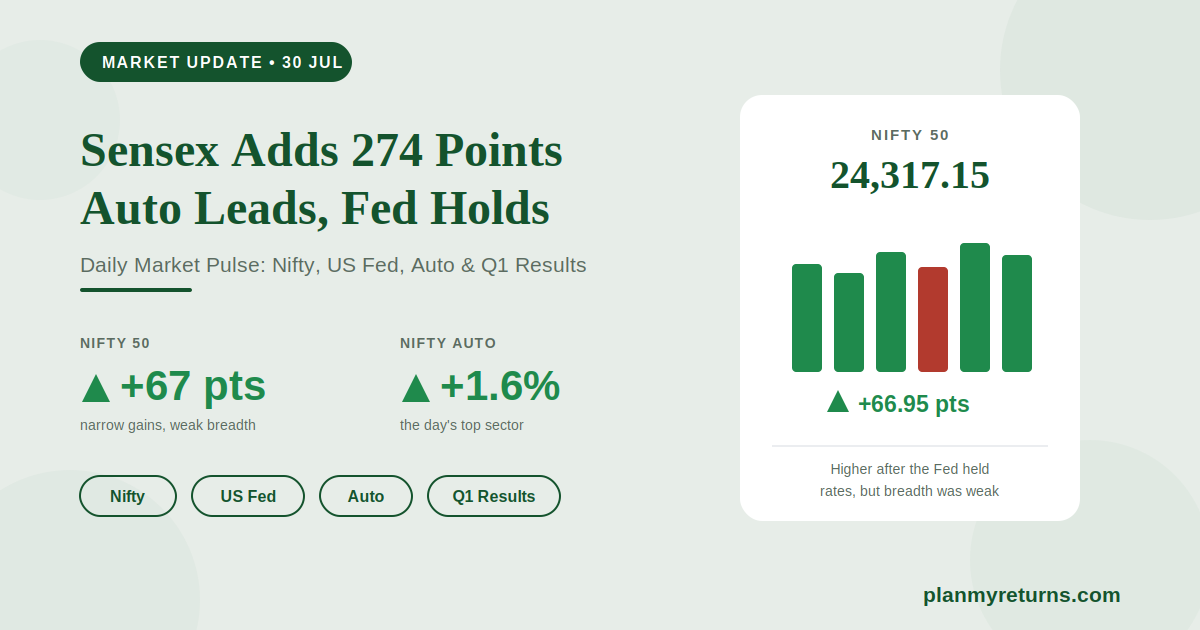
Today’s Overview: Markets eked out narrow gains. The Sensex rose 274 points (+0.35%) to 77,928 and the Nifty added 67 points (+0.28%) to 24,317. Auto and oil and gas stocks led after the US Fed held rates overnight with a cautious, hawkish tone. But breadth was weak, with far more stocks falling than rising, and the realty sector dropped 2%.
Today’s Top Finance Stories
1. Why Did the Sensex Rise but Most Stocks Fall on 30 July?
What happened: The Sensex rose +273.55 points (+0.35%) to 77,928.15 and the Nifty 50 added +66.95 points (+0.28%) to 24,317.15. But the gains were narrow. On the NSE, only about 1,326 stocks rose while roughly 1,975 fell. The broader market slipped, with the Nifty MidCap 100 down -0.35% and the SmallCap 100 down -0.56%. A few heavyweights like Reliance and HDFC Bank did the heavy lifting.
Why does it matter: This is what traders call weak market breadth. The index can look green because a handful of large stocks rose, even when most shares actually fell. It is a reminder to look beyond the headline number: a rising Sensex does not always mean your particular stocks or funds had a good day.
Key Takeaway: Market breadth shows how many stocks rose versus fell. A green index with weak breadth means the gains were narrow, not broad.
2. What Did the US Fed Decide, and Why Did It Keep Markets Cautious?
What happened: The US Federal Reserve, America’s central bank, held its key interest rate steady overnight at a range of 3.50% to 3.75%. The move was expected. But three of its members voted for a rate hike instead, and the Fed kept stressing its worry about inflation. That hawkish tone pushed US bond yields to a fresh high and made global investors cautious.
Why does it matter: A hawkish tone means the Fed is leaning towards keeping rates high, or even raising them, to fight inflation. Higher US rates and bond yields tend to pull global money towards the US and away from markets like India. That is why our market stayed cautious and range-bound despite the rate pause.
Key Takeaway: It is not just the rate decision that matters, but the tone. A hawkish message can unsettle markets even when rates are left unchanged.
3. Why Did Auto Stocks Lead the Market Today?
What happened: The Nifty Auto index was the top-performing sector, rising +1.6%. Mahindra & Mahindra was the single biggest gainer in the Nifty 50, up +2.26%, with Eicher Motors and Maruti Suzuki also higher. Oil and gas and consumer durable stocks joined the move up.
Why does it matter: On a cautious day, money often rotates towards sectors with a clear domestic growth story. Auto demand is tied to India’s own consumers rather than to global jitters, so it can hold up when foreign cues are shaky. That home-market strength is a useful anchor for investors during uncertain global spells.
Key Takeaway: Domestic-demand sectors like autos can lead when global cues are shaky, because their fortunes depend more on India than on the world.
4. Bajaj Finance Q1: Why Did Its Profit Jump 28%?
What happened: Bajaj Finance, India’s largest non-bank lender by market value, reported a strong June quarter. Net profit rose +28% from a year earlier to about Rs 6,081 crore. Its net interest income, the gap between what it earns on loans and pays on deposits, grew +23% to Rs 12,571 crore, and its loan book (assets under management) expanded +24% to about Rs 5.47 lakh crore. The stock ended roughly flat as the strong numbers were widely expected.
Why does it matter: Bajaj Finance is a bellwether for how comfortable Indians are borrowing and spending. Fast growth in its loan book suggests healthy consumer demand for everything from phones to two-wheelers. If you follow lenders or plan to compare loan options, our personal loan calculator can help you see the real cost.
Key Takeaway: A lender’s loan-book growth is a window into consumer demand. Strong growth here often signals confident spending across the economy.
5. Why Did Adani Ports Fall While the Index Rose?
What happened: Adani Ports was the biggest faller in the Nifty 50, down -3.38%. It was joined on the losing side by financial and insurance names such as HDFC Life, SBI Life, Shriram Finance and Jio Financial Services. This was a sharp turn for Jio Financial, which had been the top gainer just a day earlier.
Why does it matter: It shows how quickly sentiment can swing on individual stocks. Yesterday’s winners can be today’s losers as traders book profits and rotate money between sectors. For long-term investors, these daily swings are noise; what matters is the underlying business, not one session’s move.
Key Takeaway: Yesterday’s top gainer can be today’s top loser. Daily rotation is normal and rarely changes a company’s long-term story.
6. What Is the RBI Likely to Do at Next Week’s Meeting?
What happened: Attention is now turning to the Reserve Bank of India’s own interest rate meeting, due in early August. Most economists expect the RBI to keep its key repo rate, the rate at which it lends to banks, unchanged. Investors will focus on what the RBI says about inflation and growth.
Why does it matter: The repo rate influences the interest you pay on loans and earn on deposits. If the RBI holds, your home loan EMI and fixed deposit rates are likely to stay broadly where they are. Its tone on inflation will hint at whether cheaper loans could come later in the year.
Key Takeaway: The RBI’s repo rate flows straight through to your loan EMIs and deposit returns, so its meetings are worth watching.
Today’s Q1 Results
A simple summary of the major June-quarter (Q1 FY27) results announced today. More than 100 companies reported on 30 July.
Bajaj Finance
The country’s biggest non-bank lender posted consolidated net profit of about Rs 6,081 crore, up +28% year-on-year. Net interest income rose +23% to Rs 12,571 crore and its loan book grew +24% to about Rs 5.47 lakh crore, with 16.1 million new loans booked in the quarter. The stock ended roughly flat, as the market had already expected a strong set of numbers.
Vedanta Aluminium and others
Vedanta Aluminium reported a striking +205% year-on-year jump in quarterly profit, and its shares rose about +4%. It was a heavy results day overall: Mahindra & Mahindra, Tata Steel, Torrent Pharma, Hyundai Motor India, Swiggy and IRFC were among the many companies that also reported June-quarter numbers, keeping stock-specific action busy beneath the flat index.
Market Snapshot
Equity figures are official closing levels for 30 July 2026. Gold, silver, crude, currency and crypto reflect rates reported through the evening; confirm these closer to 7 PM IST as they trade round the clock. Gold and silver are retail reference rates that vary by city. Petrol and diesel are Mumbai retail rates and vary by state taxes.
Top Gainers & Losers Nifty 50, 30 July 2026
▲ Top Gainers
- Mahindra & Mahindra +2.26%
Top Nifty 50 gainer, leading the auto rally.
- Coal India Higher
Among the day’s leading large-cap gainers.
- Eicher Motors Higher
Rose as the auto pack outperformed.
- Maruti Suzuki Higher
Added to the strength in auto stocks.
▼ Top Losers
- Adani Ports -3.38%
The day’s biggest Nifty 50 faller.
- HDFC Life Lower
Insurance names weighed on the index.
- SBI Life Lower
Slipped alongside other insurers.
- Jio Financial Services Lower
Fell back after leading gains a day earlier.
Market Breadth
Meaning: Market breadth compares how many stocks rose against how many fell in a session. Strong breadth means most stocks gained. Weak breadth means the index rose only because a few big stocks did the work, while most shares actually fell.
Example: On 30 July the Nifty closed higher, yet about 1,975 NSE stocks fell against only 1,326 that rose. That weak breadth showed the rally was narrow, not broad-based.
Next Session to Watch
- The RBI’s interest rate decision, due in early August.
- More Q1 FY27 results, with heavyweights still to report.
- How global markets digest the Fed’s hawkish tone and higher US yields.
- Crude oil, which stayed choppy on West Asia tensions.
- Whether market breadth improves or stays narrow.
- Foreign investor flows after their recent turn to buying.
With central banks in focus, interest rates touch your loans and savings. Check where you stand.
Use PlanMyReturns to plan around rates: work out your home loan EMI, compare a personal loan, or see your returns on a fixed deposit.
Explore All CalculatorsThis article is for general information only and is not investment advice. Read our full disclaimer.