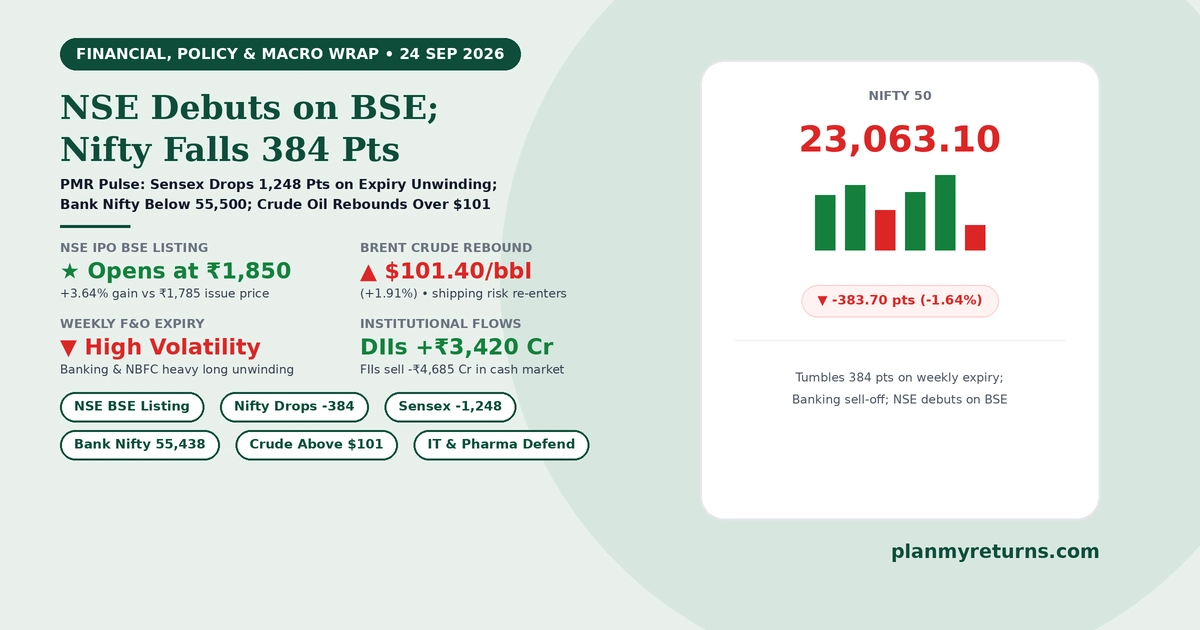
Today’s Overview: The Nifty 50 tumbled 383.70 points to 23,063.10 on September 24, 2026, while the BSE Sensex plunged 1,247.71 points to 73,580.54. The landmark NSE IPO debuted on the BSE at ₹1,850, while weekly derivatives expiry unwinding, heavy banking sell-offs, and crude oil rebounding above $101 pressured domestic market sentiment.
Today’s Top Finance & Economy Stories
1. How Did the Landmark NSE IPO Perform on Its BSE Listing Debut?
What happened: Shares of the National Stock Exchange of India (NSE) officially debuted on the BSE on Thursday, 24 September 2026. The stock listed at ₹1,850 per share, delivering an immediate premium of 3.64% over its final issue price of ₹1,785. The ₹22,561.57 crore initial public offering generated record opening turnover as institutional funds, mutual fund houses, and retail allottees actively traded India’s foremost market exchange operator.
Why it matters: As India’s largest market infrastructure provider transitions to public trading, capital reallocations across domestic equities accelerated significantly. For investors considering how to deploy listing capital into wealth-building mutual fund portfolios, evaluate your growth horizon on our Lumpsum Calculator.
Key Takeaway: NSE shares listed on the BSE at ₹1,850 per share, locking in a 3.64% opening gain over the ₹1,785 issue price.
2. Why Did Brent Crude Rebound Above $101 as US Tariffs and Gulf Supply Risks Resurfaced?
What happened: International crude oil benchmark Brent crude rebounded 1.91% to $101.40 a barrel on Thursday, recovering swiftly after briefly dipping below the $100 mark. Although diplomatic meetings between Washington and Tehran took place earlier in New York, energy desks remained cautious over secondary sanction enforcement rules under the new US tariff law. At the same time, ongoing maritime patrol operations in the Persian Gulf kept freight insurance rates elevated.
Why it matters: Elevated international fuel benchmarks expand India’s monthly trade deficit and increase transport operational expenditures. To examine how fluctuating commodity prices affect your family’s purchasing power over time, test your household budget on our Inflation Calculator.
Key Takeaway: Brent crude regained the $101 level as global tariff enforcement concerns and Gulf shipping risk premiums re-emerged.
3. Why Did Nifty Plunge 384 Points to 23,063 as Bank Nifty Tumbled Over 1,110 Points?
What happened: Indian equity benchmarks witnessed sharp across-the-board liquidations on Thursday. The Nifty 50 dropped -383.70 points (-1.64%) to settle at 23,063.10, while the BSE Sensex sank -1,247.71 points (-1.67%) to 73,580.54. Bank Nifty plummeted -1,110.40 points (-1.96%) to 55,438.50, hit by weekly derivatives expiry unwinding and substantial long position liquidations.
Why it matters: Sharp market consolidations offer attractive opportunities to accumulate quality assets systematically rather than trying to time volatile trading swings. For long-term wealth accumulation, track your disciplined investment plan with our SIP Calculator.
Key Takeaway: Expiry-day unwinding, banking liquidations, and crude gains triggered a 384-point drop in Nifty and 1,248-point decline in Sensex.
4. How Did FII and DII Liquidity Flow on Thursday’s High-Turnover Session?
What happened: Institutional trading data revealed significant selling from Foreign Institutional Investors (FIIs), who recorded net outflows of ₹4,685 crore in the cash equity segment on Thursday. Conversely, Domestic Institutional Investors (DIIs) absorbed substantial volatility by registering net purchases of ₹3,420 crore, providing vital baseline support to broader market capitalizations.
Why it matters: Steady domestic mutual fund flows continue to provide essential support against global portfolio adjustments. If you are calculating new average share costs following market dips, calculate your revised purchase targets on our Stock Average Calculator.
Key Takeaway: FIIs offloaded ₹4,685 crore while DIIs bought ₹3,420 crore, cushioning index levels against deeper declines.
5. Why Did Banking and NBFC Majors Lead the Broad Market Decline?
What happened: Heavyweight commercial banks and financial lenders bore the brunt of Thursday’s unwinding. HDFC Bank slipped 2.85% to ₹1,610.20, ICICI Bank declined 2.45% to ₹1,245.50, and State Bank of India fell 2.10% to ₹1,010.80. Non-banking finance leader Bajaj Finance dropped 2.60% to ₹1,028.00 as traders closed leveraged derivatives contracts ahead of the expiry bell.
Why it matters: Financial institutions hold substantial index weighting, making banking fluctuations influential on broader market sentiment. For borrowers evaluating property financing and interest schedules, calculate your installments with our Home Loan EMI Calculator.
Key Takeaway: Banking and NBFC heavyweights fell over 2%, exerting heavy downward pressure on Bank Nifty and benchmark indices.
6. Why Did Information Technology and Healthcare Stocks Stand Out as Market Defensives?
What happened: While cyclical sectors retreated, export-oriented technology firms and healthcare providers attracted steady defensive buying. Tata Consultancy Services gained 1.45% to ₹2,084.80, Infosys advanced 1.20% to ₹1,492.70, and Sun Pharma climbed 1.05% to ₹1,891.65. Sector strength was supported by currency dynamics as the Indian Rupee softened against the US Dollar.
Why it matters: Balancing cyclical holdings with defensive exporters helps stabilize total portfolio returns during volatile sessions. For taxpayers structuring investment deductions across fiscal quarters, compare your obligations on our Old vs New Tax Regime Calculator, and plan annual savings increases with our Step-Up SIP Calculator.
Key Takeaway: TCS, Infosys, and Sun Pharma posted gains between 1% and 1.5%, providing valuable portfolio insulation.
7. Which Stocks Led and Lagged the Market on Thursday, 24 September 2026?
What happened: Leading gainers on the Nifty 50 included Tata Consultancy Services (+1.45% to ₹2,084.80), Infosys (+1.20% to ₹1,492.70), Sun Pharma (+1.05% to ₹1,891.65), Cipla (+0.85% to ₹1,560.40), and Dr. Reddy’s Laboratories (+0.70% to ₹6,640.00). On the losing side, major decliners were HDFC Bank (-2.85% to ₹1,610.20), Bajaj Finance (-2.60% to ₹1,028.00), ICICI Bank (-2.45% to ₹1,245.50), Larsen & Toubro (-2.20% to ₹3,501.20), and State Bank of India (-2.10% to ₹1,010.80).
Why it matters: Defensive rotation dominated trading as investors shifted capital away from rate-sensitive financials into healthcare and IT exporters. For individuals building balanced long-term portfolios, evaluate compounding projections with our SIP Calculator.
Key Takeaway: IT and healthcare stocks advanced on defensive allocation, while large-cap banks and lenders faced steep liquidations.
Comprehensive Finance, Policy & Market Updates
Macro, Regulatory & Commodity Updates
- NSE IPO Listing Debut: National Stock Exchange shares listed at ₹1,850 on the BSE, achieving a 3.64% opening premium over the ₹1,785 issue price.
- Crude Oil Rebound: Brent crude rose 1.91% to $101.40 per barrel on renewed Middle East shipping cautions and US sanctions monitoring.
- Weekly Expiry Volatility: Nifty weekly options expiry triggered intense position liquidations across banking and financial contracts.
- Currency Pressure: The Indian Rupee closed at 96.18 against the US dollar under pressure from foreign equity outflows.
- Precious Metals Firmness: Domestic 24K retail gold ticked up to Rs 1,51,600 per 10g, while retail silver rose to Rs 2,38,650 per 1kg on safe-haven buying.
- Tax Compliance Reminder: CBDT notified taxpayers to complete post-Advance Tax reconciliation ahead of quarterly accounting closings.
- Digital Payment Reliability: NPCI reported steady payment throughput across UPI networks during high-volume expiry settlement hours.
Corporate Stock Buzzers
- National Stock Exchange of India (NSE): Debuted on the BSE at ₹1,850 with massive institutional turnover.
- Tata Consultancy Services: Rose 1.45% to ₹2,084.80, leading defensive IT sector buying.
- Infosys: Gained 1.20% to ₹1,492.70 on foreign exchange realization benefits.
- Sun Pharma: Added 1.05% to ₹1,891.65, supported by pharmaceutical safe-haven demand.
- HDFC Bank: Dropped 2.85% to ₹1,610.20 amid broad banking sector unwinding.
- Bajaj Finance: Declined 2.60% to ₹1,028.00 following profit booking after recent gains.
- Larsen & Toubro: Slipped 2.20% to ₹3,501.20 on broader capital goods consolidation.
Market & Macro Snapshot
Market figures reflect official closing numbers on 24 September 2026. Indicative 24K retail gold was Rs 1,51,600 per 10g and retail silver was Rs 2,38,650 per 1kg. Retail rates vary across cities because of local taxes, octroi, and jeweller making charges.
Top Gainers & Losers Nifty 50, 24 September 2026
▲ Top 5 Gainers
- Tata Consultancy Services +1.45%
₹2,084.80 | Led large-cap defensives on foreign exchange gains.
- Infosys +1.20%
₹1,492.70 | Gained as investors rotated into software exporters.
- Sun Pharma +1.05%
₹1,891.65 | Advanced on strong healthcare defensive demand.
- Cipla +0.85%
₹1,560.40 | Accumulated by institutions seeking earnings stability.
- Dr. Reddy’s Laboratories +0.70%
₹6,640.00 | Supported by steady export formulation revenues.
▼ Top 5 Losers
- HDFC Bank -2.85%
₹1,610.20 | Led bank decliners amid heavy expiry derivatives unwinding.
- Bajaj Finance -2.60%
₹1,028.00 | Slipped after institutional profit taking following Wednesday’s rally.
- ICICI Bank -2.45%
₹1,245.50 | Weighed down by institutional liquidation in private lenders.
- Larsen & Toubro -2.20%
₹3,501.20 | Softened on broader capital goods sector consolidation.
- State Bank of India -2.10%
₹1,010.80 | Eased along with public sector banking peers.
Listing Premium
Meaning: A listing premium is the percentage gain that an initial public offering (IPO) share achieves on its first day of trading above its final issue price upon debuting on a recognized stock exchange.
Example: On its BSE debut, the National Stock Exchange of India (NSE) opened at ₹1,850 per share, delivering an immediate listing premium of 3.64% over its ₹1,785 issue price.
Frequently Asked Questions
How did NSE shares perform on their BSE listing debut?
National Stock Exchange of India (NSE) shares opened on the BSE at ₹1,850 on Thursday, 24 September 2026, securing a 3.64% opening gain (an increase of ₹65) compared to the public issue price of ₹1,785 per share.
Why did the Sensex drop 1,248 points and Nifty slide to 23,063 today?
Benchmark equity indices fell sharply due to weekly derivatives expiry unwinding, significant profit taking in large-cap banking leaders, and Brent crude oil rebounding above $101 per barrel.
Which sectors demonstrated defensive strength during Thursday’s sell-off?
Information technology and pharmaceutical companies showed notable defensive strength, with TCS, Infosys, and Sun Pharma posting gains between 1.0% and 1.5% as investors sought refuge in dollar-earning exporters.
Upcoming Market & Economic Events to Watch
- NSE Secondary Market Settlement: Tracking Day-2 institutional trading volume and liquidity absorption on Friday, 25 September 2026.
- Global Macro Data: United States Core PCE Price Index release scheduled for Friday to guide global interest rate expectations.
- Foreign Institutional Inflows: Monitoring foreign portfolio rebalancing trends following the weekly derivatives expiry.
Plan Your Financial Strategy with PlanMyReturns Tools
Use our free financial calculators to plan your savings, calculate loan payments, and estimate taxes:
- SIP Calculator: Calculate mutual fund returns over your investment horizon
- Stock Average Calculator: Calculate your average share price after multiple buys
- Home Loan EMI Calculator: Check your monthly home loan installments and interest schedule
- Old vs New Tax Regime Calculator: Compare your income tax bill under both tax slabs
- Inflation Calculator: Check how future prices change the purchasing power of your money
About PMR Pulse
PMR Pulse is PlanMyReturns’ flagship daily market and finance wrap. We track domestic stock benchmarks, global economic indicators, banking policies, taxation changes, and primary markets to give Indian households and investors clear, actionable context every trading day.