
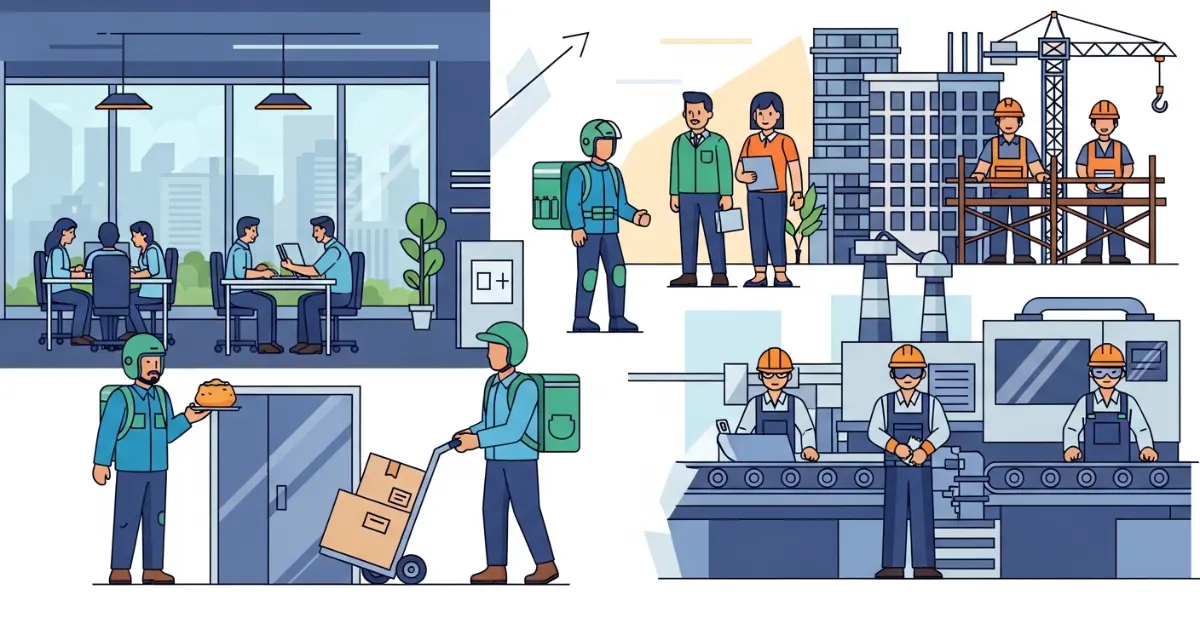
Labour Codes 2025 came into effect on November 21, reshaping how more than 50 crore Indians work, earn and plan their financial future. India has replaced 29 separate labour laws with four modern codes, many of which were originally written during the British era or in the early decades after Independence.
This change is not a routine policy update. It is the biggest shift in worker rights, wage rules and employer obligations since Independence. Whether someone earns a salary in Bangalore, rides for a delivery platform in Mumbai, works at a construction site in Delhi or runs a startup in Pune, these reforms affect daily working life.
Here’s a clear look at what changed and how these updates will influence workers, employers and industries across India.
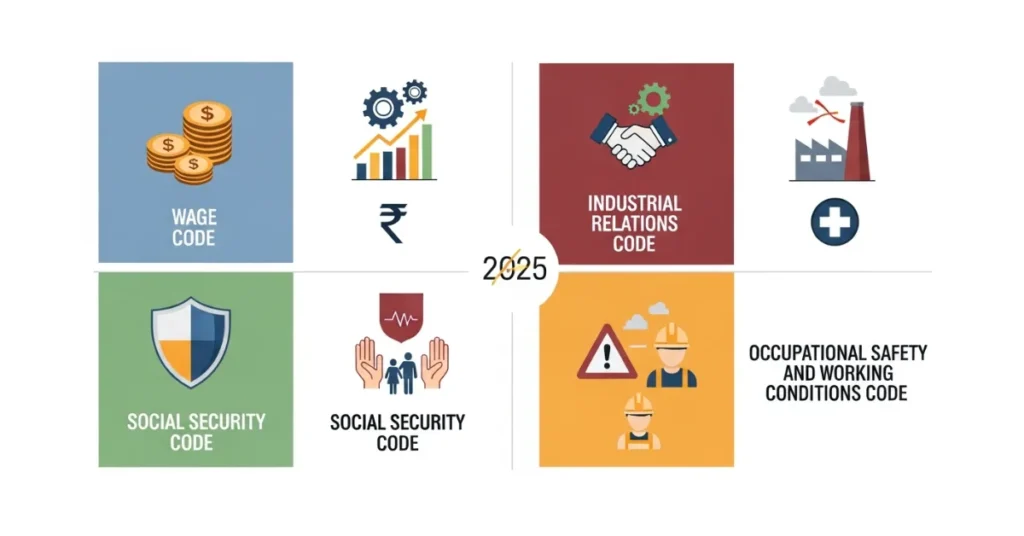
What Are the Four Labour Codes? A Complete Breakdown
For decades, India operated under a maze of 29 different central labour laws, each with its own definitions, coverage, and compliance requirements. Companies faced nightmarish complexity. Workers fell through protection gaps. Courts struggled with conflicting interpretations.
The new framework consolidates everything into four streamlined codes:
1. Code on Wages, 2019: One Rule for All Pay
This code creates a single, universal system for how every worker in India gets paid and protected.
What’s Revolutionary:
- Universal minimum wage for absolutely everyone – from corporate executives to agricultural workers
- Statutory floor wage that no state can go below
- New “wages” definition that changes how your PF and gratuity are calculated
- Mandatory timely payment – your salary must be paid by the 7th of every month
- Equal pay provisions explicitly banning gender-based wage discrimination
Real Impact: A tea plantation worker in Assam, a software engineer in Hyderabad, and a domestic worker in Chennai now all have the same fundamental wage protections under one law.
2. Industrial Relations Code, 2020: How Work Relationships Function
This code modernizes how employers and employees negotiate, how unions operate, and how disputes get resolved.
Game-Changing Provisions:
- Layoff threshold increased from 100 to 300 workers before government approval is needed
- Fixed-term employment officially recognized with full rights equal to permanent employees
- Single negotiating union or council to streamline collective bargaining
- 14-day mandatory notice before strikes to allow time for resolution
- Faster dispute resolution through streamlined tribunals
Real Impact: If you’re on a contract, you now have the same rights as permanent employees. If your company has 250 workers, management has more flexibility to restructure without bureaucratic delays.
3. Code on Social Security, 2020: Safety Nets for Everyone
This is perhaps the most revolutionary code – extending social security to India’s massive informal and gig economy workforce for the first time in history.
Historic Changes:
- Gig and platform workers get formal legal recognition and benefits
- Aggregators like Zomato, Swiggy, Uber, Ola must contribute 1-2% of annual turnover to welfare funds
- Universal social security registration covering previously excluded workers
- Portable benefits that move with you across jobs and states
- Expanded ESIC and EPF coverage to smaller establishments
Real Impact: The 7.7 million delivery partners, drivers, and platform workers who existed in a legal grey zone now have health insurance, disability benefits, and retirement security.
4. Occupational Safety, Health and Working Conditions Code, 2020: Safe, Modern Workplaces
This code brings 21st-century safety and working condition standards to every workplace in India.
Major Updates:
- Work-from-home officially recognized with legal protections for remote workers
- Women can work night shifts in all sectors including mining and manufacturing, with mandatory safety provisions
- Working hours capped at 8-12 hours per day, maximum 48 hours per week
- Overtime must be voluntary and paid at double the regular wage rate
- Free annual health checkups mandatory for all workers over 40
- Transgender-inclusive facilities and protections explicitly mandated
- Safety committees required for establishments with 500+ workers
Real Impact: A woman software engineer can now legally work night shifts with proper safety measures. A 45-year-old factory worker gets a free annual medical examination. A remote worker has legal rights and protections even while working from home.
The Five Changes That Will Actually Impact Your Life
Change #1: The 50% Wage Rule – Your Salary Structure is Changing
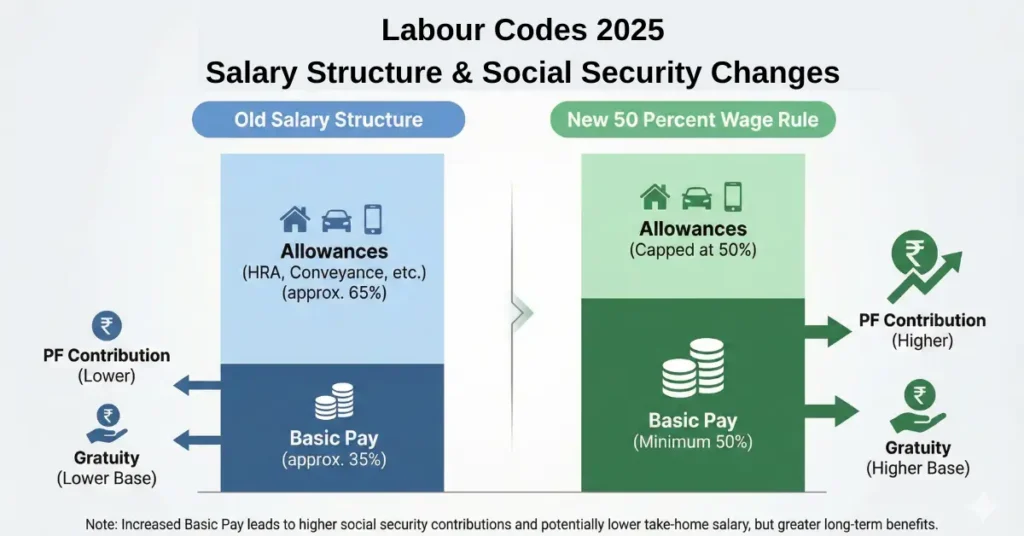
The most immediate and talked-about change: at least 50% of your total compensation must be classified as basic wages (basic pay + dearness allowance + retaining allowance).
Why This Matters:
Many companies currently structure salaries with low basic pay (maybe 30-35% of CTC) and high allowances (HRA, special allowances, conveyance, etc.). This kept their PF and gratuity contributions low.
Not anymore.
Example Calculation:
Let’s say you earn ₹10 lakh annually (₹83,333 monthly):
Old Structure:
- Basic Pay: ₹3.5 lakh per year (35%)
- Allowances: ₹6.5 lakh per year (65%)
- Your monthly PF contribution (12% of basic): ₹3,500
- Employer PF contribution: ₹3,500
- Total monthly PF: ₹7,000
New Structure (50% Rule):
- Basic Pay: ₹5 lakh per year minimum (50%)
- Allowances: ₹5 lakh maximum (50%)
- Your monthly PF contribution (12% of basic): ₹5,000
- Employer PF contribution: ₹5,000
- Total monthly PF: ₹10,000
Net Effect:
- Your take-home drops by ₹1,500 per month
- BUT your retirement corpus increases by ₹36,000 per year
- Your gratuity calculation base also increases significantly
Important Caveat: Most employees already earning above ₹15,000 basic per month won’t see PF changes (due to the existing ₹15,000 PF cap). But gratuity calculations will definitely increase for everyone.
Change #2: Gig Workers Finally Get Social Security
For the first time in Indian legal history, gig and platform workers have formal recognition.
Who This Covers:
- Zomato, Swiggy, and other food delivery partners
- Uber, Ola, and ride-hailing drivers
- Amazon, Flipkart, and e-commerce delivery personnel
- Urban Company and other service platform workers
- Freelancers working through digital platforms
What Changes:
- Platform companies must contribute 1-2% of annual turnover (capped at 5% of total payments to workers) to a dedicated welfare fund
- Access to health insurance schemes
- Disability and accident coverage
- Old-age pension schemes
- Maternity benefits for women workers
- Portable benefits linked to your Aadhaar across all platforms
Cost Reality: Companies like Zomato estimate this adds ₹1.5-2.5 per order. That cost will either be absorbed, passed to consumers, or offset through efficiency. But workers get genuine protection.
Myth Buster: You DON’T become an employee. You remain an independent contractor with flexibility. You just now have a safety net.
Change #3: Fixed-Term Workers Get Permanent Rights
India has millions of workers on fixed-term or project-based contracts, especially in automotive, electronics, apparel, IT, and manufacturing sectors.
The Breakthrough:
- Fixed-term employees get exactly the same wages and benefits as permanent employees doing similar work
- Gratuity payable after just ONE year of continuous service (not five)
- Pro-rata calculation for shorter periods
- Full access to PF, ESIC, and other social security
- Equal access to bonuses, overtime pay, and other benefits
Example: You’re hired on a 2-year contract for a special project in an automotive company. Under old rules, you might get lower pay, no gratuity (since you won’t complete 5 years), and potentially fewer benefits. Under new codes, you get the same pay as permanent employees, gratuity after 1 year, and all statutory benefits.
Impact Sectors: This is massive for industries like automotive (which employ thousands on contracts during model launches), seasonal businesses, project-based IT work, and event management.
Change #4: Women Can Work Night Shifts – Legally
One of the most progressive changes eliminates decades-old restrictions that barred women from working night shifts in many sectors.
What’s New:
- Women can work night shifts in all sectors – IT, manufacturing, mining, hazardous industries, everything
- Mandatory safety provisions: adequate lighting, safe transport, security personnel, separate washrooms
- Consent-based: Women must explicitly agree; it cannot be forced
- Committee oversight: Establishments must have committees to monitor safety compliance
Real-World Impact:
- IT/ITeS companies with 24/7 operations can now legally employ women in night shifts with proper safety measures
- Manufacturing plants running multiple shifts can tap into a much larger talent pool
- Women in high-paying sectors like mining and heavy industry no longer face artificial barriers
Important: This isn’t forcing women to work nights. It’s removing legal barriers that prevented those who want to from doing so.
Change #5: Digital Compliance and Inspector Reform
One under-discussed but hugely important change: the codes introduce “inspector-cum-facilitator” systems with algorithm-driven, web-enabled inspections.
Old System (“Inspector Raj”):
- Multiple inspectors from different departments
- Subjective, sometimes corrupt inspection processes
- Paper-based documentation nightmares
- Harassment potential high
New System:
- Single registration, single license, single return across all four codes
- Digital compliance platforms
- Algorithm-based inspection scheduling (not inspector discretion)
- Inspectors trained as facilitators to help compliance, not just penalize
- Most minor violations converted to monetary penalties, not criminal offenses
What This Means: A small business no longer juggles 14 different registrations and licenses. A mid-sized company doesn’t face random, potentially corrupt inspector visits. Everything moves online with transparency.
Busting the Top 10 Myths About Labour Codes
Myth 1: “My take-home salary will crash”
Reality: Your total compensation (CTC) doesn’t change. The structure shifts. More goes to PF (retirement savings with employer matching) and less comes as immediate cash. Yes, your monthly cash in hand might decrease slightly, but your long-term wealth increases significantly. Think of it as enforced savings that your employer matches – your 60-year-old self will be grateful.
Myth 2: “Companies will do mass layoffs now”
Reality: The layoff threshold INCREASED from 100 to 300 workers. This gives mid-sized companies (100-299 workers) MORE flexibility, not less. Companies with fewer than 300 employees can now manage workforce changes without government approval. Plus, fixed-term employment reduces the need for layoffs by allowing legitimate project-based hiring.
Myth 3: “Small businesses are crushed by compliance”
Reality: The codes specifically REDUCE burden on small businesses through:
- Higher thresholds (Factory Act now applies at 20 workers, up from 10)
- Digital single-window systems replacing multiple registrations
- Converting many violations to monetary penalties instead of criminal prosecution
- Inspector-cum-facilitator model instead of harassment-prone inspection raj
Many small businesses actually benefit from clearer, simpler rules.
Myth 4: “Gig workers lose their flexibility”
Reality: Gig workers are NOT classified as employees. You remain an independent contractor. Your work flexibility doesn’t change. What changes is that you now have access to social security benefits through aggregator contributions. You get protection without losing autonomy.
Myth 5: “This is anti-worker” OR “This is anti-business”
Reality: It’s neither. The codes attempt balance:
- Workers gain: Better wages, safety, security, universal coverage, stronger protections
- Businesses gain: Simplified compliance, digital systems, hiring flexibility, clearer rules
- Trade-offs exist: Workers might see lower monthly cash but higher total benefits; businesses face higher costs but clearer frameworks
Like any major reform, there are legitimate concerns on both sides. But calling it purely one-sided oversimplifies a nuanced framework.
Myth 6: “Implementation happened overnight everywhere”
Reality: It’s complicated. The Centre notified the codes effective November 21, 2025. BUT labour is a concurrent subject – states must issue their own implementation rules. As of now:
- Most states except West Bengal, Meghalaya, Nagaland, and Sikkim have published draft rules
- Central rules for detailed implementation are still being finalized (expected in 45 days for consultation)
- A dual compliance environment exists during transition where old laws remain relevant for areas where new rules aren’t yet notified
Full, harmonized implementation will take months across 2025.
Myth 7: “Everyone gets gratuity after 1 year now”
Reality: ONLY fixed-term employees get gratuity after 1 year. Permanent employees still need 5 years of continuous service for gratuity. This myth confuses one specific provision for a universal change.
Myth 8: “PF contributions will skyrocket for everyone”
Reality: Most employees won’t see PF changes because of the existing ₹15,000 monthly PF ceiling. If your basic pay already exceeds ₹15,000 per month, your PF deduction stays the same. What WILL increase for many is gratuity calculation base.
Myth 9: “Work-from-home means employers can pay less”
Reality: The codes recognize remote work but don’t reduce protections. Remote workers get the same wages, social security, safety protections, and benefits as office workers. The only difference is work location – rights remain identical.
Myth 10: “Old labour laws completely disappear immediately”
Reality: During the transition period, old labour laws and their rules remain in force for areas where new code rules haven’t been notified. This creates temporary dual compliance until states complete rule-making and old laws are formally repealed.
Who Wins? Who Faces Challenges? The Honest Assessment
Clear Winners
1. Informal and Unorganized Workers The biggest winners. Construction workers, agricultural laborers, street vendors, domestic workers, and 40+ crore informal sector workers get legal recognition, minimum wage protection, and social security for the first time.
2. Gig and Platform Workers 7.7 million (and growing) delivery partners, drivers, and app-based workers finally have a safety net. No more working without health insurance, accident coverage, or retirement benefits.
3. Women in the Workforce Night shift permissions, equal pay mandates, enhanced maternity benefits, transgender-inclusive provisions, and harassment protections create a more equitable workplace.
4. Fixed-Term and Contract Workers Equal treatment, proportional benefits, and gratuity after one year eliminate the exploitative two-tier system that treated temporary workers as second-class.
5. Workers Over 40 Free annual health checkups, enhanced safety provisions, and stronger protections benefit older workers significantly.
6. Multi-State Employers (Eventually) Once the transition chaos settles, companies operating across states benefit from unified codes versus navigating 29 different laws with state variations for each.
Those Facing Adjustment Challenges
1. Small and Medium Enterprises (SMEs) Higher wage bills (due to 50% rule), increased statutory contributions, and compliance investments create short-term financial pressure. MSMEs operating on thin margins face genuine challenges, though digital simplification helps.
2. Companies with Allowance-Heavy Structures Organizations that kept basic pay at 30-35% of CTC face significant restructuring. IT services, consulting firms, and companies that heavily incentivized through allowances must completely revamp salary structures.
3. Aggregator Platforms Zomato, Swiggy, Uber, Ola, and similar platforms face direct costs through mandatory welfare fund contributions. Initial estimates suggest ₹1.5-2.5 per order impact.
4. Labor-Intensive Manufacturing Industries like textiles, garments, footwear, and electronics assembly with tight margins and thousands of workers face increased costs through expanded social security and gratuity obligations.
5. Businesses in Transition ANY organization large or small, faces short-term complexity navigating both old and new systems during the transition period until rules are fully harmonized.
What This Means for Different Workers
If You’re a Salaried Employee (IT, Services, Corporate)
Immediate Changes:
- Your salary structure will be revised (expect communication from HR in coming weeks)
- Monthly take-home may decrease slightly if your basic was below 50%
- PF and gratuity calculations change (likely increasing retirement benefits)
- Salary must be paid by 7th of every month (no more delays)
- If you’re over 40, you’re entitled to a free annual health checkup
Action Steps:
- Request salary restructuring details from your HR department
- Calculate your new basic wage and PF impact
- Adjust your monthly budget if take-home decreases
- Understand your increased gratuity entitlement
- Ask about the annual health checkup process
If You’re a Gig Worker (Delivery, Driving, Platform Work)
Immediate Changes:
- You’re now legally recognized as a “platform worker”
- Your aggregator must contribute to a social security fund
- You’ll gain access to health insurance, accident coverage, and retirement benefits
- Benefits will be portable across platforms
- Registration likely through Aadhaar-linked systems
Action Steps:
- Keep records of all your platform work and earnings
- Watch for announcements about social security fund registration
- Register for benefits once the system is operational
- Understand what coverage you’re entitled to
- Join or form worker collectives for stronger advocacy
If You’re on a Fixed-Term Contract
Immediate Changes:
- You now have EQUAL rights to permanent employees
- Same wages for similar work (legally enforceable)
- Gratuity payable after just 1 year of continuous service
- Full PF, ESIC, and social security coverage
- Equal access to bonuses and overtime
Action Steps:
- Review your contract terms versus permanent employee benefits
- Ensure you’re receiving equal pay for equal work
- Understand your gratuity calculation after 1 year
- Confirm you’re enrolled in PF and ESIC
- Know your rights if they’re being violated
If You’re an Entrepreneur or Business Owner
Immediate Changes:
- You must comply with the 50% wage definition rule
- Salary structures need immediate review and restructuring
- Payroll systems require upgrades
- Multiple registrations consolidate into single systems
- Higher statutory contribution costs
- Simplified digital compliance (eventually)
Action Steps:
- Conduct immediate compliance audit across all four codes
- Engage HR/legal consultants to guide restructuring
- Model the financial impact of 50% wage rule on your payroll
- Upgrade HRIS and payroll software for new calculations
- Communicate transparently with employees about changes
- Budget for increased statutory costs (PF, gratuity, gig contributions if applicable)
- Train your HR and compliance teams on new provisions
If You’re in Manufacturing or Labor-Intensive Industry
Immediate Changes:
- Higher thresholds (Factory Act at 20 workers, not 10)
- Expanded social security obligations
- Enhanced safety standards and committees (if 500+ workers)
- Women can work night shifts (with safety provisions)
- Fixed-term workers get equal benefits
Action Steps:
- Review whether you now fall above/below new thresholds
- Assess safety compliance requirements
- Calculate increased social security costs
- Develop women’s night shift safety protocols if relevant
- Restructure contract worker arrangements for compliance
The Implementation Reality: What’s Actually Happening
Here’s the uncomfortable truth nobody’s talking about enough:
The codes are notified and legally in effect as of November 21, 2025. BUT…
- Central rules for detailed implementation are still being drafted. The government will release draft rules for 45-day public consultation soon.
- Most states have published draft rules, but final notifications vary. West Bengal, Meghalaya, Nagaland, and Sikkim are still completing their drafts.
- During this transition, old labour laws and their rules CONTINUE TO APPLY for provisions where new code rules aren’t yet notified.
- Businesses face dual compliance, navigating both old systems and preparing for new ones simultaneously.
- Digital infrastructure (single registration portals, unified return systems, algorithm-based inspections) is still being built.
What This Means:
- Full implementation will be gradual throughout 2025
- State-to-state variations will exist despite central consolidation
- Some provisions are immediately effective; others await rules
- Confusion is normal during this transition period
The government’s strategy seems to be: Notify the codes to create urgency, finalize detailed rules through consultation, allow states to align their systems, and achieve full harmonized implementation by mid-to-late 2025.
The Long-Term Vision: What Success Looks Like
If implemented effectively over the next 2-3 years, India’s labour codes could:
Economic Impacts:
- Formalize 40+ crore informal workers currently outside legal protections
- Increase household incomes through better wage enforcement and social security
- Boost consumption as workers have more financial security and retirement savings
- Improve productivity through better workplace conditions and worker health
- Attract manufacturing investment through simplified, transparent compliance
- Position India competitively in global labour standards
Social Impacts:
- Reduce gender pay gaps through equal pay mandates
- Empower women through night shift permissions and safety provisions
- Protect vulnerable workers (migrants, contract workers, gig workers)
- Strengthen retirement security for millions
- Create portable benefits that move with workers across states and jobs
- Reduce exploitation through stronger enforcement and digital transparency
Governance Impacts:
- Replace “Inspector Raj” harassment with facilitator-based compliance
- Digitize labour administration reducing corruption
- Create single-window systems making compliance easier
- Harmonize central-state labour regulations (eventually)
- Speed up dispute resolution through streamlined tribunals
- Make India’s labour market more predictable and rule-based
The Big Question: Can India actually execute this vision?
Success requires:
- Functional digital infrastructure at central and state levels
- Trained, empowered labour inspectors-cum-facilitators
- Active welfare boards that actually deliver benefits
- Strong enforcement in informal sectors (construction, agriculture)
- Sustained political will across election cycles
- Cultural shifts in employer attitudes toward compliance
- Empowered workers aware of their rights
The Critical Challenges Nobody’s Discussing Enough
1. The State Capacity Gap
Most state labour departments are understaffed, under-resourced, and lack digital infrastructure. Expecting them to suddenly implement complex new codes seamlessly is optimistic at best.
What’s Needed: Massive capacity building, technology investments, inspector training programs, and dedicated implementation cells in each state.
2. The Informal Sector Enforcement Problem
85% of India’s workforce is informal. Construction sites, agricultural fields, small workshops, and domestic work are areas where enforcement is weakest and violations aremost common.
What’s Needed: Creative enforcement mechanisms beyond traditional inspections, worker helplines, community monitors, gig worker collectives, NGO partnerships, and simplified grievance systems.
3. The MSME Compliance Complexity
Small businesses lack HR sophistication to analyze new definitions, recalculate benefits, restructure salaries, and implement revised systems, especially when detailed state rules don’t even exist yet.
What’s Needed: Government-supported transition assistance, compliance toolkits, simplified calculators, helplines, training programs, and handholding for MSMEs.
4. The Gig Worker Benefit Delivery Challenge
Creating a functional welfare fund system for millions of gig workers across multiple platforms with portable, Aadhaar-linked benefits is technologically and administratively complex.
What’s Needed: World-class digital platforms, clear fund management structures, transparent benefit schemes, simple registration processes, and dispute resolution mechanisms.
5. The Trade Union Opposition
Major trade unions including INTUC, AITUC, and CITU strongly oppose the codes, viewing them as diluting worker protections. They’ve called for nationwide protests starting November 26.
Specific Concerns:
- Higher layoff threshold (300 vs 100) reduces job security
- Fixed-term employment undermines permanent employment
- Insufficient consultation with unions before implementation
- Pro-employer bias in dispute resolution mechanisms
What’s Needed: Continued dialogue, demonstration that worker protections are strengthened (not weakened), transparent implementation, and addressing legitimate concerns.
Your Action Plan: What to Do Right Now
For Employees:
This Week:
- Read your employment contract and current salary breakdown
- Calculate your basic wage as percentage of total CTC
- Estimate how the 50% rule affects your take-home and retirement savings
- Understand your new rights under the relevant code (especially if you’re on contract or in gig work)
This Month:
- Request clarity from your HR department about implementation timeline
- Get details on salary restructuring plans
- Confirm your PF and ESIC enrollment status
- If you’re over 40, ask about free annual health checkup procedures
- Update your financial planning based on potential take-home changes
This Quarter:
- Monitor your salary structure changes
- Verify correct PF and gratuity calculations
- Register for any new social security benefits you’re entitled to (especially gig workers)
- Join relevant worker associations or collectives for stronger advocacy
- Learn your grievance redressal mechanisms under new codes
For Employers:
This Week:
- Form a cross-functional team (HR, Legal, Finance, IT) to manage transition
- Conduct rapid assessment of current compliance gaps
- Model financial impact of 50% wage rule across your workforce
- Identify which provisions need immediate action vs. can wait for rules
This Month:
- Engage specialized labour law consultants for guidance
- Begin salary restructuring process (model scenarios, consult legal, plan communication)
- Assess HRIS and payroll system capabilities for new calculations
- Identify required upgrades or new software
- Budget for increased statutory costs
This Quarter:
- Implement new salary structures (with clear employee communication)
- Update employment contracts and appointment letters
- Upgrade payroll and compliance systems
- Train HR, finance, and management on new provisions
- Establish monitoring system for ongoing compliance
- Begin preparing for single registration portals when they go live
- If you employ gig workers, understand your contribution obligations
Within 6 Months:
- Achieve full compliance with immediately effective provisions
- Monitor state-level rule notifications relevant to your locations
- Transition from old to new systems as rules are finalized
- Conduct employee awareness programs on their new rights
- Establish updated grievance mechanisms
- Review vendor/contractor compliance (you’re liable if they default)
The Global Context: How India Compares
With these codes, India joins global standards in several ways:
Alignment with ILO Conventions:
- Better compliance with International Labour Organization core labour standards
- Improved social protection frameworks
- Enhanced freedom of association and collective bargaining (though unions disagree)
Comparison with Developed Economies:
- 48-hour weekly limit matches OECD standards
- Overtime at 2x wage rate is generous by global standards
- Maternity benefits (26 weeks) exceed many developed countries
- Gig worker recognition puts India ahead of many nations still grappling with platform economy regulations
Comparison with Emerging Economies:
- China: More rigid in some areas (layoff approvals), more flexible in others (working hours)
- Bangladesh: India’s codes provide stronger social security
- Vietnam: Similar attempts at consolidation and modernization
- Brazil: More comprehensive worker protections but higher compliance costs
India’s Unique Position:
- Attempting to formalize 85% informal workforce (unprecedented scale)
- Balancing worker protection with business flexibility
- Using digital infrastructure for enforcement (leapfrogging traditional inspection models)
Challenges Remain:
- Enforcement in practice often lags legislative ambition
- India still has among the longest working hours globally
- Productivity per worker remains low despite longer hours
- Wage growth hasn’t matched economic growth
The Real Test: Can India translate these laws into actual improvements in workers’ lives? Legislative frameworks matter less than implementation and enforcement on the ground.
What These Codes Mean for India’s Future
November 21, 2025, marks a genuine turning point. For the first time since Independence, India has a coherent, modern labour framework that acknowledges how work actually happens in the 21st century, in gig economies, on digital platforms, through remote arrangements, and via flexible contracts.
The Promise:
- Universal minimum wages and social security
- Formalization of 40+ crore informal workers
- Simplified compliance encouraging businesses to grow
- Modern workplace protections for all
- Gender equality in access and compensation
- Portable benefits across states and jobs
- Digital, transparent governance replacing Inspector Raj
The Reality Check:
- Laws don’t enforce themselves
- State capacity varies dramatically
- Informal sectors are hardest to reach
- Digital infrastructure is still being built
- Trade unions remain strongly opposed
- Transition confusion will persist for months
- Cultural change takes years
What Determines Success:
The next 2-3 years are critical. If implemented well with strong state capacity, functioning digital systems, genuine enforcement, and cultural shifts, these codes could be transformative. India could dramatically improve worker welfare while becoming more attractive for manufacturing investment.
If implemented poorly with weak state capacity, non-functional systems, lax enforcement, and resistance from both employers and unions, these codes risk becoming yet another layer of well-intentioned regulation that fails in practice.
The difference will be made not in New Delhi’s legislative chambers, but in:
- Millions of workplaces where employers choose compliance or evasion
- State labour departments where inspectors become facilitators or remain harassers
- Construction sites and agricultural fields where informal workers either gain protections or remain vulnerable
- Digital platforms where welfare funds either function seamlessly or create bureaucratic nightmares
- Courts and tribunals where disputes are resolved quickly or drag on for years
One thing is certain: India’s labour law has entered the 21st century. Whether it delivers 21st-century outcomes depends on all of us, workers asserting rights, employers embracing compliance, governments building capacity, and civil society holding everyone accountable.
The codes are notified. The hard work of implementation begins now.
Frequently Asked Questions (FAQs)
The codes were notified effective November 21, 2025. However, full implementation is gradual, some provisions are immediately effective, while others await detailed central and state rules expected throughout 2025.
Your total CTC doesn’t change. Your take-home may decrease slightly if more goes to PF due to the 50% basic wage rule. However, your retirement benefits increase correspondingly. Most employees above ₹15,000 basic won’t see PF changes due to the existing ceiling.
Employees should review their salary structures, understand their new rights, and confirm enrollment in PF/ESIC. Employers need immediate compliance audits and salary restructuring plans. Gig workers should track their earnings and watch for benefit registration announcements.
The codes strengthen grievance mechanisms and introduce faster dispute resolution. You can file complaints with labour departments, approach tribunals, or use digital grievance portals (once operational). Document violations carefully.
No. Gig workers remain independent contractors with work flexibility. They’re simply gaining social security benefits through aggregator contributions without changing their employment classification.
During transition, old laws remain in force for areas where new code rules aren’t yet notified. As detailed rules are finalized, old laws will be formally repealed. This creates temporary dual compliance.
The codes primarily apply to private sector and public sector undertakings. Central and state government employees have separate service rules, though some provisions may indirectly apply.
The government is establishing welfare funds and registration systems, likely Aadhaar-linked. Official announcements on registration processes are expected soon. Keep tracking your platform work and earnings in the meantime.
Source: Official government notifications, Ministry of Labour & Employment press releases, expert legal analysis
Did you find this guide helpful? Share it with colleagues, employees, and workers who need to understand these historic changes. Knowledge is power, especially when it comes to your rights and obligations under the new labour codes.