
Most investors spend their time chasing returns.
Very few focus on asset allocation, even though it plays a bigger role in long-term wealth creation than picking the “best” investment.
Recent market volatility has made this painfully clear. Sharp equity corrections, sudden bond yield changes, and global uncertainty have shown that what you invest in matters less than how you spread your money.
This guide explains asset allocation in simple terms, why it matters more than returns, and how to build a balanced portfolio using equity, debt, and diversification.
What Is Asset Allocation?
Asset allocation is the process of dividing your money across different asset classes such as:
- Equity (stocks, equity mutual funds)
- Debt (fixed deposits, bonds, debt mutual funds)
- Cash or low-risk instruments
- Sometimes gold or other alternatives
The goal is not to maximize returns every year.
The goal is to reduce risk, manage volatility, and improve long-term outcomes.
In simple words:
Asset allocation decides how much you lose in bad times and how much you gain in good times.
Why Asset Allocation Matters More Than Returns
Returns look attractive on paper. But returns without balance often fail in real life.
The Reality of Market Volatility
In the last few years, investors have experienced:
- Sudden equity drawdowns
- Sharp recoveries
- Long sideways markets
- Interest rate shocks impacting debt investments
Many people exited investments at the worst time, not because returns were bad, but because their portfolios were emotionally unmanageable.
A well-allocated portfolio:
- Falls less during market crashes
- Recovers faster
- Helps investors stay invested
Staying invested matters more than earning an extra 1–2% return.

Equity Explained Simply
Equity represents ownership in companies. When companies grow, equity grows.
Why Equity Is Important
- Best asset for long-term wealth creation
- Beats inflation over long periods
- Essential for goals 10+ years away
Risks of Equity
- High short-term volatility
- Can fall sharply during market corrections
- Requires time and patience
Equity works best when:
- You have a long time horizon
- You invest systematically
- You do not panic during downturns
You can use a SIP calculator on PlanMyReturns to understand how equity grows over time through disciplined investing.
Debt Explained Simply
Debt investments are loans you give to governments or institutions, earning interest in return.
Examples include:
- Fixed deposits
- Bonds
- Debt mutual funds
- PPF and similar instruments
Why Debt Is Important
- Provides stability
- Reduces portfolio volatility
- Acts as a cushion during equity crashes
Limitations of Debt
- Lower long-term returns
- May struggle to beat inflation over long periods
Debt is not meant to make you rich.
Debt is meant to protect what you already have.
You can explore expected outcomes using tools like the FD calculator, PPF calculator, or RD calculator on PlanMyReturns.
Why Diversification Matters
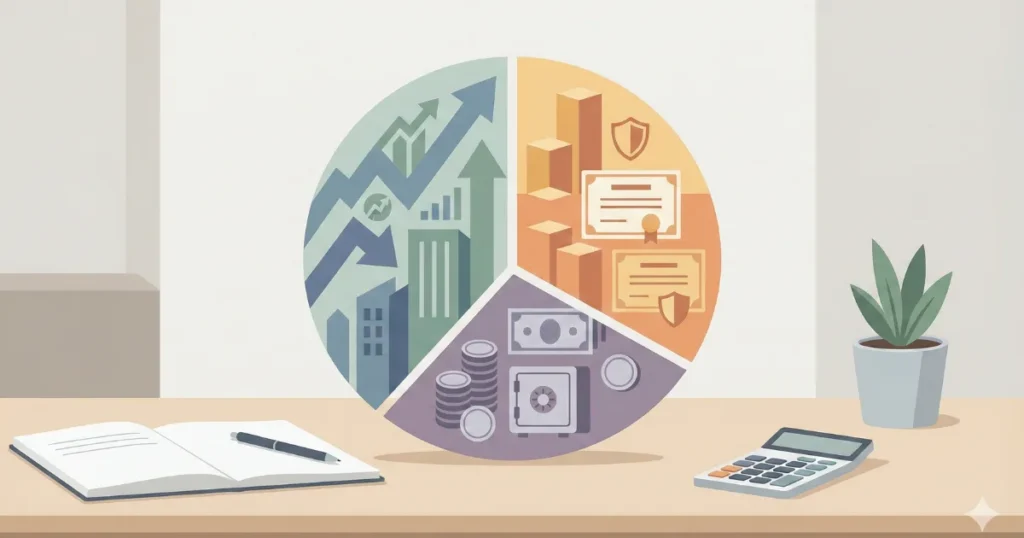
Diversification means not putting all your money in one place.
This applies at multiple levels:
- Across asset classes (equity, debt)
- Within equity (large-cap, mid-cap, international)
- Within debt (short-term, long-term)
What Diversification Does
- Reduces impact of a single bad event
- Smoothens returns over time
- Improves risk-adjusted performance
Diversification does not eliminate losses.
It reduces the severity of losses.
That difference decides whether investors stay calm or exit in panic.
Asset Allocation During Market Volatility
Recent market behavior has shown a clear pattern:
- Equity-heavy portfolios swing wildly
- Balanced portfolios decline less
- Conservative portfolios remain stable
When markets fall:
- Equity provides recovery potential
- Debt provides emotional stability
- Cash gives flexibility to rebalance
This is why asset allocation becomes more important during volatile phases, not less.
Simple Asset Allocation Models (Easy to Understand)
Conservative Allocation
- Equity: 20–30%
- Debt: 70–80%
Suitable for:
- Near-term goals
- Retirees
- Low risk tolerance
Balanced Allocation
- Equity: 50–60%
- Debt: 40–50%
Suitable for:
- Most working professionals
- Medium to long-term goals
- Moderate risk tolerance
Aggressive Allocation
- Equity: 70–80%
- Debt: 20–30%
Suitable for:
- Young investors
- Long-term wealth creation
- High risk tolerance
Your age, income stability, and goal timeline matter more than market predictions.
Asset Allocation vs Fund Selection
Many investors ask:
“Which fund should I choose?”
A better question is:
“How should I allocate my money?”
A perfect fund in a wrong allocation still fails.
An average fund in a good allocation often succeeds.
Studies consistently show:
Asset allocation explains most of long-term portfolio outcomes, not fund selection or market timing.
Rebalancing: The Missing Piece
Over time:
- Equity grows faster
- Allocation drifts
- Risk increases silently
Rebalancing means restoring your original allocation periodically.
Example:
If equity grows from 60% to 75%, you shift some money back to debt.
Rebalancing:
- Controls risk
- Forces disciplined profit booking
- Improves long-term consistency
You can evaluate this using return comparison tools like SIP vs Lump Sum calculators available on PlanMyReturns.
Common Asset Allocation Mistakes
- Investing only in equity during bull markets
- Ignoring debt completely
- Reacting emotionally to short-term volatility
- Copying others’ portfolios
- Not adjusting allocation as goals approach
Asset allocation is personal.
What works for someone else may fail for you.
How Asset Allocation Improves Financial Outcomes
A balanced portfolio:
- Reduces stress
- Improves consistency
- Helps you stay invested
- Aligns investments with real-life goals
Returns are meaningless if you cannot stay invested long enough to earn them.
Final Takeaway: Balance Beats Brilliance
Asset allocation is boring.
But boring is what builds wealth.
Instead of chasing returns:
- Focus on balance
- Control risk
- Stay invested
- Rebalance periodically
Markets will always be volatile.
A well-allocated portfolio helps you survive volatility and benefit from it.