A complete guide to NPS tax benefits for FY 2026-27 including the exclusive ₹50,000 extra deduction under Section 80CCD(1B), employer contribution benefits, tax treatment at maturity, and how to save up to ₹15,600 more tax every year.
The National Pension System (NPS) offers the single largest tax benefit any Indian investor can get in a year: ₹50,000 over and above the ₹1.5 lakh Section 80C limit. This exclusive deduction under Section 80CCD(1B) is not available in any other investment product. No other instrument – not PPF, not ELSS, not SSY – gives you this extra ₹50,000.
But most Indian taxpayers either do not know about this benefit or get confused by the three different NPS tax sections: 80CCD(1), 80CCD(1B), and 80CCD(2). This guide breaks down every NPS tax benefit for FY 2026-27 with exact calculations, eligibility rules, and real-life examples.
By the end of this guide, you will know exactly how much tax you can save with NPS, which sections apply to you, and whether NPS deserves a place in your financial plan.
Key Update for 2026: Budget 2025 retained all existing NPS tax benefits. The ₹50,000 extra deduction under Section 80CCD(1B) continues to be available only under the old tax regime. Employer contribution under 80CCD(2) remains available under both old AND new tax regimes. If you are in the new tax regime, your employer’s NPS contribution is your biggest tax-saving tool.
Understanding the 3 NPS Tax Sections
NPS tax benefits come from three separate sections of the Income Tax Act. Each section has different rules, different limits, and different eligibility. Understanding these is critical to maximizing your tax savings.
The winning strategy: Exhaust your ₹1.5 lakh 80C limit with other instruments first (PPF, ELSS, EPF). Then invest an additional ₹50,000 in NPS to claim the exclusive 80CCD(1B) benefit. This gives you a total deduction of ₹2,00,000 per year. Calculate the impact on your tax using the Income Tax Calculator.
See how much extra tax you save with NPS.
Enter your salary and NPS contribution to see your exact savings.
Section 80CCD(1B): The Extra ₹50,000 Explained
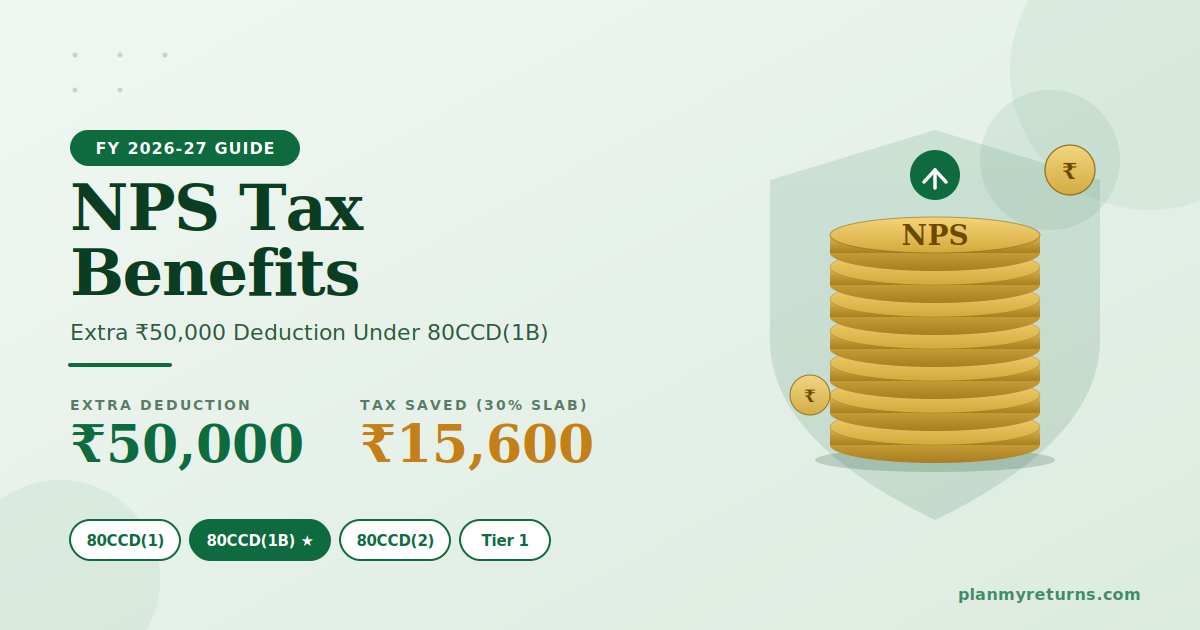
This is the headline benefit of NPS. Section 80CCD(1B) was introduced in 2015 to encourage long-term retirement savings. It allows an additional deduction of up to ₹50,000 for contributions to NPS Tier 1 account, completely separate from the ₹1.5 lakh 80C limit.
How much can you actually save? It depends on your income tax slab. Here is the exact breakdown for FY 2026-27 under the old tax regime:
Think about what this means. In the 30% tax slab, you invest ₹50,000 and immediately save ₹15,600 in taxes. That is a 31.2% return on day one, guaranteed. No market risk, no fund selection risk. Just the tax benefit alone. Before even counting the actual NPS investment returns of 9 to 12% CAGR.
Important Rule: The ₹50,000 under 80CCD(1B) must be contributions BEYOND your ₹1.5 lakh 80C claim. You cannot claim the same contribution under both sections. You also cannot claim 80CCD(1B) if you have not first exhausted the 80CCD(1) limit (10% of salary) separately.
Section 80CCD(2): Employer Contribution Benefit
This is the most overlooked NPS benefit, yet potentially the most valuable for senior employees. Section 80CCD(2) allows a deduction for your employer’s contribution to your NPS account, and this is over and above the ₹1.5 lakh 80C limit AND over and above the ₹50,000 under 80CCD(1B).
Employer contribution limits (FY 2026-27):
Real example: If your Basic + DA is ₹1,00,000/month (₹12 lakh/year) and your employer contributes 10% of this to your NPS, that is ₹1,20,000/year. This entire ₹1,20,000 is deductible from your taxable income under Section 80CCD(2). At the 30% tax slab, this saves you ₹37,440 in tax (including 4% cess).
This is the single biggest reason to ask your employer about NPS. Many companies offer NPS as an optional benefit but employees do not opt in because they do not understand the tax implication.
Calculate your employer’s NPS contribution benefit.
See exactly how much tax you can save with corporate NPS.
Maximum NPS Deduction: Stacking All 3 Sections
Here is the math that most tax advisors never show their clients. When you combine all three NPS sections optimally with your other 80C investments, you can deduct up to ₹3,20,000+ in a single financial year.
Real scenario: Rajesh, 35, Private Sector, Salary ₹15 lakh (Basic ₹7.5 lakh + HRA + others), Old Tax Regime
Tax savings for Rajesh: ₹2,75,000 × 30% = ₹82,500 + 4% cess = ₹85,800 in annual tax savings. That is ₹7,150 extra in his pocket every month, just from smart NPS usage.
Use the NPS Calculator to see how your own corpus grows with these contributions, and the Income Tax Calculator to verify your exact tax savings.
NPS vs Other Tax-Saving Options: Head-to-Head
How does NPS compare to PPF, ELSS, and other Section 80C alternatives for pure tax-saving purposes? Let’s compare the five most popular options side by side.
Verdict: NPS is not a replacement for PPF or ELSS. It is a complement to them. Use NPS specifically for the extra ₹50,000 benefit that no other product offers. Compare your own PPF vs ELSS vs NPS scenarios using the PPF Calculator, ELSS Calculator, and NPS Calculator.
NPS Tier 1 vs Tier 2: Which Gets Tax Benefits?
This confuses most first-time NPS investors. Only Tier 1 contributions qualify for tax deductions. Tier 2 is a flexible, voluntary savings account with NO tax benefits for private sector employees.
For tax-saving purposes, always invest in Tier 1. Tier 2 is useful only as a low-cost investment alternative to mutual funds, but it offers no tax advantage for private sector employees.
Tax Treatment at NPS Maturity (Age 60)
Getting tax deductions on NPS contributions is only half the story. What happens when you retire at 60? This is where the “EEE vs EET” debate comes in. Here are the exact rules as per Budget 2024 and continuing into FY 2026-27.
60% Lump Sum Withdrawal: Fully Tax-Free
At age 60, you can withdraw up to 60% of your accumulated NPS corpus as a tax-free lump sum. This was a major improvement over the earlier rule where only 40% was tax-free. The Budget 2019 amendment made this entire 60% portion completely exempt from income tax.
Example: If your NPS corpus at 60 is ₹2 crore, you can withdraw ₹1.2 crore (60%) as a tax-free lump sum.
40% Annuity Purchase: Mandatory
The remaining 40% of your NPS corpus must be used to purchase an annuity from an approved annuity service provider (ASP). This annuity pays you a monthly pension for life. Current annuity rates range from 5% to 7% depending on the annuity type chosen.
Taxation: The annuity purchase itself is tax-free. But the monthly pension you receive is taxed as regular income at your income tax slab rate in the year you receive it.
Example: If ₹80 lakh buys you an annuity yielding 6%, you get ₹48,000/month pension. This ₹5.76 lakh/year is added to your taxable income for that year.
Small Corpus Exception: Corpus Below ₹5 Lakh
If your total NPS corpus at age 60 is below ₹5 lakh, you can withdraw 100% as a tax-free lump sum. No annuity purchase is required. This is designed for low-income contributors who would get an impractically small monthly pension.
5 NPS Tax Tips Most People Miss
Tip 1: Do not claim NPS under 80C first. Many people fill up their ₹1.5 lakh 80C limit with NPS, then “discover” 80CCD(1B) and claim another ₹50,000. Smart move is the opposite. Fill 80C with PPF/ELSS/EPF first (since those lock in less money). Then use the ₹50,000 NPS quota for 80CCD(1B). Both routes give the same tax savings, but the second gives you more liquidity elsewhere.
Tip 2: Ask your employer to enable NPS. Even if you have a personal NPS account, you lose the 80CCD(2) employer benefit without corporate NPS. If your company does not offer NPS, request HR to add it. Most Indian companies have it available but employees are not aware.
Tip 3: Choose Active vs Auto allocation wisely. Auto Choice allocates based on your age (high equity when young, shifting to debt as you age). Active Choice lets you set your own equity/debt mix (max 75% equity till age 50). For anyone under 40, Active Choice with maximum equity allocation typically beats Auto Choice over 20+ years.
Tip 4: Partial withdrawal can be tax-free. After 3 years of NPS contributions, you can make partial withdrawals for specific purposes (higher education, house purchase, critical illness, marriage of children). Up to 25% of YOUR contributions (not employer’s or gains) can be withdrawn. Partial withdrawals are completely tax-free.
Tip 5: Do not exit NPS early for tax reasons. If you exit NPS before age 60 (other than for the specific allowed purposes), 80% of your corpus must be used to buy an annuity. Only 20% can be withdrawn as lump sum. The tax benefits you claimed earlier become questionable. Treat NPS as truly retirement-focused money.
Who Should NOT Invest in NPS?
NPS is not for everyone. Here are four scenarios where NPS might not be the right choice:
Real-Life Example: Anjali’s NPS Tax Planning
Anjali, 32, Product Manager in Pune. Annual salary: ₹18,00,000 (Basic + DA: ₹9,00,000). Old tax regime. Employer offers corporate NPS.
Anjali’s tax-saving plan uses all three NPS sections plus regular 80C:
Anjali’s tax savings: ₹2,90,000 × 30% = ₹87,000 + 4% cess = ₹90,480 per year. That is ₹7,540 extra in her take-home every month.
Corpus projection: Anjali contributes ₹50,000/year personal NPS + ₹90,000/year employer NPS = ₹1,40,000/year total into NPS. Assuming 10% CAGR for 28 years (till she is 60), her NPS corpus grows to approximately ₹1.79 crore. At 60, she can withdraw ₹1.07 crore tax-free and use ₹72 lakh for annuity yielding ₹4.3 lakh/year pension.
You can replicate Anjali’s plan using the NPS Calculator, SIP Calculator, and Income Tax Calculator on PlanMyReturns.
See your exact NPS corpus projection.
Enter your contribution, age, and expected returns to plan retirement.
How to Open an NPS Account in 2026
Opening an NPS account takes 15-20 minutes online via eNPS portal. You need: PAN card, Aadhaar linked to mobile, bank account details, cancelled cheque photo, scanned signature, and passport-size photo.
Steps: Visit the eNPS portal, choose “Registration” and select Tier 1 (tax benefits) or both Tier 1 + Tier 2. Enter PAN and complete Aadhaar OTP verification. Choose your pension fund manager (HDFC Pension, SBI Pension, ICICI Pension, LIC Pension, UTI, etc. – returns vary by 1-2% between them). Select your investment choice (Auto vs Active) and asset allocation. Make the first contribution (minimum ₹500). Your Permanent Retirement Account Number (PRAN) is generated instantly. You can also open NPS offline through any bank that is a registered Point of Presence (POP).
Plan Your Retirement Beyond NPS
NPS is one tool in your retirement toolkit, not the entire toolkit. Use these calculators on PlanMyReturns to plan a complete retirement strategy.
Calculate the total corpus you need at retirement with the Retirement Calculator. Plan a parallel equity SIP for additional wealth creation using the SIP Calculator. Build safe, tax-free corpus alongside NPS with the PPF Calculator. See your current take-home and scope for more NPS using the Take Home Salary Calculator. Chasing financial independence? Check your target corpus with the FIRE Calculator. Planning for early retirement at 50? Use the Crorepati Calculator.
Explore all free financial calculators at PlanMyReturns Calculators. Every calculation follows transparent methodology and assumptions you can verify.
Frequently Asked Questions: NPS Tax Benefits