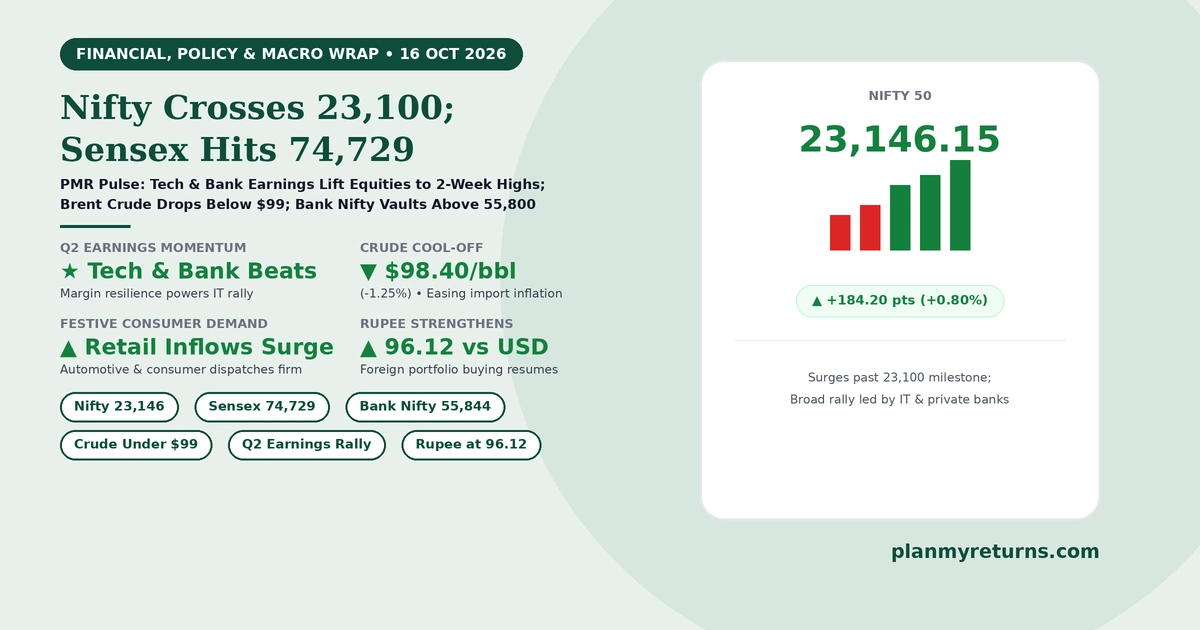
Today’s Overview: The Nifty 50 surged 184.20 points to close at 23,146.15 on October 16, 2026, while the BSE Sensex jumped 612.45 points to 74,729.27. Strong quarterly corporate earnings from technology and banking leaders, alongside Brent crude softening below $99, bolstered investor confidence across domestic equities, supporting household wealth creation as festive season consumer demand accelerated nationwide.
Today’s Top Finance & Economy Stories
1. Why Did Sensex Jump 612 Points and Nifty Vault Above 23,100 on Friday?
What happened: Indian equity benchmarks concluded the trading week on a decisive high note on Friday. The BSE Sensex surged +612.45 points (+0.83%) to close at 74,729.27, while the Nifty 50 advanced +184.20 points (+0.80%) to reclaim the psychological threshold of 23,100, settling at 23,146.15. Widespread buying in technology exporters, private banks, and passenger vehicle manufacturers propelled benchmark indices, while Bank Nifty rose +428.10 points (+0.77%) to 55,844.00.
Why it matters: Equities recovering past major resistance levels underscores the importance of maintaining consistent systematic investment plans without attempting to time market fluctuations. To model how uninterrupted monthly compounding performs across alternating market cycles, test your investment goals on our SIP Calculator.
Key Takeaway: Sensex jumped 612 points to 74,729 and Nifty crossed 23,146 as solid corporate earnings and softening crude lifted broad investor sentiment.
2. How Did Resilient Q2 Corporate Results Power Technology and Banking Shares?
What happened: Leading Indian software exporters and financial institutions reported second-quarter operating scorecards that surpassed analyst expectations. Information technology majors maintained operating profit margins above 21%, supported by effective cost optimization and steady digital transformation contracts across North America and Europe. Meanwhile, private banking leaders reported stable net interest margins (NIMs) near 3.5% alongside low non-performing assets.
Why it matters: Corporate earnings stability reinforces underlying stock valuations and drives long-term mutual fund net asset value expansion. For investors evaluating portfolio adjustments or averaging holding costs after volatile phases, monitor your asset positions using our Stock Average Calculator.
Key Takeaway: Tech companies protected 21%+ operating margins while banks sustained 13.8% credit growth, giving benchmarks fundamental backing.
3. How Is Festive Retail Credit Growth Supporting Financial Institutions?
What happened: Bank Nifty advanced 428.10 points to finish at 55,844.00, driven by healthy demand for vehicle loans, consumer durable financing, and personal credit lines during the pre-Diwali festive window. State Bank of India, HDFC Bank, and ICICI Bank registered active loan originations, benefiting from the Reserve Bank of India maintaining the benchmark repo rate at 6.50% during its monetary policy review.
Why it matters: Steady interest rates give prospective home buyers and consumer borrowers certainty on monthly repayment installments. If you are planning property acquisitions or reviewing mortgage interest amortizations, calculate your repayment schedule with our Home Loan EMI Calculator.
Key Takeaway: Bank Nifty closed near 55,850 on strong festive retail credit demand and stable interest rate benchmarks.
4. Gold at Rs 1.52 Lakh: How Should Households Approach Festive Bullion Purchases?
What happened: Indicative 24K retail gold edged up to Rs 1,52,400 per 10 grams on Friday, while silver traded at Rs 2,39,800 per kilogram as jewellers reported steady pre-booking inquiries ahead of Dhanteras. With physical jewellery carrying making charges between 10% and 18%, wealth advisers noted increasing retail adoption of electronic Gold Exchange Traded Funds (ETFs) and digital gold accumulation accounts.
Why it matters: Electronic Gold ETFs eliminate jewellery making charges and purity discounts, enabling households to participate in gold appreciation with complete liquidity and transparent exchange pricing. For families balancing festive budgets with disciplined wealth accumulation, structure your lump-sum investments on our Lumpsum Calculator and plan progressive yearly savings targets on our Step-Up SIP Calculator.
Key Takeaway: Retail gold held at Rs 1,52,400 per 10g, with savers increasingly combining physical jewellery with zero-making-charge Gold ETFs.
5. Why Did Brent Crude Fall Below $99 and How Does It Ease Household Inflation?
What happened: International benchmark Brent crude slipped 1.25% to trade at $98.40 per barrel on Friday, retreating below the $100 mark as global production supplies stabilized. Softening international crude prices supported the Indian Rupee, which strengthened 16 paise to close at 96.12 against the US Dollar, easing imported inflation concerns across commercial supply chains.
Why it matters: Lower crude oil prices lower domestic logistics costs for fast-moving consumer goods, fertilizers, and packaged transport fuels, directly protecting family disposable incomes. To see how changing inflation rates influence your long-term purchasing power and retirement nest egg, check your financial targets with our Inflation Calculator.
Key Takeaway: Brent crude retreating to $98.40 and the Rupee firming to 96.12 offer welcome macro relief for household living costs and corporate operating margins.
6. How Are Digital Payment Rails Powering Record Festive E-Commerce Transactions?
What happened: Digital payments processed through the Unified Payments Interface (UPI) saw record transaction volumes during mid-October, led by festive e-commerce sales and regional retail purchases. The National Payments Corporation of India (NPCI) noted that transaction counts consistently surpassed 520 million per day, aided by credit card on UPI integration and instant small-ticket checkouts via UPI Lite.
Why it matters: Seamless digital payment infrastructure provides individuals with automated spending records, making family cash-flow budgeting more transparent. For taxpayers planning end-of-year tax deductions and reviewing tax brackets under the current financial framework, evaluate your savings on our Old vs New Tax Regime Calculator.
Key Takeaway: Over 520 million daily UPI transactions supported nationwide festive shopping, signaling the expanding formalization of retail commerce.
Comprehensive Finance, Policy & Economic Updates
Banking, Regulatory & Tax Developments
- Lending Benchmark Stability: Commercial banks maintained External Benchmark Lending Rates (EBLR) tied to the 6.50% repo rate, keeping home loan EMIs predictable for retail borrowers.
- Form 26AS Tax Credit Updates: Tax deductors are completing quarterly statement reconciliation, enabling salaried employees and vendors to verify deposited September tax credits before the October 31 filing deadline.
- Input Tax Credit Matching for GST: Following the monthly GSTR-1 filing cut-off, accounting departments are reconciling supplier invoices in GSTR-2B to ensure compliant input tax credit claims under Section 16(2)(aa).
- Special Festive Term Deposit Rates: Leading public and private sector banks continue offering promotional fixed deposit yields between 7.40% and 7.80% for tenures of 400 to 500 days.
- Health Insurance Cashless Expansion: General insurance providers continue expanding network hospital tie-ups under the National Health Claims Exchange, streamlining cashless hospital admissions during the festive travel period.
Personal Wealth, FinTech & Consumer Living Costs
- Mutual Fund SIP Investment Inflows: Retail systematic investment contributions maintained strong daily momentum, providing consistent liquidity support to Indian equities as foreign institutional buying resumed.
- UPI Delegated Payments Rollout: NPCI digital rails expanded family delegated authorization features, enabling primary account holders to grant secure transaction limits to dependents and students.
- Festive Bullion Demand Dynamics: Indicative 24K retail gold traded at Rs 1,52,400 per 10 grams, prompting savers to evaluate electronic Gold ETFs to avoid jewellery making charges and storage overheads.
- Crude Oil Price Drop Below $99: Brent crude softening to $98.40 per barrel eased commercial logistics expenditure, reducing pressure on interstate trucking and packaged consumer goods delivery costs.
- Corporate Treasury Liquidity Deployment: Corporate treasury desks deployed short-term operational cash surpluses into liquid and overnight mutual funds following the first wave of second-quarter financial disclosures.
Market & Macro Snapshot
Market figures reflect official closing numbers on 16 October 2026. Indicative 24K retail gold was Rs 1,52,400 per 10g and retail silver was Rs 2,39,800 per 1kg. Retail rates vary across cities because of local taxes, octroi, and jeweller making charges.
Top Gainers & Losers Nifty 50, 16 October 2026
▲ Top 5 Gainers
- Infosys +2.45%
₹1,942.50 | Led benchmark rally after delivering solid Q2 operating margins and steady deal wins.
- HCL Technologies +2.10%
₹1,788.00 | Advanced on resilient software services revenue and maintained annual guidance.
- ICICI Bank +1.85%
₹1,272.00 | Lifted private banking index on healthy credit expansion and stable margins.
- Maruti Suzuki +1.60%
₹12,850.00 | Gained on positive festive booking dispatches and lower commodity input costs.
- Tata Motors +1.40%
₹968.20 | Supported by commercial vehicle demand and festive showroom delivery footfalls.
▼ Top 5 Losers
- ONGC -1.75%
₹278.40 | Pressured as international benchmark Brent crude dipped below $99 per barrel.
- Oil India -1.50%
₹504.20 | Softened on lower upstream crude price realisations.
- NTPC -0.90%
₹394.50 | Eased slightly as institutional funds rotated toward high-beta tech and consumer shares.
- Coal India -0.75%
₹472.00 | Traded with a mild negative bias following recent dividend ex-dates.
- JSW Steel -0.60%
₹985.00 | Consolidated in line with global metal price trends.
EBIT Margin (Operating Profit Margin)
Meaning: Earnings Before Interest and Taxes (EBIT) margin measures a company’s operating profitability as a percentage of total revenue. It indicates how effectively core business operations generate profit before factoring in capital structure financing costs and income tax payments.
Example: Major Indian software exporters sustaining EBIT margins above 21% during the second quarter demonstrated efficient delivery cost control, boosting benchmark investor confidence.
Frequently Asked Questions
Why did the Nifty 50 cross 23,100 on 16 October 2026?
The benchmark advance was driven by resilient second-quarter earnings from technology companies, solid private bank loan growth, and Brent crude oil dropping below $99 per barrel.
How does crude oil dropping below $99 benefit the Indian economy?
Crude oil below $99 reduces India’s energy import bill, supports the Rupee against the US Dollar, and lowers transportation freight expenses across domestic consumer supply chains.
Why are retail savers combining physical gold with Gold ETFs for festive purchases?
While physical jewellery satisfies traditional festive customs, Gold ETFs avoid making charges of 10% to 18% and offer complete exchange liquidity, allowing investors to participate in gold appreciation without storage costs.
Upcoming Market & Economic Events to Watch
- Second-Quarter Banking Earnings: Leading private and public sector commercial banks schedule quarterly scorecards next week.
- Q2 TDS/TCS Statement Filing Deadline: Mandatory quarterly statement remittance cut-off on October 31, 2026.
- Dhanteras & Diwali Bullion Demand: Physical jewellery showrooms track festive token demand and coin purchases.
- India Wholesale Price Index (WPI): Commerce Ministry releases monthly wholesale inflation readings.
Plan Your Financial Strategy with PlanMyReturns Tools
Use our free financial calculators to plan your savings, calculate loan payments, and estimate taxes:
- SIP Calculator: Calculate mutual fund returns over your investment horizon
- Stock Average Calculator: Calculate your average share price after multiple buys
- Home Loan EMI Calculator: Check your monthly home loan installments and interest schedule
- Old vs New Tax Regime Calculator: Compare your income tax bill under both tax slabs
- Inflation Calculator: Check how future prices change the purchasing power of your money
About PMR Pulse
PMR Pulse is PlanMyReturns’ flagship daily market and finance wrap. We track domestic stock benchmarks, global economic indicators, banking policies, taxation changes, and primary markets to give Indian households and investors clear, actionable context every trading day.