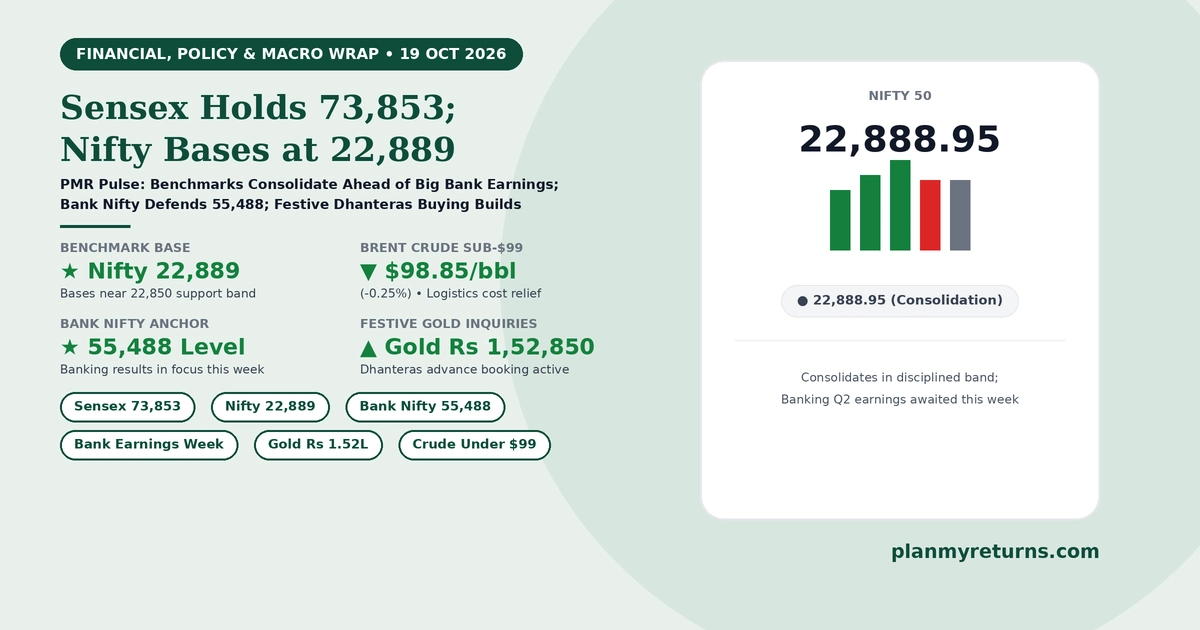
Today’s Overview: The Nifty 50 consolidated at 22,888.95 on October 19, 2026, while the BSE Sensex closed at 73,852.90. Domestic equity benchmarks established a steady foundation ahead of major banking quarterly scorecards, while stable private bank lending, sub-$99 crude oil, and expanding festive consumer activity supported household purchasing power across the economy.
Today’s Top Finance & Economy Stories
1. Why Are Benchmark Indices Basing at 22,889 Ahead of Heavyweight Bank Results?
What happened: Indian equity benchmarks consolidated in a disciplined range on Monday as trading commenced for the new week. The BSE Sensex closed at 73,852.90, while the Nifty 50 anchored at 22,888.95. Market participants adopted a wait-and-watch approach ahead of scheduled quarterly earnings from leading public and private sector commercial banks. Bank Nifty held firm at 55,488.10, showing steady underlying support across frontline financial lenders.
Why it matters: Range-bound sessions following recent market swings allow underlying valuations to absorb recent earnings data. For long-term systematic investors, disciplined allocations during base-building phases reduce average acquisition costs without market timing risk. To project your prospective compounding milestones through alternating market phases, calculate your returns on our SIP Calculator.
Key Takeaway: Sensex held 73,853 and Nifty closed at 22,889 as benchmarks established a solid support base ahead of key banking scorecards.
2. What Do Upcoming Commercial Bank Results Signal for Borrowers and Depositors?
What happened: Banking analysts forecast resilient second-quarter numbers from major commercial banks this week. Annualized loan growth across passenger vehicles, festive personal loans, and affordable mortgages remains steady near 14%. At the same time, Gross Non-Performing Asset (GNPA) ratios remain at historical lows below 2.2%, providing lenders with healthy capital adequacy to support economic activity.
Why it matters: Strong bank balance sheets enable competitive lending terms and ensure stability for retail depositors. With floating home loan benchmarks tethered to the 6.50% repo rate, prospective home buyers can structure long-term financing without facing sudden rate shocks. To calculate your monthly mortgage obligations and review amortization schedules, use our Home Loan EMI Calculator.
Key Takeaway: Clean bank balance sheets and 13.8% credit expansion provide steady economic anchors for borrowers and investors alike.
3. Gold at Rs 1.52 Lakh: How Can Households Structure Pre-Dhanteras Purchases Efficiently?
What happened: Indicative 24K retail gold traded at Rs 1,52,850 per 10 grams on Monday, while silver held at Rs 2,40,500 per kilogram as domestic jewellers reported growing advance booking registrations ahead of Dhanteras. Retail financial advisers noted that while physical coins and jewellery meet ceremonial family customs, digital Gold ETFs and Sovereign Gold Bonds (SGBs) on secondary markets allow households to invest without paying 10% to 18% in jewellery making charges.
Why it matters: Separating personal jewellery adornment from financial investment prevents high fabrication charges from reducing your net investment return. For families planning lump-sum investments or setting progressive annual savings targets, structure your goals on our Lumpsum Calculator and model increasing contributions on our Step-Up SIP Calculator.
Key Takeaway: Retail gold held near Rs 1.52 lakh per 10g, with financial advisers recommending a balanced mix of traditional jewellery and zero-making-charge Gold ETFs.
4. Why Range-Bound Market Phases Offer Ideal Conditions for Mutual Fund SIP Accumulation
What happened: As benchmark indices settled into a narrow base-building band, mutual fund transfer agencies registered steady daily systematic investment plan (SIP) execution. Retail investors maintained uninterrupted monthly contributions, channeling steady domestic liquidity into large-cap, flexi-cap, and balanced advantage funds.
Why it matters: Range-bound market phases allow rupee-cost averaging to build long-term value by accumulating units at stable net asset values without paying breakout premiums. If you are calculating the revised average acquisition price of your equity investments after multiple purchases, use our Stock Average Calculator.
Key Takeaway: Range-bound market sessions maximize rupee-cost averaging efficiency by accumulating mutual fund units at reasonable entry valuations.
5. How Does Brent Crude Below $99 Support Everyday Household Living Budgets?
What happened: International benchmark Brent crude eased to $98.85 per barrel (-0.25%) on Monday, maintaining its position below the crucial $100 psychological ceiling. The Indian Rupee closed steady at 96.18 per US Dollar. Moderating oil import prices helped prevent diesel freight cost escalations across national transit routes.
Why it matters: Sub-$99 crude oil directly lowers input costs for consumer goods packaging, petrochemical raw materials, and logistics distribution, protecting family monthly grocery budgets. To examine how changing inflation rates influence your long-term purchasing power and retirement corpus, model your goals with our Inflation Calculator.
Key Takeaway: Brent crude trading at $98.85 eases imported inflation concerns and protects household discretionary purchasing power.
6. How Are High-Speed Digital Payment Networks Driving Record Festive Commerce?
What happened: Unified Payments Interface (UPI) transaction processing maintained strong momentum across retail shopping hubs, regularly logging over 520 million transactions daily. Real-time settlement rails enabled small retail shop owners and e-commerce platforms to process seamless merchant payments during peak pre-Diwali demand.
Why it matters: Automated digital payment infrastructure provides individuals with accurate transaction logs, simplifying monthly expense categorization and tax reconciliation. For salaried professionals and consultants reviewing annual deductions under both tax systems, compare your liability with our Old vs New Tax Regime Calculator.
Key Takeaway: Over 520 million daily UPI transactions powered nationwide festive retail shopping, enhancing cash-flow transparency for businesses and consumers.
Comprehensive Finance, Policy & Economic Updates
Banking, Regulatory & Tax Developments
- Bank Lending Rate Stability: Scheduled commercial banks maintained home loan External Benchmark Lending Rates (EBLR) tied to the 6.50% repo rate, keeping monthly repayments predictable.
- Form 26AS Tax Credit Reconciliation: Accounting departments and deductors are completing TDS verification ahead of the October 31 quarterly filing deadline, ensuring tax credits reflect accurately for taxpayers.
- Mid-October GST Tax Planning: Businesses are preparing monthly GSTR-3B return submissions, reconciling electronic credit ledgers and supplier invoices under Section 16(2)(aa).
- Promotional Fixed Deposit Windows: Leading public and private banks continue offering special festive deposit yields between 7.40% and 7.80% for tenures of 400 to 500 days.
- Health Insurance Cashless Expansion: General insurance providers continued onboarding network hospitals under the National Health Claims Exchange (NHCX), reducing claim processing times.
Personal Wealth, FinTech & Consumer Living Costs
- Mutual Fund Systematic Inflow Stability: Retail mutual fund SIP contributions maintained steady daily run-rates, providing vital domestic liquidity absorption in equity schemes.
- UPI Circle Delegated Payments Rollout: NPCI digital rails expanded family delegated payment features, allowing primary users to assign secure, limit-bound spending limits to dependents.
- Pre-Dhanteras Bullion Token Inquiries: Retail 24K gold held firm at Rs 1,52,850 per 10 grams, prompting savers to evaluate zero-making-charge Gold ETFs to minimize acquisition friction.
- Crude Freight Stability Under $99: Brent crude trading at $98.85 per barrel kept commercial transportation and fuel surcharges stable across interstate freight routes.
- Corporate Treasury Cash Management: Corporate treasury desks parked short-term operational cash surpluses into overnight and liquid mutual funds ahead of upcoming financial disclosures.
Market & Macro Snapshot
Market figures reflect official closing numbers on 19 October 2026. Indicative 24K retail gold was Rs 1,52,850 per 10g and retail silver was Rs 2,40,500 per 1kg. Retail rates vary across cities because of local taxes, octroi, and jeweller making charges.
Top Gainers & Losers Nifty 50, 19 October 2026
▲ Top 5 Gainers
- HDFC Bank +1.25%
₹1,725.00 | Advanced on expectations of healthy Q2 loan growth and stable asset quality.
- ICICI Bank +1.10%
₹1,280.00 | Gained on steady retail lending dispatches ahead of quarterly results.
- Sun Pharma +0.85%
₹1,952.00 | Supported by defensive fund allocation and specialty sales momentum.
- Asian Paints +0.70%
₹3,172.00 | Lifted by Brent crude holding comfortably below the $99 threshold.
- ITC +0.55%
₹518.00 | Maintained steady performance on positive festive consumer demand.
▼ Top 5 Losers
- Tata Motors -1.95%
₹935.00 | Consolidated following sharp gains in earlier trading sessions.
- Infosys -1.60%
₹1,878.00 | Witnessed minor profit taking following recent post-earnings rally.
- Tech Mahindra -1.45%
₹1,605.00 | Eased alongside technology exporters in range-bound trade.
- Wipro -1.20%
₹532.00 | Traded with a mild negative bias ahead of corporate announcements.
- JSW Steel -1.05%
₹978.00 | Pressured by international industrial metal future movements.
Provisioning Coverage Ratio (PCR)
Meaning: Provisioning Coverage Ratio (PCR) is the percentage of funds set aside by a bank to cover prospective losses from bad loans or Non-Performing Assets (NPAs). A higher PCR (typically above 70%) demonstrates that a bank has strong financial buffers to absorb loan defaults without hurting its capital solvency.
Example: Major Indian commercial banks maintaining PCR levels above 76% ahead of second-quarter earnings demonstrated balance sheet strength, protecting depositor funds and supporting credit growth.
Frequently Asked Questions
Why are benchmark indices consolidating near 22,889 on 19 October 2026?
Following recent market advances, indices entered a healthy base-building phase as institutional investors evaluate upcoming quarterly earnings from frontline commercial banks.
How should retail buyers structure gold purchases ahead of Dhanteras?
Financial planners suggest allocating ceremonial purchases toward physical coins or jewellery while deploying investment capital into Gold ETFs to bypass traditional making charges of 10% to 18%.
Why is Bank Nifty holding firmly above 55,400?
The banking index is supported by stable credit expansion near 14%, multi-year low non-performing assets, and steady festive demand for vehicle and housing loans.
Upcoming Market & Economic Events to Watch
- Commercial Banking Q2 Earnings: Leading private and public sector lenders report quarterly scorecards this week.
- Q2 TDS/TCS Statement Remittance Cut-off: Mandatory quarterly statement remittance deadline on October 31, 2026.
- Dhanteras Bullion Shopping Window: Physical showrooms and online platforms manage peak festive gold coin deliveries.
- Fortnightly RBI Bank Credit Data: Central bank releases updated banking loan and deposit expansion statistics.
Plan Your Financial Strategy with PlanMyReturns Tools
Use our free financial calculators to plan your savings, calculate loan payments, and estimate taxes:
- SIP Calculator: Calculate mutual fund returns over your investment horizon
- Stock Average Calculator: Calculate your average share price after multiple buys
- Home Loan EMI Calculator: Check your monthly home loan installments and interest schedule
- Old vs New Tax Regime Calculator: Compare your income tax bill under both tax slabs
- Inflation Calculator: Check how future prices change the purchasing power of your money
About PMR Pulse
PMR Pulse is PlanMyReturns’ flagship daily market and finance wrap. We track domestic stock benchmarks, global economic indicators, banking policies, taxation changes, and primary markets to give Indian households and investors clear, actionable context every trading day.