
Whenever markets become uncertain, investors do not search for theory.
They search for reassurance.
Questions like:
- Should I stop my SIP now?
- Is this a good time to invest a lump sum?
- What if markets fall more after I invest?
- What did investors do during past uncertain markets?
Uncertainty does not break wealth creation. Confusion does.
This article cuts through fear, explains what history consistently shows, and helps you choose a strategy you can actually stick with.
Why Uncertain Markets Feel So Hard to Invest In
Uncertain markets usually come with:
- Sharp market swings
- Negative headlines around rates, inflation, or global events
- Social media panic
- Regret from past decisions
The problem is not volatility itself.
The real problem is decision paralysis.
This is exactly why SIP and lump sum investing behave very differently when markets are unstable.
How SIP Investing Behaves When Markets Are Uncertain
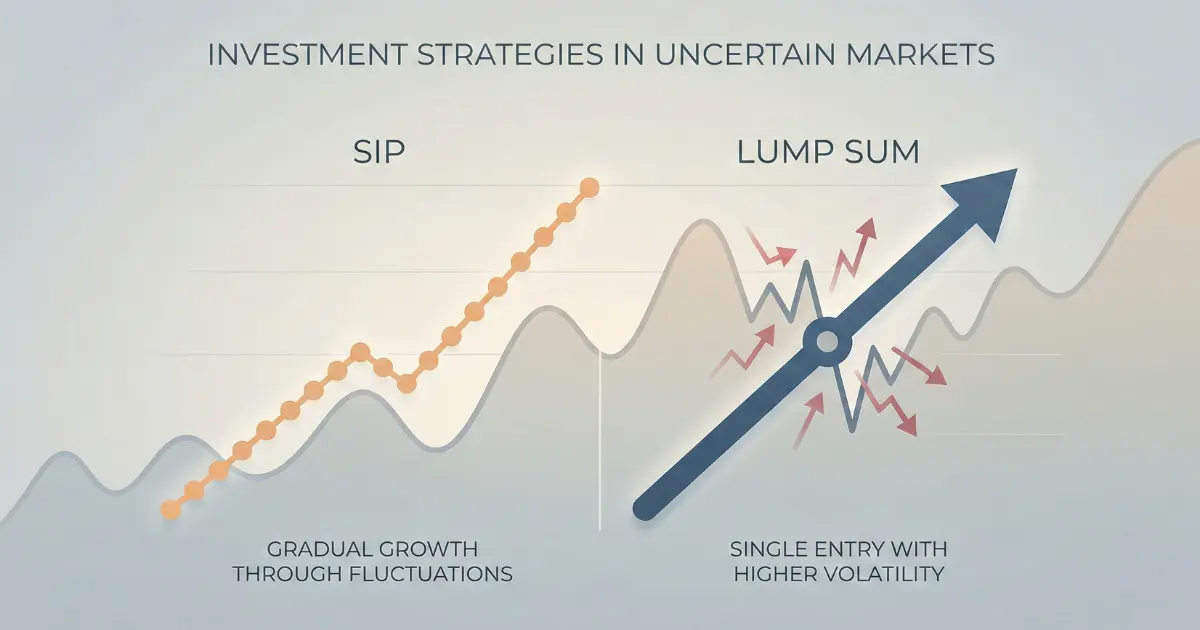
A SIP invests a fixed amount at regular intervals, regardless of market conditions.
In uncertain markets:
- You automatically buy more units when prices fall
- You buy fewer units when prices rise
- Your average purchase cost stabilizes over time
This is why SIPs are often called behaviorally safer investments.
If you want to understand how this works with real numbers, the
SIP Calculator helps visualize how regular investing smoothens market volatility over time:
SIPs remove the need to answer the hardest question in investing:
“Is this the right time?”
How Lump Sum Investing Behaves During Market Volatility
Lump sum investing puts a large amount into the market at one time.
In uncertain markets:
- Good timing can lead to strong long-term gains
- Poor timing can lead to uncomfortable short-term losses
- Emotional pressure is much higher
History shows that lump sum investing works best only when investors have clarity, patience, and surplus capital.
The challenge is not math.
The challenge is psychology.
You can test different timing scenarios using the
Lump Sum Calculator to see how entry timing affects long-term outcomes:
What History Repeatedly Teaches About SIP vs Lump Sum
Across different market cycles, one pattern repeats.
During Market Falls
- SIP investors continue buying at lower prices
- Lump sum investors hesitate or delay investing
- Those who stopped SIPs usually missed the best accumulation phase
During Recovery Phases
- SIP portfolios built during uncertainty often outperform expectations
- Lump sum investments work only if investors stayed calm through volatility
During Sideways or Confusing Markets
- SIPs quietly build positions
- Lump sum investors wait for clarity that rarely arrives on time
History does not reward prediction.
It rewards participation with discipline.
Risk Is Not Market Movement. Risk Is Investor Behavior.
This is the most misunderstood truth.
SIP Risk Profile
- Low timing risk
- Lower emotional stress
- Encourages long-term consistency
- Designed for salaried and goal-based investors
Lump Sum Risk Profile
- High timing dependency
- Short-term losses feel magnified
- Requires emotional strength and patience
- Best suited for surplus money, not essential savings
During uncertain markets, behavioral risk matters more than return projections.
SIP vs Lump Sum: Which One Actually Fits You Right Now?
SIP Usually Makes More Sense If:
- You earn regular income
- You feel anxious during market corrections
- Your goals are long term
- You do not want to time markets
- You value peace of mind over short-term returns
SIPs help investors stay invested when confidence is low.
Lump Sum Can Make Sense If:
- You already invest through SIPs
- You have surplus cash
- You can tolerate temporary losses
- You plan to invest gradually, not all at once
Very few investors succeed with aggressive lump sum investing during uncertainty.
Those who do are disciplined, not lucky.
The Most Practical Strategy During Uncertain Markets
History quietly favors a middle path.
- Continue SIPs without interruption
- Invest lump sum money in phases
- Increase allocation during deeper corrections
- Avoid reacting to news or predictions
This approach balances discipline with opportunity.
If you want to compare both strategies side by side using the same assumptions, the
SIP vs Lump Sum Calculator helps you see how each approach behaves over time:
Numbers often calm emotions better than opinions.
Common Investor Mistakes During Uncertain Markets
- Stopping SIPs after market falls
- Waiting endlessly for the perfect bottom
- Investing lump sum based on headlines
- Changing strategy frequently
- Comparing returns over short periods
Most wealth is lost not in crashes, but in reactionary decisions.
What Smart Investors Focus On Instead
- Asset allocation, not market levels
- Consistency, not prediction
- Long-term goals, not short-term noise
- Process, not emotions
Uncertain markets are uncomfortable, but they are also where future returns quietly begin.
The Question That Actually Matters
Instead of asking:
“Is this the right time to invest?”
Ask:
“Can I follow this strategy even if markets stay uncertain for years?”
History shows that investors who answer that honestly usually win.
SIPs protect you from bad timing.
Lump sums reward discipline, not bravery.
A thoughtful combination works best for most people.
Uncertainty never disappears.
A good investment process makes it manageable.