A data-based look at whether fixed deposit rates in India are keeping up with inflation in 2026. Covers current FD rates across major banks, where CPI inflation stands today, what your FD actually earns after tax, and practical ways to protect your savings from losing real value.
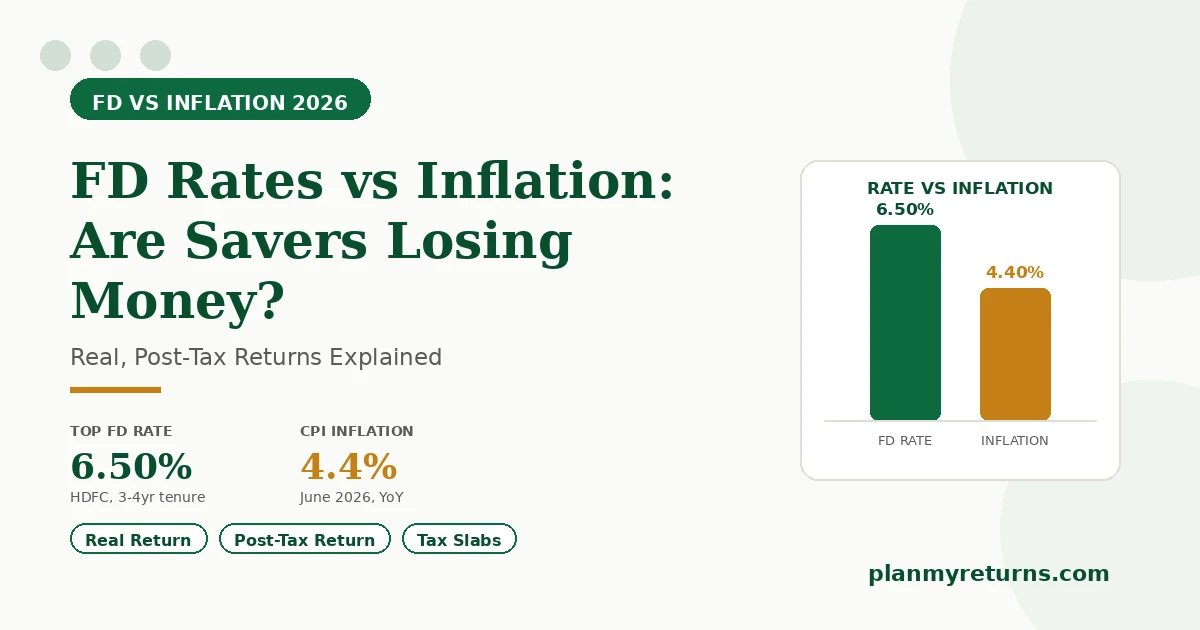
Where things stand in July 2026: The RBI has held the repo rate at 5.25% through its recent policy meetings. Top bank FD rates for regular tenures sit between roughly 6.05% and 6.50%, while retail CPI inflation was running near 4.4% in June 2026 and is projected by the RBI to average around 5.1% for FY 2026-27, with a further pickup expected later in the year.
A fixed deposit feels safe because the number on your passbook only goes up. What it hides is the second number that matters just as much: what that money can actually buy once inflation and tax have both taken their share. In 2026, with inflation trending back up after a quiet patch, that gap deserves a closer look.
This article walks through where FD rates and inflation actually stand today, works out real, post-tax returns across tax slabs, and lays out what savers can realistically do about it.
Quick Answer: At current rates, a saver in the 30% tax bracket earning a typical 6.25% FD rate is left with a post-tax return of about 4.4%, which is roughly in line with or slightly below current inflation. Savers in lower tax slabs, and senior citizens on higher FD rates, fare somewhat better, but the real, inflation-adjusted return on a plain FD remains thin for most people in 2026.
Where FD Rates Stand in July 2026
FD rates have stayed largely range-bound this year, with the RBI holding its repo rate steady after an earlier round of cuts. Here is how the major banks compare on regular, non-senior-citizen fixed deposits below Rs 3 crore, effective July 2026.
| Bank | 1-Year FD | 3-Year FD | 5-Year / 10-Year FD | Highest Published Rate |
|---|---|---|---|---|
| State Bank of India | 6.25% | 6.30% | 6.05% | 6.45% (444-day special) |
| HDFC Bank | 6.25% | 6.45% | 6.40% / 6.15% | 6.50% (3yr 1 day – 4yr 7mo) |
Note: Rates vary by bank and change frequently. Small finance banks currently advertise rates up to around 8%, but these come with a different risk and deposit-insurance profile than large public and private sector banks, so compare the fine print before chasing the headline number.
Where Inflation Stands
Retail inflation, measured by the CPI, eased to unusually low levels in late 2025 before picking back up through the first half of 2026. By June 2026, CPI inflation had risen to around 4.4% year-on-year, and the RBI has flagged further upward pressure, projecting inflation to average roughly 5.1% for FY 2026-27, rising toward 5.9% in the second half of the year in some forecasts.
Why this matters for FD holders: A fixed deposit locks in today’s rate for the full tenure, but inflation does not stay fixed. If you book a 3-year FD when inflation is low and inflation then climbs, as forecasts currently suggest, your real return over the life of that deposit can shrink well below what it looked like on the day you opened it.
The Real Return Calculation: FD Rate Minus Tax Minus Inflation
The number that actually matters is not the FD rate you see advertised, but what is left after the taxman and inflation both take a cut. FD interest is added to your total income and taxed at your slab rate, with no indexation benefit, unlike some other debt investments.
Applying this to a representative 6.25% one-year FD rate against current inflation of roughly 4.4% gives a clear picture of how tax bracket changes the outcome.
| Tax Slab | Post-Tax FD Return | Inflation | Real Return |
|---|---|---|---|
| 0% (no tax liability) | 6.25% | 4.4% | +1.85% |
| 5% | 5.94% | 4.4% | +1.54% |
| 20% | 5.00% | 4.4% | +0.60% |
| 30% | 4.38% | 4.4% | ≈ 0.00% |
Reading this table: A saver with no tax liability still earns a modest positive real return. A saver in the highest 30% slab is left with a real return of roughly zero once inflation is accounted for, meaning the FD is mainly preserving purchasing power rather than growing it. These figures use a representative 1-year rate and the latest available inflation print; your own numbers will shift with the exact rate, tenure, and inflation figure at the time.
Want your own real return, not an average? Compare FD maturity value against a recurring deposit, or work out the exact post-tax figure for your slab.
Try the FD CalculatorAre Savers Actually Losing Money?
Strictly in nominal terms, no saver loses money on an FD, since the principal and the promised interest are both guaranteed. The more accurate framing is purchasing power: if your post-tax FD return trails inflation, the same maturity amount buys less than your original deposit would have bought on the day you invested it.
For higher tax bracket savers today, the gap between post-tax FD returns and inflation is thin enough that they are close to standing still in real terms, and could slip into negative real returns if inflation rises further as the RBI’s own forecasts suggest for the coming quarters.
What Savers Can Do About It
Ladder Your FD Tenures
Instead of locking your entire corpus into one tenure, split it across multiple maturities. This lets you reinvest a portion at the prevailing rate periodically, so you are not stuck at today’s rate for years if inflation and rates both move up.
Use Senior Citizen and Special Scheme Rates Where Eligible
If you or a family member qualifies as a senior citizen, the additional interest, combined with a potentially lower tax slab in retirement, can meaningfully improve the real return compared to a working-age depositor in a higher bracket.
Manage the Tax Drag Deliberately
Submit Form 15G or 15H if your total income is below the taxable threshold, to avoid unnecessary TDS. If you are jointly managing family finances, consider whether deposits in the name of a lower-tax-bracket family member make sense for a portion of your savings.
Balance FDs With Growth-Oriented Instruments
For near-term needs and emergency funds, an FD’s safety and predictability still make sense. For long-term goals, such as retirement or a goal more than seven to ten years away, relying entirely on FDs makes it harder to outpace inflation over time, so many savers balance FDs with equity or hybrid instruments for that portion of their portfolio.
Decision Checklist Before You Book an FD
- Confirm the exact rate for your chosen tenure, not just the bank’s headline “highest rate,” which usually applies to one specific tenure band
- Calculate your post-tax return using your actual income tax slab, not the pre-tax advertised rate
- Compare that post-tax return against the current CPI inflation figure and the RBI’s forward inflation projection, not just today’s number
- Check whether you are eligible for a senior citizen or special-scheme premium rate
- Decide whether this money is for a near-term need, where FD safety matters most, or a long-term goal, where relying only on FDs may not outpace inflation
- Consider laddering tenures instead of locking the full amount into a single long tenure at today’s rate
Frequently Asked Questions
Conclusion
FDs are not losing savers money in the literal sense, the principal and promised interest are always paid. The real issue is quieter: for savers in higher tax brackets, today’s FD rates leave little to no cushion above inflation, and the RBI’s own forecast points to inflation rising further this year. That does not mean abandoning FDs, it means being deliberate about tenure, tax planning, and how much of your long-term savings sit in fixed-return instruments versus growth assets.
Check your exact post-tax maturity value with the FD Calculator, compare it against a recurring deposit using the FD vs RD Comparison Calculator, and see how today’s inflation erodes a rupee over time with the Inflation Calculator.