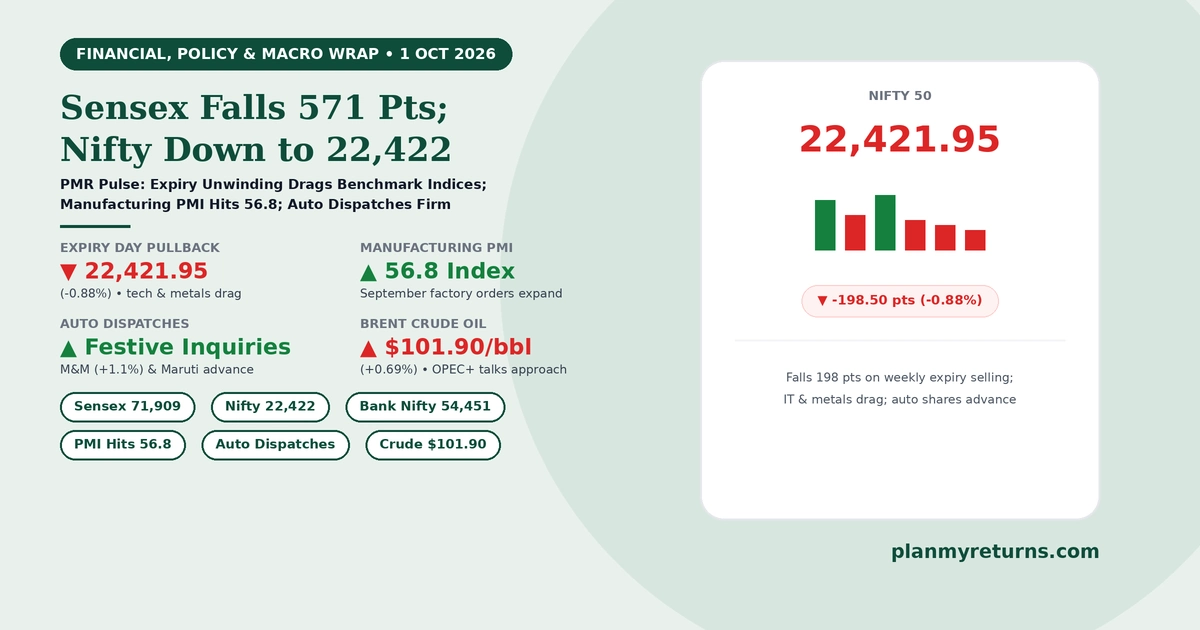
Today’s Overview: The Nifty 50 tumbled 198.50 points to 22,421.95 on October 1, 2026, while the BSE Sensex fell 570.57 points to 71,909.72. Weekly derivatives expiry liquidations and weakness across IT and metal counters pressured sentiment, even as September manufacturing PMI signaled healthy industrial expansion and automakers posted steady festive vehicle dispatches.
Today’s Top Finance & Economy Stories
1. Why Did Sensex Drop 571 Points Below 72,000 on the Opening Session of October?
What happened: Indian equity benchmarks commenced October under pressure as weekly derivatives expiry selling compounded weakness in software exporters and metal producers. The BSE Sensex fell -570.57 points (-0.79%) to close below the 72,000 level at 71,909.72, while the Nifty 50 slipped -198.50 points (-0.88%) to 22,421.95. Bank Nifty shed -182.30 points (-0.33%) to 54,450.75, giving back a portion of Wednesday’s quarter-end rally.
Why it matters: Early-month contract unwinding provides disciplined mutual fund investors with opportunities to accumulate quality equity assets at lower valuations. To examine how consistent periodic investments build long-term wealth across market pullbacks, simulate your targets on our SIP Calculator.
Key Takeaway: Weekly derivatives expiry selling and broad sector consolidation knocked 571 points off Sensex and 198 points off Nifty.
2. Why Did Brent Crude Hold Near $102 as Global Central Banks Maintained Cautious Stances?
What happened: International benchmark Brent crude traded modestly higher at $101.90 per barrel (+0.69%) on Thursday as energy traders monitored preliminary discussions among OPEC+ members regarding November output allocations. Across currency desks, the US Dollar Index hovered steadily at 105.1, leading the Indian Rupee to close slightly weaker at 96.48 per US Dollar amid moderate foreign fund sales.
Why it matters: Sustained energy costs elevate industrial input expenditures and impact household discretionary budgets. To calculate how persistent commodity price inflation alters your long-term savings purchasing power, test your future financial milestones on our Inflation Calculator.
Key Takeaway: Crude oil held near $102 while the Rupee closed at 96.48, keeping imported inflation monitoring active across domestic markets.
3. How Did India’s Manufacturing PMI Perform in September?
What happened: The S&P Global India Manufacturing Purchasing Managers’ Index (PMI) printed a solid reading of 56.8 for September, comfortably remaining in expansion territory well above the critical 50 threshold. Factory operators highlighted steady order inflows from domestic and international clients, accompanied by heightened inventory accumulation ahead of major festive holidays.
Why it matters: Sustained manufacturing strength underpins corporate revenue growth and employment creation across core industrial corridors. For individuals evaluating long-term lump-sum portfolio allocations following macro economic releases, calculate your compounding horizons with our Lumpsum Calculator.
Key Takeaway: India’s September manufacturing PMI reached 56.8, confirming healthy industrial order books and production expansion.
4. How Did Automakers Perform in September Wholesale Dispatches?
What happened: Automotive manufacturers reported steady dispatch volumes for September on Thursday. Mahindra & Mahindra recorded an 11% year-on-year increase in sport utility vehicle deliveries, while Maruti Suzuki and Tata Motors reported steady passenger vehicle shipments. Two-wheeler makers highlighted positive dealer restocking in anticipation of Navratri and Diwali showroom footfalls.
Why it matters: Strong automotive dispatches signal healthy consumer balance sheets and positive household spending sentiment. For buyers planning vehicle or home upgrades with institutional financing, evaluate your monthly repayment schedule on our Home Loan EMI Calculator.
Key Takeaway: Automobile manufacturers posted solid September dispatches, supported by healthy dealer stocking for the festive shopping season.
5. How Did Institutional Capital Move on the First Day of the New Quarter?
What happened: On the first trading session of October, Foreign Institutional Investors (FIIs) recorded net sales of ₹2,150 crore in the cash equity segment, continuing selective profit booking across large caps. Conversely, Domestic Institutional Investors (DIIs) sustained their counter-balancing role by purchasing ₹1,880 crore in equities, absorbing selling pressure across banking, auto, and pharmaceutical counters.
Why it matters: Systematic retail mutual fund investments provide continuous liquidity support against foreign capital adjustments. If you are calculating the updated average cost per share after adding quality stocks during market dips, track your positions with our Stock Average Calculator.
Key Takeaway: FIIs offloaded ₹2,150 crore while DIIs bought ₹1,880 crore, establishing orderly liquidity at lower index valuations.
6. Why Did Information Technology and Metal Shares Face Selling Pressure?
What happened: Software services exporters and metal stocks led Thursday’s declines. Tech Mahindra fell 2.10% to ₹1,450.85, Infosys lost 1.45% to ₹1,489.50, and Tata Steel retreated 1.85% to ₹151.35. Global tech spending cautions and soft international commodity pricing prompted traders to book profits in cyclical and technology contracts on weekly expiry day.
Why it matters: Sectoral rotations illustrate the necessity of maintaining balanced asset distribution across both defensive and cyclical holdings. For taxpayers planning investment deductions and income tax exemptions, evaluate your tax bracket on our Old vs New Tax Regime Calculator, and set increasing annual savings goals on our Step-Up SIP Calculator.
Key Takeaway: Technology and metal shares dropped between 1.4% and 2.1%, accounting for the bulk of Thursday’s benchmark index decline.
7. Which Stocks Gained and Lost the Most Ground on Thursday, 1 October 2026?
What happened: Top gainers on the Nifty 50 included select auto and healthcare names: Mahindra & Mahindra (+1.10% to ₹3,224.30), Cipla (+0.80% to ₹1,616.50), Sun Pharma (+0.60% to ₹1,926.90), Maruti Suzuki (+0.55% to ₹12,480.00), and State Bank of India (+0.35% to ₹1,011.45). Leading losers were spearheaded by Tech Mahindra (-2.10% to ₹1,450.85), Tata Steel (-1.85% to ₹151.35), Hindalco Industries (-1.60% to ₹669.70), Infosys (-1.45% to ₹1,489.50), and Larsen & Toubro (-1.25% to ₹3,424.65).
Why it matters: Automobile shares stood out positively on strong September dispatches, while export-oriented IT and metals faced notable consolidation. For savers building balanced, all-weather portfolios, assess your long-term compounding with our SIP Calculator.
Key Takeaway: Auto and pharma shares resisted the downturn, while tech and metal heavyweights led losses across broader indices.
Comprehensive Finance, Policy & Market Updates
Macro, Regulatory & Commodity Updates
- Expiry Day Drawdown: Sensex dropped 570.57 points and Nifty lost 198.50 points on weekly options settlement unwinding.
- Manufacturing Health: S&P Global India Manufacturing PMI printed 56.8 for September, showing resilient factory demand.
- Crude Benchmark Firmness: Brent crude traded at $101.90 a barrel as international traders evaluated OPEC+ supply outlooks.
- Currency Pressure: The Indian Rupee closed at 96.48 per US dollar under moderate foreign portfolio sales.
- Precious Metals Firmness: Retail 24K gold rose to Rs 1,52,300 per 10g, while retail silver closed at Rs 2,39,400 per 1kg on festive demand.
- NSE Day-6 Trade: National Stock Exchange shares traded at ₹1,812.50 on the BSE, preserving gains over the ₹1,785 issue price.
- Digital Payment Volume: NPCI reported steady UPI transaction throughput as festive shopping season promotions commenced.
Corporate Stock Buzzers
- Mahindra & Mahindra: Gained 1.10% to ₹3,224.30 on double-digit September SUV dispatch growth.
- Cipla: Advanced 0.80% to ₹1,616.50 on defensive pharmaceutical accumulation.
- Sun Pharma: Added 0.60% to ₹1,926.90, maintaining steady health care sector demand.
- State Bank of India: Rose 0.35% to ₹1,011.45, sustaining levels above the ₹1,000 threshold.
- Tech Mahindra: Slipped 2.10% to ₹1,450.85 on software consulting profit booking.
- Tata Steel: Declined 1.85% to ₹151.35 on softer global steel benchmark prices.
- Infosys: Dropped 1.45% to ₹1,489.50, weighing on benchmark technology indices.
Market & Macro Snapshot
Market figures reflect official closing numbers on 1 October 2026. Indicative 24K retail gold was Rs 1,52,300 per 10g and retail silver was Rs 2,39,400 per 1kg. Retail rates vary across cities because of local taxes, octroi, and jeweller making charges.
Top Gainers & Losers Nifty 50, 1 October 2026
▲ Top 5 Gainers
- Mahindra & Mahindra +1.10%
₹3,224.30 | Led large-cap advancers on strong September SUV dispatch numbers.
- Cipla +0.80%
₹1,616.50 | Accumulated by institutional funds seeking earnings stability.
- Sun Pharma +0.60%
₹1,926.90 | Maintained steady buying support on consistent formulation sales.
- Maruti Suzuki +0.55%
₹12,480.00 | Supported by positive dealer inventory buildup for festive season.
- State Bank of India +0.35%
₹1,011.45 | Showed resilience, keeping prices comfortably above four digits.
▼ Top 5 Losers
- Tech Mahindra -2.10%
₹1,450.85 | Dragged IT sector on weekly derivatives expiry unwinding.
- Tata Steel -1.85%
₹151.35 | Pressured by softer global steel and industrial metal cues.
- Hindalco Industries -1.60%
₹669.70 | Eased along with international base metal commodity benchmarks.
- Infosys -1.45%
₹1,489.50 | Faced institutional selling in export software services.
- Larsen & Toubro -1.25%
₹3,424.65 | Softened on capital goods sector consolidation.
Purchasing Managers’ Index (PMI)
Meaning: The Purchasing Managers’ Index (PMI) is an economic indicator based on monthly surveys of supply chain managers across manufacturing and service sectors. A reading above 50 represents expansion, while a figure below 50 indicates contraction.
Example: India’s September Manufacturing PMI registered 56.8 on October 1, indicating healthy factory orders and operational expansion despite stock market consolidation.
Frequently Asked Questions
Why did the Sensex drop 571 points and Nifty fall below 22,450 on 1 October 2026?
The market decline was driven by weekly derivatives expiry selling, profit taking across software exporters like Tech Mahindra and Infosys, and international crude oil holding near $102 per barrel.
How did automobile stocks perform following September wholesale figures?
Automobile shares outperformed the broader market, led by Mahindra & Mahindra (+1.10%) and Maruti Suzuki (+0.55%), after companies reported strong delivery dispatches ahead of the festive season.
What does the September Manufacturing PMI reading of 56.8 indicate?
A PMI print of 56.8 confirms strong economic expansion across India’s manufacturing sector, signaling growing export orders and healthy corporate capacity utilization.
Upcoming Market & Economic Events to Watch
- Services PMI Release: S&P Global India Services PMI data scheduled for early October to evaluate service sector momentum.
- RBI Monetary Policy Committee Review: Bi-monthly MPC meeting in early October to announce benchmark policy repo rate decisions.
- Q2 Corporate Earnings Season Kickoff: Initial IT bellwether quarterly financial results commencing in the second week of October.
Plan Your Financial Strategy with PlanMyReturns Tools
Use our free financial calculators to plan your savings, calculate loan payments, and estimate taxes:
- SIP Calculator: Calculate mutual fund returns over your investment horizon
- Stock Average Calculator: Calculate your average share price after multiple buys
- Home Loan EMI Calculator: Check your monthly home loan installments and interest schedule
- Old vs New Tax Regime Calculator: Compare your income tax bill under both tax slabs
- Inflation Calculator: Check how future prices change the purchasing power of your money
About PMR Pulse
PMR Pulse is PlanMyReturns’ flagship daily market and finance wrap. We track domestic stock benchmarks, global economic indicators, banking policies, taxation changes, and primary markets to give Indian households and investors clear, actionable context every trading day.