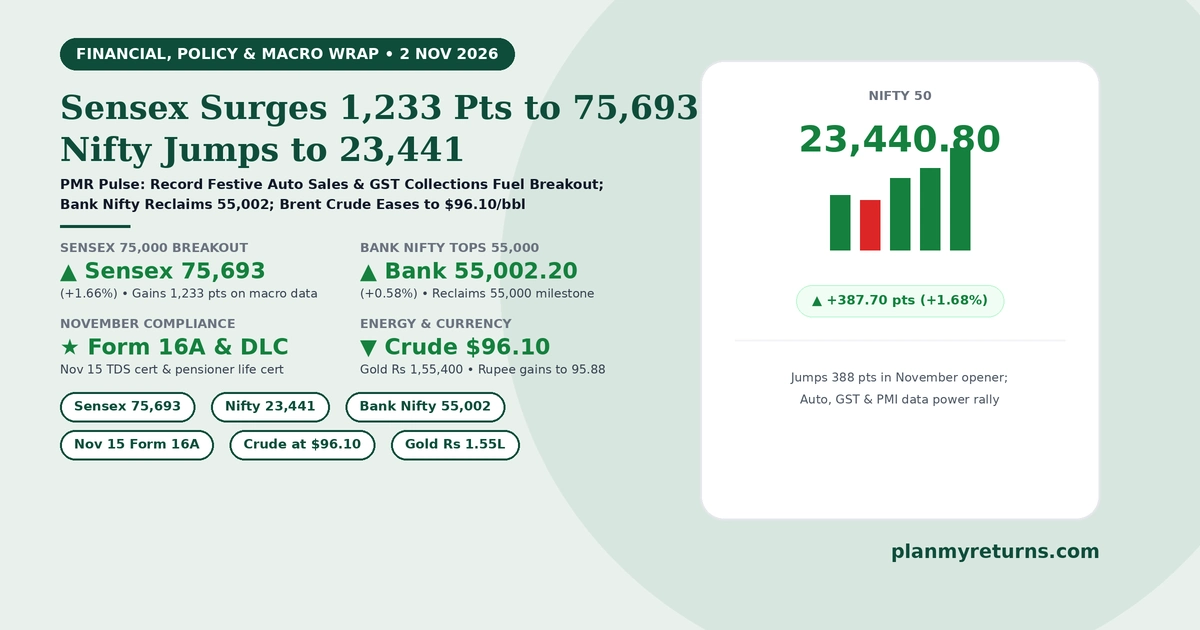
Today’s Overview: The BSE Sensex surged 1,233.25 points to 75,692.78 on November 2, 2026, while the Nifty 50 leaped 387.70 points to 23,440.80 and Bank Nifty reclaimed 55,002.20. Strong October GST collections, record festive auto dispatches, and Brent crude easing to $96.10 lifted equities as November tax and pension compliance opened.
Today’s Top Finance & Economy Stories
1. Why Did Sensex Surge 1,233 Points Past 75,600 and Nifty Jump 388 Points to Open November?
What happened: Indian equity benchmarks kicked off November with an explosive rally on Monday, building on weekend Muhurat trading optimism and strong macroeconomic releases. The BSE Sensex vaulted +1,233.25 points (+1.66%) to close at 75,692.78, smashing past the 75,000 milestone. The Nifty 50 surged +387.70 points (+1.68%) to settle at 23,440.80, while Bank Nifty climbed +315.25 points (+0.58%) to reclaim the 55,000 mark at 55,002.20. Record October passenger vehicle and two-wheeler wholesale dispatches, combined with gross GST collections crossing ₹1.88 lakh crore, sparked institutional buying across automobiles, financials, and infrastructure leaders.
Why it matters: The 840-point recovery in Nifty from its October 23 low of 22,600 to 23,440.80 shows why staying invested through short-term pullbacks is essential for long-term wealth creation. Investors who maintain uninterrupted monthly SIPs capture lower unit costs during dips and full upside during breakouts. To project how your monthly investments compound across market cycles, run your numbers on our SIP Calculator.
Key Takeaway: Sensex leaped 1,233 points to 75,693 and Nifty reached 23,441 as record festive auto sales, strong GST receipts, and sub-$97 crude drove broad institutional accumulation.
2. Form 16A, Form 26AS Verification, and Jeevan Pramaan: What Are the Key November Deadlines for Taxpayers and Pensioners?
What happened: Following the October 31 close of second-quarter TDS return filings, the November compliance window opened on Monday with two major household milestones. First, banks and corporate deductors must issue Form 16A (quarterly TDS certificates for fixed deposit interest, rent, and professional fees) by November 15, 2026. Second, the general November 1 to November 30 window has opened for central and state government pensioners to submit their annual Digital Life Certificate (Jeevan Pramaan) via Aadhaar face authentication or bank branches.
Why it matters: Salaried employees, consultants, and fixed deposit holders should log into the income tax portal this month to verify that all July to September TDS deductions match their Form 26AS and Annual Information Statement (AIS) ahead of the December 15 third-quarter advance tax installment. To compare your total tax liability and check whether switching regimes lowers your outgo, use our Old vs New Tax Regime Calculator.
Key Takeaway: Taxpayers should verify Q2 tax credits in Form 26AS and collect Form 16A certificates by November 15, while pensioners must submit their annual life certificate by November 30.
3. Gold Holds Firm at Rs 1,55,400: How Should Families Plan Wedding Season Bullion Purchases?
What happened: Indicative 24K retail gold rose to Rs 1,55,400 per 10 grams on Monday, while silver advanced to Rs 2,44,500 per kilogram as bullion markets transitioned from Diwali festivities into the peak November-December wedding buying season. Exchange data showed sustained retail participation in demat Gold Exchange Traded Funds (ETFs) alongside physical ornament bookings.
Why it matters: Families accumulating gold for upcoming weddings or long-term goals can avoid 12% to 20% jewellery making charges by building their corpus in Gold ETFs first and redeeming units only when purchasing physical ornaments. To project how lump-sum festive bonuses or stepped-up monthly savings grow over time, test your numbers on our Lumpsum Calculator and Step-Up SIP Calculator.
Key Takeaway: Retail 24K gold touched Rs 1,55,400 per 10g on wedding season demand, with financial planners recommending Gold ETFs to accumulate bullion without making charges.
4. Bank Nifty Reclaims 55,000: What Does Strong Festive Credit Growth Mean for Borrowers and Depositors?
What happened: The Bank Nifty index advanced 315.25 points (+0.58%) to close at 55,002.20 on Monday, reclaiming the 55,000 mark on the back of strong October retail credit figures. Scheduled commercial banks reported brisk festive loan disbursals across housing, passenger vehicles, and consumer durables, while keeping deposit rates elevated on special 400-day to 555-day tenures.
Why it matters: With the RBI policy repo rate steady at 6.50%, external benchmark linked home loan rates remain stable while savers can still lock in peak fixed deposit yields between 7.40% and 7.85%. If you are planning a home purchase or prepaying an existing mortgage to cut interest costs, check your schedule on our Home Loan EMI Calculator.
Key Takeaway: Bank Nifty closed above 55,002 as strong festive mortgage and vehicle loan growth supported bank earnings while keeping borrower EMIs stable.
5. Brent Crude Drops to $96.10 and Rupee Firms to 95.88: How Does Cheaper Oil Support Household Budgets?
What happened: International benchmark Brent crude fell 0.41% to trade at $96.10 per barrel on Monday, marking its fifth consecutive session of declines on comfortable global supply. Softer crude prices and strong foreign portfolio inflows into Indian equities helped the Indian Rupee appreciate 8 paise to close at 95.88 against the US Dollar.
Why it matters: Crude oil trading near $96 per barrel lowers imported inflation and keeps domestic diesel freight rates steady across agricultural and industrial supply chains. To see how inflation affects your household’s purchasing power and long-term corpus targets, evaluate your projections on our Inflation Calculator.
Key Takeaway: Brent crude easing to $96.10 and the Rupee strengthening to 95.88 reduce imported cost pressures and support domestic price stability.
6. How Should Investors Manage Portfolio Allocations After Sensex Crosses 75,600?
What happened: Following Monday’s 1,233-point surge in Sensex and Nifty’s climb to 23,440.80, domestic mutual fund houses reported continued retail inflows into diversified flexi-cap, large-and-mid-cap, and balanced advantage funds. Wealth advisors cautioned against deploying entire cash reserves at a single index level, advocating staggered purchases instead.
Why it matters: When markets rally sharply, staggered buying and periodic portfolio rebalancing help investors avoid overpaying for momentum stocks while maintaining target equity weights. If you are adding to existing shareholdings across multiple price levels, calculate your exact weighted holding cost on our Stock Average Calculator.
Key Takeaway: With Sensex above 75,600 and Nifty at 23,441, staggered equity accumulation and disciplined asset allocation remain the safest routes to long-term compounding.
Comprehensive Finance, Policy & Economic Updates
Banking, Regulatory & Tax Developments
- October GST Collections Cross ₹1.88 Lakh Crore: Festive consumer spending and improved e-way bill compliance lifted October gross GST revenues past ₹1.88 lakh crore, supporting fiscal stability.
- November 15 Form 16A Issuance Deadline: Banks, tenants, and corporate deductors must issue Q2 TDS certificates in Form 16A by November 15 following the October 31 return filing cut-off.
- Annual Pensioner Life Certificate Window: Central and state government pensioners have until November 30 to submit their Digital Life Certificate (Jeevan Pramaan) for uninterrupted pension disbursals.
- Manufacturing PMI Expansion: India’s October Manufacturing PMI expanded strongly on higher domestic new orders and festive factory output.
- GSTR-1 Monthly Filing Reminder: Registered businesses under the regular GST scheme must file October outward supply returns in GSTR-1 by November 11, 2026.
Personal Wealth, FinTech & Consumer Living Costs
- All-Time High October UPI Volume: NPCI data showed October UPI transactions crossing 16.8 billion transfers as festive shopping and merchant QR payments hit record highs.
- Record Festive Auto Wholesale Dispatches: Leading passenger vehicle and two-wheeler makers posted record October dealership dispatches driven by urban SUV and rural two-wheeler demand.
- Mutual Fund SIP Inflows Stay Above ₹23,500 Crore: Retail systematic investment plan contributions maintained record monthly momentum going into November.
- Wedding Season Gold ETF Inflows: With 24K retail gold at Rs 1,55,400 per 10g, households increasingly used demat Gold ETFs to accumulate wedding bullion without making charges.
- Sub-$97 Crude Stabilizes Freight Rates: Brent crude easing to $96.10 per barrel and the Rupee firming to 95.88 kept interstate diesel transport costs stable for winter produce.
Market & Macro Snapshot
Market figures reflect official closing numbers on 2 November 2026. Indicative 24K retail gold was Rs 1,55,400 per 10g and retail silver was Rs 2,44,500 per 1kg. Retail rates vary across cities because of local taxes, octroi, and jeweller making charges.
Top Gainers & Losers Nifty 50, 2 November 2026
▲ Top 5 Gainers
- Mahindra & Mahindra +3.45%
₹3,120.00 | Led auto shares after reporting record October SUV and tractor dispatches.
- Maruti Suzuki +2.85%
₹14,208.00 | Surged on strong festive passenger vehicle deliveries and export growth.
- Reliance Industries +2.30%
₹2,968.00 | Powered the Sensex past 75,600 on institutional buying in retail and telecom.
- Larsen & Toubro +2.10%
₹3,760.00 | Advanced on strong October manufacturing PMI and capital expenditure momentum.
- HDFC Bank +1.55%
₹1,765.00 | Lifted Bank Nifty above 55,000 on healthy festive retail credit expansion.
▼ Top 5 Losers
- ONGC -1.15%
₹266.30 | Eased as international Brent crude softened further to $96.10 per barrel.
- Cipla -0.80%
₹1,502.85 | Saw mild profit-taking as investors rotated from defensive pharma into cyclicals.
- Dr. Reddy’s -0.65%
₹6,603.00 | Consolidated quietly during the broader market rally.
- Apollo Hospitals -0.45%
₹6,980.00 | Traded marginally lower on routine institutional portfolio rebalancing.
- Britannia Industries -0.30%
₹5,740.00 | Ended slightly lower in quiet defensive consumer staples trade.
Form 16A (Quarterly Non-Salary TDS Certificate)
Meaning: Form 16A is an official Tax Deducted at Source (TDS) certificate issued quarterly by banks, companies, and individuals when deducting tax on non-salary income such as fixed deposit interest, rent, insurance commission, or professional consultancy fees. It must be generated through the TRACES portal within 15 days of the quarterly TDS return due date.
Example: After filing Q2 TDS returns by October 31, your bank issues Form 16A by November 15 certifying the exact tax deducted on your fixed deposit interest between July and September, which you can cross-check against Form 26AS.
Frequently Asked Questions
Why did Sensex surge 1,233 points and Nifty cross 23,440 on 2 November 2026?
Benchmarks rallied on a combination of record October auto wholesale dispatches, gross GST collections exceeding ₹1.88 lakh crore, strong manufacturing PMI data, and Brent crude easing to $96.10 per barrel.
What is the November 15 Form 16A deadline and who needs it?
Deductors must issue Form 16A by November 15 for tax deducted between July and September on non-salary payments like bank FD interest, rent, and freelance fees. Taxpayers use it to verify their Form 26AS tax credits.
When must government pensioners submit their annual life certificate?
The annual Jeevan Pramaan (Digital Life Certificate) submission window runs from November 1 to November 30, 2026. Completing it on time ensures uninterrupted monthly pension credits.
Upcoming Market & Economic Events to Watch
- S&P Global Services PMI Release: October services sector activity data releases on Wednesday, November 4, 2026.
- GSTR-1 Outward Supplies Deadline: Monthly GST return filing for October sales is due on Wednesday, November 11, 2026.
- Q2 Form 16A Issuance Cut-off: Statutory deadline for banks and deductors to issue Q2 TDS certificates on Sunday, November 15, 2026.
- Annual Life Certificate (Jeevan Pramaan) Deadline: Mandatory submission window for pensioners closes on Monday, November 30, 2026.
Plan Your Financial Strategy with PlanMyReturns Tools
Use our free financial calculators to plan your savings, calculate loan payments, and estimate taxes:
- SIP Calculator: Calculate mutual fund returns over your investment horizon
- Stock Average Calculator: Calculate your average share price after multiple buys
- Home Loan EMI Calculator: Check your monthly home loan installments and interest schedule
- Old vs New Tax Regime Calculator: Compare your income tax bill under both tax slabs
- Inflation Calculator: Check how future prices change the purchasing power of your money
About PMR Pulse
PMR Pulse is PlanMyReturns’ flagship daily market and finance wrap. We track domestic stock benchmarks, global economic indicators, banking policies, taxation changes, and primary markets to give Indian households and investors clear, actionable context every trading day.