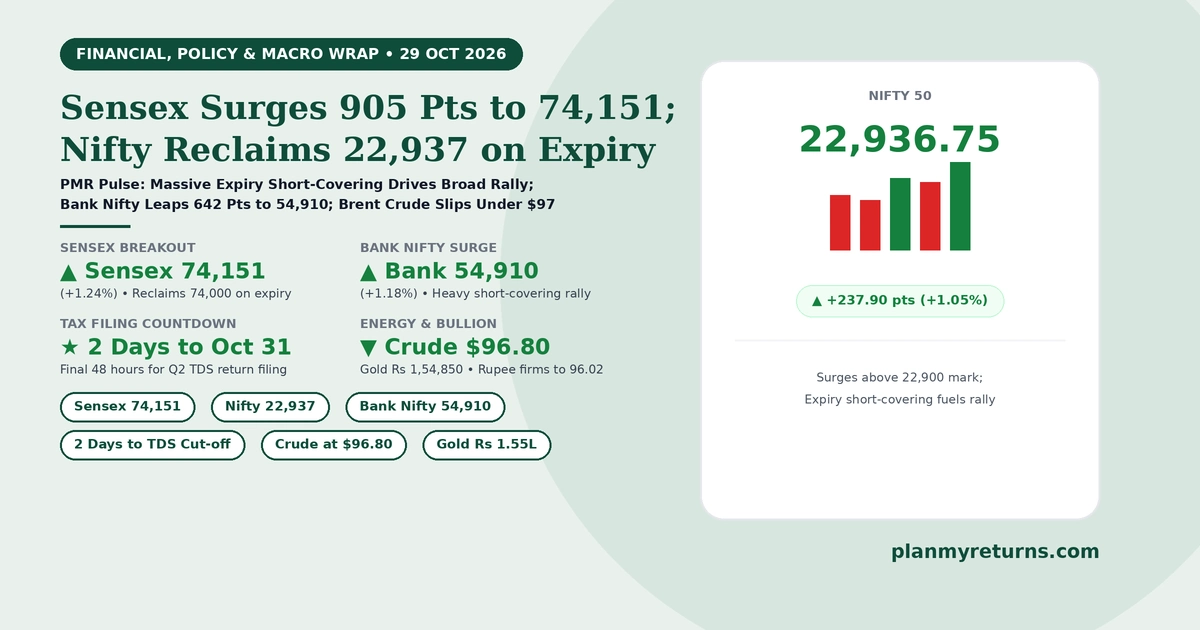
Today’s Overview: The BSE Sensex surged 905.01 points to 74,151.04 on October 29, 2026, while the Nifty 50 jumped 237.90 points to 22,936.75 and Bank Nifty leaped 642.25 points to 54,909.65. Strong short-covering during monthly derivative expiry, Brent crude softening to $96.80, and pre-Diwali accumulation lifted equities ahead of Saturday’s TDS deadline.
Today’s Top Finance & Economy Stories
1. Why Did Sensex Jump 905 Points and Nifty Surge to 22,937 on Monthly F&O Expiry Day?
What happened: Indian stock markets staged a massive broad-based rally on Thursday as monthly derivative contracts settled. The BSE Sensex skyrocketed +905.01 points (+1.24%) to settle at 74,151.04, reclaiming the 74,000 threshold. The Nifty 50 surged +237.90 points (+1.05%) to close at 22,936.75, while the Bank Nifty leaped +642.25 points (+1.18%) to 54,909.65. Aggressive short-covering across banking heavyweights, auto manufacturers, and Reliance Industries propelled indices to fresh weekly highs.
Why it matters: Heavy derivative rollover volumes with positive roll spreads indicate institutional confidence heading into November. Long-term wealth creation relies on uninterrupted compounding through such volatile expiry swings rather than trying to time daily momentum. To calculate how automated monthly investments grow over multiple market cycles, analyze your projections on our SIP Calculator.
Key Takeaway: Sensex climbed 905 points to 74,151 and Nifty hit 22,937 as strong F&O expiry short-covering and falling crude prices sparked powerful buying across all sectors.
2. Final 48 Hours: What Must Deductors and Taxpayers Check Before the October 31 Q2 TDS Deadline?
What happened: Accounts teams and business deductors entered the final 48-hour sprint to submit quarterly TDS statements for the second quarter (July to September 2026) ahead of Saturday’s statutory cut-off. Failure to upload Form 24Q (salaries) and Form 26Q (non-salary professional and vendor payments) by October 31 triggers an unavoidable late fee of Rs 200 per day under Section 234E.
Why it matters: Timely filing by employers guarantees that your tax deductions reflect cleanly in Form 26AS and AIS by mid-November, preventing mismatched credits during year-end tax planning. Early credit verification also allows salaried professionals to assess their tax bracket and choose the most beneficial tax regime. To verify whether your current deduction strategy minimizes tax outgo, use our Old vs New Tax Regime Calculator.
Key Takeaway: With only two days until October 31, deductors must finalize quarterly TDS submissions to prevent statutory late penalties and enable early November Form 26AS credit updates.
3. Gold Nears Rs 1.55 Lakh: How Are Households Optimizing Dhanteras Purchases Across Jewellery and ETFs?
What happened: Indicative retail 24K gold edged higher to Rs 1,54,850 per 10 grams on Thursday, while silver traded at Rs 2,43,600 per kilogram as festive demand reached peak showroom delivery volumes. Bullion exchanges saw heavy volumes, with institutional and retail investors allocating capital into electronic Gold Exchange Traded Funds alongside traditional physical coin buying.
Why it matters: Opting for demat Gold ETFs helps savers acquire pure 24-carat bullion without paying 10% to 20% in non-refundable making charges and storage insurance. For households deploying festive bonuses or structuring long-term portfolios, evaluate your projected returns using our Lumpsum Calculator and plan gradual allocation increases on our Step-Up SIP Calculator.
Key Takeaway: 24K gold reached Rs 1,54,850 per 10g as buyers combined symbolic token purchases with low-cost, zero-making-charge Gold ETFs for pure investment.
4. Why Did Bank Nifty Surge 642 Points and How Does It Support Retail Lending?
What happened: Bank Nifty powered ahead by 642.25 points to close at 54,909.65 on Thursday, coming within touching distance of the key 55,000 benchmark. Large private lenders including ICICI Bank, HDFC Bank, and Axis Bank led the advance as aggressive rollover activity into November contracts coincided with record festive personal and auto loan disbursals.
Why it matters: Strong lender profitability and clean balance sheets enable commercial banks to maintain competitive home loan interest spreads linked to the RBI’s 6.50% repo rate. For homebuyers planning purchases or evaluating interest savings, review your loan amortization breakdown on our Home Loan EMI Calculator.
Key Takeaway: Bank Nifty jumped to 54,910 as strong balance sheets and pre-Diwali credit demand fueled institutional accumulation in leading commercial banks.
5. Brent Crude Drops to $96.80: How Does Falling Oil Price Help Domestic Freight and Everyday Costs?
What happened: International benchmark Brent crude slipped 0.31% to trade at $96.80 per barrel on Thursday, falling to its lowest level this month. Softening international oil prices allowed the Indian Rupee to gain another 6 paise to 96.02 against the US Dollar, lowering landed costs for imported energy and industrial inputs.
Why it matters: Crude oil declining below $97 per barrel curbs diesel transport costs across supply chains, easing inflationary pressure on retail consumer goods and grocery staples. To understand how price movements affect your family’s future purchasing power and retirement corpus, test your savings targets on our Inflation Calculator.
Key Takeaway: Brent crude softening to $96.80 and the Rupee strengthening to 96.02 provide vital macro relief for supply chains and household living costs.
6. How Can Investors Prepare for Muhurat Trading Following Thursday’s Market Breakout?
What happened: Following Thursday’s 905-point surge in Sensex, retail and institutional participants turned their attention to the upcoming Diwali Muhurat trading session. Market strategists emphasized that Muhurat trading should focus on building core equity holdings in financially stable companies rather than chasing high-beta momentum stocks.
Why it matters: Adding select quality stocks during auspicious windows enhances portfolio diversification and benefits from multi-year economic expansion. If you are accumulating shares across multiple tranches, keep track of your weighted purchase costs with our Stock Average Calculator.
Key Takeaway: Investors are using the post-expiry rally to structure disciplined equity portfolios ahead of the annual Diwali Muhurat trading session.
Comprehensive Finance, Policy & Economic Updates
Banking, Regulatory & Tax Developments
- Two Days to Q2 TDS Deadline: Employers and deductors face the statutory October 31 deadline for quarterly TDS returns to avoid Section 234E fees of Rs 200 per day.
- Successful October F&O Settlement: Stock exchanges reported smooth derivative settlement with strong rollover rates into November futures contracts.
- Bank Credit Expansion: Reserve Bank of India data revealed credit growth remaining healthy at 14.2% year-on-year, led by retail mortgages and festive auto loans.
- Corporate Advance Tax Reconciliation: Corporate finance departments are assessing second-half earnings trends to determine third-quarter advance tax installments.
- Health Insurance Portability Acceleration: Insurance regulator initiatives helped cut health policy transfer processing times to under five business days.
Personal Wealth, FinTech & Consumer Living Costs
- Record Monthly Mutual Fund Collections: Domestic SIP flows maintained daily run-rates above ₹23,000 crore, providing strong support to equity valuations.
- Festive Digital Retail Spends: UPI merchant transactions scaled fresh peaks as festive discounts boosted consumer electronics and apparel purchases.
- Demat Gold Allocation Momentum: Gold ETFs experienced heavy buying as retail investors chose paper gold to bypass physical fabrication fees.
- Fuel Freight Cost Moderation: Brent crude slipping to $96.80 per barrel provided relief to road logistics operators, keeping inter-state freight rates steady.
- Diwali Muhurat Trading Readiness: Broking firms finalized client systems for the ceremonial one-hour trading session scheduled for this weekend.
Market & Macro Snapshot
Market figures reflect official closing numbers on 29 October 2026. Indicative 24K retail gold was Rs 1,54,850 per 10g and retail silver was Rs 2,43,600 per 1kg. Retail rates vary across cities because of local taxes, octroi, and jeweller making charges.
Top Gainers & Losers Nifty 50, 29 October 2026
▲ Top 5 Gainers
- ICICI Bank +2.45%
₹1,299.50 | Led banking gains on massive short-covering and strong credit growth numbers.
- Reliance Industries +2.15%
₹2,901.00 | Propelled headline indices higher on aggressive derivative contract rollover buying.
- Maruti Suzuki +1.90%
₹13,490.00 | Advanced on expectations of strong October festive delivery data.
- TCS +1.75%
₹4,208.50 | Rebounded sharply after previous session’s pre-expiry pullback.
- Larsen & Toubro +1.60%
₹3,683.00 | Climbed on fresh international order pipeline disclosures.
▼ Top 5 Losers
- Coal India -1.15%
₹461.15 | Faced modest profit-taking as capital rotated toward private financials.
- NTPC -0.85%
₹387.85 | Softened in quiet utility trading amid broader market risk-on sentiment.
- ONGC -0.70%
₹271.85 | Eased marginally as international crude oil slipped below $97 per barrel.
- Dr. Reddy’s -0.50%
₹6,646.50 | Consolidated quietly during broad cyclical benchmark rally.
- Cipla -0.35%
₹1,515.00 | Traded with a mild negative bias as funds shifted to high-beta stocks.
Rollover Spread (Derivative Series Settlement)
Meaning: The rollover spread represents the price difference between the expiring derivative contract month and the next month’s contract. A positive rollover spread indicates that traders are willing to pay a premium to carry forward their bullish positions into the subsequent month.
Example: During Thursday’s October expiry, traders rolled over long positions in Bank Nifty at a positive spread, driving a 642-point rally in anticipation of festive season credit growth.
Frequently Asked Questions
Why did Sensex and Nifty surge on 29 October 2026?
The market rallied as October derivative contracts settled, triggering strong short-covering across banks, autos, and Reliance Industries, further supported by Brent crude dipping below $97.
What happens if employers miss the October 31 TDS filing deadline?
Employers failing to submit Q2 TDS statements by Saturday, October 31, face an automatic late fee of Rs 200 per day under Section 234E, and employee tax credits will be delayed in Form 26AS.
How does sub-$97 crude oil support the Indian economy?
Cheaper international oil lowers the national trade deficit, helps strengthen the Rupee toward 96.00, and contains domestic transportation freight costs for consumer staples.
Upcoming Market & Economic Events to Watch
- Q2 TDS/TCS Statutory Filing Deadline: Mandatory quarterly tax statement submission cut-off on Saturday, October 31, 2026.
- October Auto Wholesale Dispatches: Automakers publish festive monthly delivery numbers on Sunday, November 1, 2026.
- Diwali Muhurat Trading Session: Stock exchanges conduct the ceremonial one-hour evening trading window this weekend.
- Manufacturing PMI Data: S&P Global releases India’s monthly industrial activity survey for October on Monday, November 2, 2026.
Plan Your Financial Strategy with PlanMyReturns Tools
Use our free financial calculators to plan your savings, calculate loan payments, and estimate taxes:
- SIP Calculator: Calculate mutual fund returns over your investment horizon
- Stock Average Calculator: Calculate your average share price after multiple buys
- Home Loan EMI Calculator: Check your monthly home loan installments and interest schedule
- Old vs New Tax Regime Calculator: Compare your income tax bill under both tax slabs
- Inflation Calculator: Check how future prices change the purchasing power of your money
About PMR Pulse
PMR Pulse is PlanMyReturns’ flagship daily market and finance wrap. We track domestic stock benchmarks, global economic indicators, banking policies, taxation changes, and primary markets to give Indian households and investors clear, actionable context every trading day.