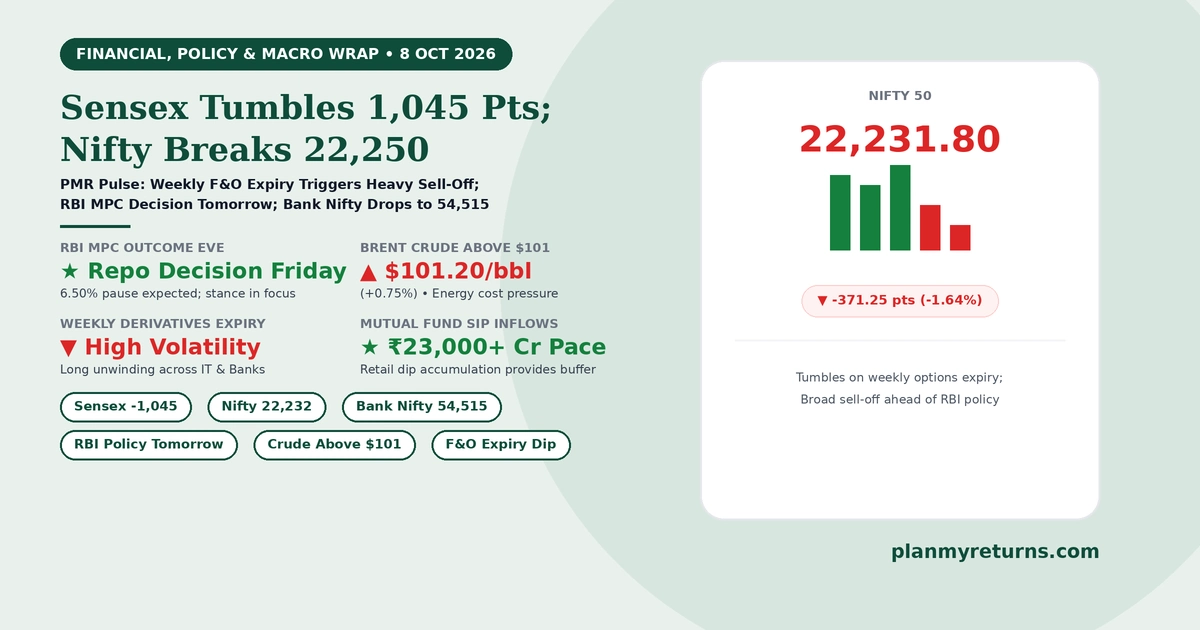
Today’s Overview: Thursday, October 8, 2026 was a broad risk-off day for Indian markets. The Sensex fell 1,045.46 points to 71,593.24 and the Nifty 50 dropped 371.25 points to 22,231.80, while mid- and small-cap indices fell more than 2%. The sell-off reflected the RBI’s hawkish policy shift, higher crude oil prices, elevated global bond yields, a weak rupee and continued foreign selling. Outside stocks, today’s important money stories included TCS’s September-quarter results, possible timing changes to UPI merchant fees, bank deposits moving toward inclusion in consolidated account statements, stronger festive-season goods movement and a proposed annual FASTag pass for local highway users.
Today’s Top Finance, Economy & Money Stories
1. Why Did the Sensex Crash 1,045 Points Today?
What happened: The Sensex closed at 71,593.24, down 1,045.46 points, while the Nifty 50 fell 371.25 points to 22,231.80. The Nifty touched an intraday low of 22,179.90. Small- and mid-cap indices fell about 2.3% and 2.5%, respectively, and all 16 major sectoral indices ended lower.
Why it matters: This was not a single-company sell-off. Higher crude, rising global bond yields, a weaker rupee, foreign outflows and the RBI’s tighter policy stance all increased the market’s risk premium. A broad sell-off can also affect mutual-fund NAVs and retirement portfolios even when the underlying long-term investment thesis has not changed.
PMR Insight: Today’s fall is best understood as a macro-risk event rather than evidence that every Indian company has suddenly become weaker. Long-term investors should separate business fundamentals from short-term market repricing.
2. RBI Raises Repo Rate to 5.50%: What Changes for Borrowers, Savers and Businesses?
What happened: The RBI raised the repo rate by 25 basis points to 5.50% and shifted its stance from neutral to “calibrated tightening”. The move came as inflation risks increased amid higher transport-fuel costs and a difficult external environment.
Who is affected: Floating-rate borrowers could face higher borrowing costs as rate transmission occurs. Businesses with significant debt may face pressure on financing costs. For savers, a higher-rate environment can support deposit yields, although banks do not necessarily pass policy changes through immediately or equally across products.
Sector impact: Capital-intensive sectors such as real estate, metals, infrastructure and oil & gas can be more sensitive to higher financing costs. Banks can see mixed effects because lending yields may benefit while funding costs and credit demand also matter.
PMR Insight: The important change is not only the 25-bps hike. The shift in stance signals that future inflation and rate decisions deserve closer attention.
3. Crude Oil Jumps Above $104: Which Sectors Gain and Which Lose?
What happened: Brent crude moved above $104 per barrel as concerns over Middle East supply and shipping disruptions intensified. MCX crude was around ₹8,939, up about 4.53% at the latest available evening reading.
Sector impact: Negative: airlines, logistics, paints, tyres, chemicals and other businesses with high fuel or petroleum-linked input costs. Potentially positive: upstream oil producers and some integrated energy businesses, depending on their product mix and refining margins.
Consumer impact: Petrol and diesel prices were unchanged across major cities today despite the crude surge. However, sustained high crude can eventually increase transport and logistics costs, which can feed into prices across the economy.
PMR Insight: Don’t treat rising crude as uniformly good or bad for “oil stocks”. The effect depends on whether a company produces oil, refines it, sells fuel or consumes fuel as a major input.
4. TCS Q2 Results: Strong Profit and AI Growth, But One Metric Needs Attention
What happened: TCS reported September-quarter revenue of about ₹73,188 crore, up 11.2% year-on-year, while net profit rose 15% to ₹13,884 crore. Annualised AI revenue reached $3.1 billion, up from $2.6 billion in the previous quarter. Deal wins were $9.6 billion.
What looks good: Profit growth, AI-related revenue and steady deal bookings show that TCS is participating in the growing demand for AI-led services. Its banking and financial-services business also grew 3.9% year-on-year excluding currency effects.
What should investors watch: Constant-currency sequential revenue growth was only 0.5%, the weakest for a July-September quarter in three years, while operating margin fell 120 basis points to 24.2% because of higher wages. AI is therefore both an opportunity and a source of disruption to traditional IT pricing models.
PMR Insight: TCS delivered healthy headline growth, but investors should look beyond profit growth and watch deal conversion, margins and how quickly AI revenue becomes a larger, profitable part of the business.
5. UPI Merchant Fee May Be Delayed: What It Means for Consumers, Merchants and FinTech Companies
What happened: Reports indicate that India is considering delaying the planned 0.4% merchant fee on selected UPI transactions above ₹2,000, originally scheduled for October 15. NPCI has not yet made a final decision.
Consumer impact: A delay could give merchants and payment companies more time to prepare systems and pricing, reducing the possibility of sudden festive-season disruption.
Company impact: Payment firms that expected revenue from the fee could see the timing of that opportunity pushed out. Shares of Paytm, MobiKwik and Pine Labs fell after reports of a possible delay.
PMR Insight: This is still a developing regulatory story. Treat the reported delay as a proposal/ongoing discussion until NPCI formally confirms the implementation date.
6. Bank Deposits to Become Visible Alongside Investments in Consolidated Statements
What happened: RBI has enabled SEBI-regulated depositories to include bank-deposit information in Consolidated Account Statements through the Account Aggregator framework, with the change taking effect from January 1, 2027.
Why it matters: A consolidated financial view can make it easier for people and families to identify bank deposits they may otherwise forget, particularly when managing the finances of a deceased family member. It will depend on participating banks, linked accounts and customer consent.
PMR Insight: This is a financial-visibility improvement, not an automatic transfer of ownership or access. Nominees and heirs may still need to complete the relevant bank claim or succession process.
7. FASTag Annual Local Pass Proposed: Who Could Benefit?
What happened: The road ministry is preparing a proposal for an annual FASTag-based local pass for residents living within 20 km of selected national-highway toll plazas. The proposed price is around ₹3,000 for unlimited crossings at the designated plaza, compared with repeated monthly-pass renewals.
Who benefits: Frequent local commuters, small businesses and people who repeatedly cross the same toll plaza could potentially reduce their annual travel costs. The proposal is not yet a final nationwide rule.
PMR Insight: Transport-policy changes can have a real household-finance impact even when they never appear on a stock-market screen.
8. Festive Goods Movement Strengthens: E-Way Bills Hit FY27 High
What happened: September e-way bill generation reached 141.53 million, up 7.2% year-on-year and 1.8% from August, the highest monthly level so far in FY27. The increase came as goods movement strengthened ahead of the festive season.
Why it matters: Higher goods movement can be a useful high-frequency signal for wholesale activity, logistics, retail inventory and consumption. It does not by itself prove that consumer demand is universally strong, but it provides a positive activity indicator going into the festive period.
PMR Insight: Watch logistics, retail, auto and discretionary businesses alongside festive-season sales data to see whether the improvement in goods movement translates into actual consumption.
9. FII Selling Remains a Major Pressure Point
What happened: Foreign investors have been heavy sellers, with net equity outflows over a nine-day period reaching roughly ₹46,990 crore and year-to-date outflows reaching a record level. Domestic institutions have been providing some offsetting support.
Why it matters: Persistent foreign selling can pressure the rupee and large-cap valuations, particularly when global bond yields are rising. Domestic institutional buying can cushion the decline but may not fully offset foreign selling every session.
PMR Insight: FII selling is a market-flow signal, not a standalone reason to buy or sell. The more important question is whether earnings and domestic liquidity can eventually absorb the external pressure.
10. India-US Trade Deal: RBI Says a Failure Would Have a Negative Impact
What happened: RBI Governor Sanjay Malhotra said it would be premature to quantify the impact if an India-US trade agreement fails, but acknowledged that tariffs would have a negative effect depending on their extent.
Who could be affected: Export-oriented industries could face higher barriers or weaker competitiveness, while companies with diversified export markets may be better positioned. The final impact depends on the tariff structure and any alternative trade agreements India can use to diversify demand.
PMR Insight: Trade policy is not just a geopolitical story. Tariffs can affect company revenue, margins, currency flows, employment and ultimately consumer prices.
Today’s Sector Impact: What Changed and Why?
- Metals 🔴: Among the weakest areas as higher rates and global macro concerns pressured capital-intensive businesses.
- Real Estate 🔴: Higher borrowing costs are negative for a capital-intensive sector and can affect project financing and demand.
- Oil & Gas 🔴/🟢: Rising crude hurts fuel consumers and oil marketing economics, while upstream producers can benefit from higher realised oil prices.
- Auto 🔴: Higher crude raises fuel-cost pressure and broader risk-off sentiment, although underlying quarterly demand remained an area of earnings optimism.
- IT 🟡: TCS results showed strong profit and AI growth, but weak sequential constant-currency growth and lower margins remain watch points.
- Financials 🟡: Higher rates can support lending yields but may also increase funding costs and pressure credit demand. Large banks remain central to the earnings outlook.
- Digital Payments 🟡: Possible UPI MDR timing changes affect the revenue outlook for payment platforms, while the underlying UPI ecosystem remains large.
- Logistics & Retail 🟢: Stronger September e-way-bill activity points to improved goods movement ahead of the festive season.
- Travel & Aviation 🔴: Higher crude is a cost headwind because jet fuel is a major operating expense.
Comprehensive Finance, Economy, Corporate & Daily-Life Updates
Economy, Policy & Regulation
- RBI Rate Hike: Repo rate increased to 5.50%; policy stance shifted to calibrated tightening.
- Government Bonds: The benchmark 10-year government bond yield moved near a three-year high after the RBI policy shift.
- Bank Deposits in CAS: Depository statements can incorporate bank-deposit information through Account Aggregators from January 2027, subject to consent and participating institutions.
- UPI MDR: Reports suggest the October 15 rollout of the 0.4% charge on selected UPI transactions above ₹2,000 could be deferred; NPCI decision pending.
- E-Way Bills: September generation rose 7.2% YoY to 141.53 million.
- India-US Trade: RBI Governor said failure of a trade agreement would have a negative impact depending on tariff levels.
Corporate News That Matters
- TCS: Q2 net profit ₹13,884 crore, up 15%; revenue ₹73,188 crore, up 11.2%; AI annualised revenue $3.1 billion; ₹12 dividend declared.
- Ola Electric: Approved a nearly ₹1,000 crore rights issue at ₹27 per share; proceeds include debt repayment and organic growth.
- Adani Enterprises: CARE Ratings upgraded its long-term rating to CARE AA; Stable from CARE AA-; Stable.
- Tata Power: Partnered with Norway’s Ocean Sun for a 300 kWp floating-solar pilot at the Mulshi reservoir.
- HCLTech: Opened a new regional headquarters in Johannesburg.
- Jubilant FoodWorks: Reported Q2 revenue from operations of ₹2,608.7 crore, up 11.9% YoY.
- Fino Payments Bank: September loan-referral disbursals rose 223% YoY to ₹278 crore.
- Allcargo Terminals: September volumes fell 7% YoY to 61,800 TEUs, a useful logistics datapoint to monitor.
Market & Macro Snapshot
Market figures reflect October 8, 2026 closing data where available. Commodity figures use the latest available evening MCX readings. Retail gold and fuel prices can vary by city, product and tax structure.
Top Gainers & Losers Nifty 50, 8 October 2026
▲ Top 3 Gainers
- Infosys +0.50%
₹997.00 | One of only three Nifty 50 constituents to finish higher.
- Tech Mahindra +0.34%
₹1,496.20 | Held up despite the broad technology and market risk-off environment.
- Axis Bank +0.20%
₹1,245.00 | Finished marginally higher against a weak financial-market backdrop.
▼ Top 5 Losers
- Adani Enterprises -5.36%
₹2,596.00 | Among the biggest casualties in the broad risk-off session.
- JSW Steel -4.46%
₹1,175.20 | Metals were among the weakest areas as rates and macro risks rose.
- ITC -4.03%
₹255.00 | Fell sharply despite its traditionally defensive characteristics.
- Max Healthcare -3.81%
₹873.40 | Healthcare also participated in the broad market sell-off.
- InterGlobe Aviation -3.54%
₹4,813.10 | Higher crude prices create a direct operating-cost headwind for airlines.
Company Deep Dive: TCS
Business performance: Strong YoY revenue and profit growth, with AI annualised revenue reaching $3.1 billion.
Advantage: AI demand and large deal wins can support the next phase of growth, while the BFSI business remained resilient.
Risk to watch: Sequential constant-currency growth was only 0.5% and operating margin declined to 24.2%. Higher wages and AI-driven changes in the traditional IT-services model remain important variables.
Customer impact: TCS’s increasing AI capabilities could mean more AI-led automation and transformation services for enterprise clients, potentially changing the mix of technology spending.
PMR Verdict: Fundamentally positive quarter, but the quality of future growth should be judged through margins, deal conversion and recurring AI-led revenue rather than headline profit alone.
What Today’s News Means for You
Monetary Policy Stance
Meaning: A monetary policy stance describes the RBI’s broad approach to interest rates and liquidity. A tightening or hawkish stance generally means the central bank is more willing to keep financial conditions restrictive to control inflation.
Why it matters today: The RBI moved its stance from neutral to “calibrated tightening”, making the direction of future inflation and rate decisions more important for borrowers, businesses and investors.
Investor Lesson: Don’t Confuse a Falling Market With Falling Business Quality
A market can fall because interest rates, currency, crude, foreign flows or global risk appetite changed even when many underlying businesses continue to operate normally. Investors should separate the price of a stock today from the long-term economics of the business.
The better question during a sell-off is not “How much did my stock fall?” but “Has the company’s earnings power, balance sheet or competitive position materially changed?”
Today’s Money Question
Should I stop my SIP after a market crash?
A market fall by itself is not a reason to stop a long-term SIP. SIPs buy more units when prices are lower and fewer when prices are higher. However, the right decision depends on your goal horizon, asset allocation, emergency fund and whether the fund still matches your original investment objective. A correction is different from a permanent deterioration in an investment’s fundamentals.
Tomorrow’s Market & Economy Watch
- RBI Policy Aftermath: Watch bond yields, the rupee and rate-sensitive sectors as investors digest the new tightening stance.
- Crude Oil: Any further move above $104 could keep inflation, currency and margin concerns elevated.
- Q2 Earnings: Follow the next wave of corporate results after TCS kicks off the earnings season.
- UPI MDR Decision: Watch for NPCI/official clarification on whether the October 15 implementation is delayed.
- Global Yields: US Treasury yields and Federal Reserve expectations remain important for foreign flows into emerging markets.
- Rupee: ₹96.96 remains the recent record-low reference point; movement toward or away from that level will matter for importers and exporters.
Plan Your Financial Strategy with PlanMyReturns Tools
Use our free financial calculators to turn today’s market and money news into practical planning:
- SIP Calculator: Calculate long-term investment growth.
- Stock Average Calculator: Understand your average purchase price after multiple buys.
- Home Loan EMI Calculator: Check how borrowing costs affect your repayment.
- Inflation Calculator: See how rising prices can change future purchasing power.
- Old vs New Tax Regime Calculator: Compare tax liabilities under both regimes.
About PMR Pulse
PMR Pulse is PlanMyReturns’ daily finance, economy and market briefing. We track markets, RBI and SEBI policy, companies, global developments, commodities, personal finance, consumer-impacting changes and important daily-life financial developments, then explain what they mean for investors, borrowers, savers and households.
Published: 8 October 2026, 6 PM IST. Market and commodity figures use the latest available closing/evening data. Developing stories are labelled as such and should be rechecked against official announcements.