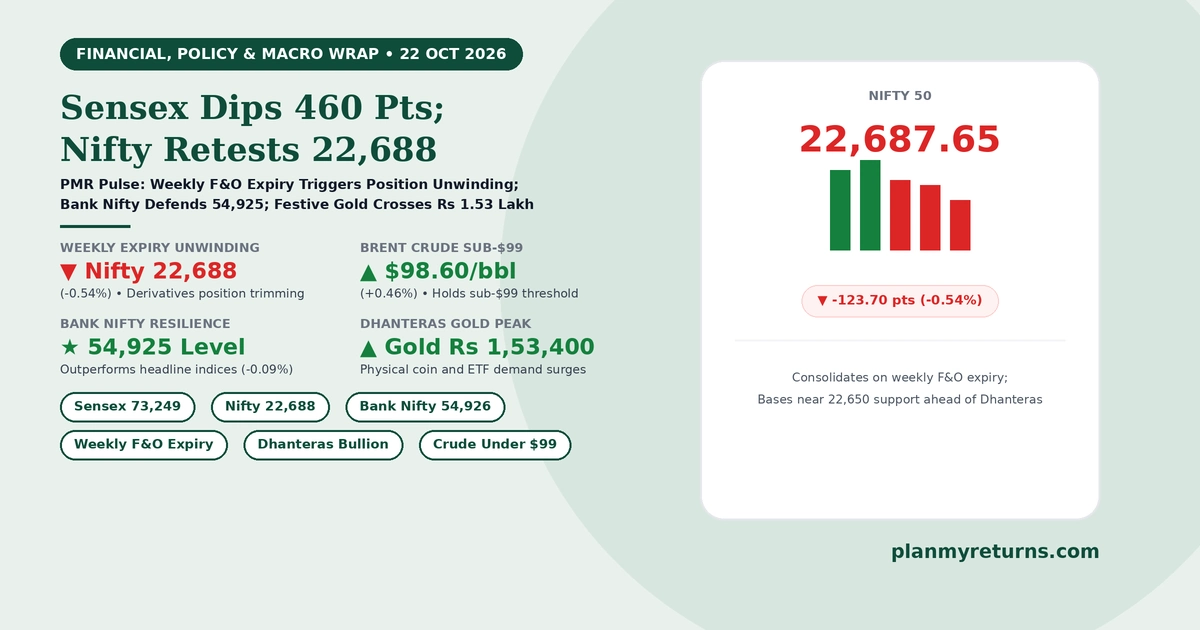
Today’s Overview: The Nifty 50 surrendered 123.70 points to 22,687.65 on October 22, 2026, while the BSE Sensex fell 460.30 points to 73,249.39. Weekly derivatives expiry triggered targeted position adjustments across software exporters, while steady banking resilience, sub-$99 crude oil, and record pre-Dhanteras consumer gold inquiries supported underlying household financial stability.
Today’s Top Finance & Economy Stories
1. Why Did Sensex Drop 460 Points and Nifty Test 22,688 on Weekly Expiry?
What happened: Indian equity benchmarks witnessed targeted position unwinding during Thursday’s weekly derivatives expiry session. The BSE Sensex retreated -460.30 points (-0.62%) to finish at 73,249.39, while the Nifty 50 surrendered -123.70 points (-0.54%) to close at 22,687.65. Institutional selling in IT exporters and metal counters led index declines, whereas Bank Nifty displayed notable relative stability, easing just -51.20 points (-0.09%) to 54,925.70 on private lender buying support.
Why it matters: Derivative expiry sessions frequently generate short-term volatility, offering systematic equity investors opportunities to accumulate diversified mutual fund units at lower net asset values without market timing risk. To model how uninterrupted periodic allocations compound wealth across weekly market swings, evaluate your portfolio targets on our SIP Calculator.
Key Takeaway: Sensex closed at 73,249 and Nifty settled at 22,688 due to expiry position adjustments, while Bank Nifty held firm near 54,925.
2. Gold Crosses Rs 1.53 Lakh: How Can Families Optimize Dhanteras Purchases Between Jewellery and Gold ETFs?
What happened: Indicative 24K retail gold reached Rs 1,53,400 per 10 grams on Thursday, while silver held at Rs 2,41,200 per kilogram as jewellery showrooms registered peak advance booking footfalls ahead of Dhanteras and Diwali. Financial advisers emphasized that while physical jewellery satisfies traditional ceremonial customs, digital Gold ETFs enable investors to participate in gold appreciation without incurring 12% to 18% in fabrication making charges.
Why it matters: Allocating long-term financial savings to Gold ETFs avoids resale purity deductions and bank locker expenses, allowing your capital to track pure 24K bullion prices with complete market liquidity. For households planning lump-sum investments or setting progressive annual savings targets, calculate your compounding returns on our Lumpsum Calculator and model increasing contributions on our Step-Up SIP Calculator.
Key Takeaway: Retail gold climbed to Rs 1,53,400 per 10g ahead of Dhanteras, with financial planners recommending Gold ETFs to bypass traditional jewellery making fees.
3. Why Did Bank Nifty Hold Strong at 54,925 While Headline Benchmarks Eased?
What happened: Bank Nifty demonstrated notable relative strength on expiry day, slipping just 51.20 points (-0.09%) to settle at 54,925.70. Frontline commercial lenders registered active retail originations across festive vehicle loans, consumer durable financing, and personal credit lines. With the Reserve Bank of India anchoring the policy repo rate at 6.50%, commercial banks continue offering promotional zero-processing-fee festive home loan packages to qualified retail applicants.
Why it matters: A stable interest rate benchmark ensures predictable monthly repayment schedules for prospective home buyers. If you are comparing prospective mortgage rates or reviewing repayment structures, calculate your exact monthly installment on our Home Loan EMI Calculator.
Key Takeaway: Bank Nifty defended 54,925 as strong festive retail lending demand and predictable interest rate benchmarks cushioned financial shares.
4. How Can Investors Use Expiry Volatility to Enhance Systematic Mutual Fund Portfolios?
What happened: Minor market pullbacks during weekly derivative expiry sessions allow retail mutual fund Systematic Investment Plans (SIPs) to accumulate fund units at discounted net asset values (NAVs). Mutual fund industry data indicates that domestic retail investors maintained disciplined periodic allocations without panic redemptions, ensuring steady cash inflows into diversified equity and hybrid mutual funds.
Why it matters: Rupee-cost averaging automatically lowers your average cost per unit during market pauses, generating higher compounding returns when indices resume upward momentum. To assess your portfolio average purchase price after multiple buys, use our Stock Average Calculator.
Key Takeaway: Expiry pullbacks allow systematic investors to accumulate mutual fund units at lower average acquisition costs.
5. How Does Brent Crude Below $99 Protect Household Living Budgets?
What happened: International benchmark Brent crude traded at $98.60 per barrel (+0.46%) on Thursday, maintaining its position below the crucial $100 psychological ceiling. The Indian Rupee closed steady at 96.18 per US Dollar. Moderating oil import prices helped prevent diesel freight cost escalations across national transit routes.
Why it matters: Sub-$99 crude oil directly lowers input costs for consumer goods packaging, petrochemical raw materials, and logistics distribution, protecting family monthly grocery budgets. To examine how changing inflation rates influence your long-term purchasing power and retirement corpus, model your goals with our Inflation Calculator.
Key Takeaway: Brent crude trading at $98.60 eases imported inflation concerns and protects household discretionary purchasing power.
6. How Are Real-Time Digital Payment Rails Powering Record Festive Merchant Volumes?
What happened: The National Payments Corporation of India (NPCI) highlighted that daily Unified Payments Interface (UPI) transaction processing maintained brisk velocity above 525 million payments. Real-time settlement rails enabled small retail shop owners and e-commerce platforms to process seamless merchant payments during peak pre-Diwali demand.
Why it matters: Cashless digital commerce provides transparent transaction receipts, simplifying bookkeeping and cash-flow monitoring for households and small businesses. For individuals preparing advance tax payments and reviewing deductions under revised tax brackets, evaluate your tax bill on our Old vs New Tax Regime Calculator.
Key Takeaway: Over 525 million daily UPI transactions powered nationwide festive retail shopping, enhancing cash-flow transparency for businesses and consumers.
Comprehensive Finance, Policy & Economic Updates
Banking, Regulatory & Tax Developments
- Bank Lending Rate Anchoring: Major scheduled commercial banks confirmed that floating home loan rates will remain anchored to the 6.50% repo rate, keeping monthly mortgage EMIs predictable.
- Form 26AS Tax Credit Matching: Finance departments and chartered accountants are actively reconciling September TDS challans to ensure tax credits populate accurately in Form 26AS before the October 31 quarterly cut-off.
- Input Tax Credit Matching for GST: Taxpayers are finalizing input tax credit reconciliations against GSTR-2B following the monthly outward filing deadline, ensuring compliance under Section 16(2)(aa).
- Special Festive Fixed Deposit Windows: Public and private lenders maintain attractive promotional term deposit yields up to 7.85% for senior citizens across 400 to 555-day tenures.
- Cashless Health Claim Networks: General insurers continued onboarding network hospitals under the National Health Claims Exchange (NHCX), reducing claim settlement turnaround times for policyholders.
Personal Wealth, FinTech & Consumer Living Costs
- Mutual Fund Systematic Allocation Health: Daily retail SIP collections remained steady across flexi-cap and balanced advantage funds, maintaining strong domestic liquidity in Indian financial markets.
- UPI Delegated Payment Adoption: NPCI reported increased adoption of UPI Circle delegated payments, enabling primary account holders to assign secure spending limits to students and dependents.
- Festive Bullion Booking Trends: Retail 24K gold reached Rs 1,53,400 per 10 grams, prompting cost-conscious savers to allocate into Gold ETFs to bypass traditional jewellery making fees.
- Crude Freight Stability Under $99: Brent crude holding at $98.60 per barrel helped commercial transport fleets maintain stable freight rates for consumer goods and festive dispatches.
- Corporate Working Capital Positioning: Corporate finance departments maintained disciplined liquidity deployment in overnight and liquid debt funds ahead of upcoming corporate earnings disclosures.
Market & Macro Snapshot
Market figures reflect official closing numbers on 22 October 2026. Indicative 24K retail gold was Rs 1,53,400 per 10g and retail silver was Rs 2,41,200 per 1kg. Retail rates vary across cities because of local taxes, octroi, and jeweller making charges.
Top Gainers & Losers Nifty 50, 22 October 2026
▲ Top 5 Gainers
- Titan Company +1.65%
₹3,522.00 | Led consumer gainers on peak pre-Dhanteras showroom booking disclosures.
- Asian Paints +1.20%
₹3,256.00 | Advanced as Brent crude remained comfortably below $99 per barrel.
- ITC +0.75%
₹526.30 | Outperformed broader indices on steady consumer goods consumption.
- Sun Pharma +0.60%
₹1,976.00 | Gained on defensive buying and specialty formulation sales momentum.
- Nestle India +0.45%
₹2,506.00 | Supported by positive festive packaged food and confectionery demand.
▼ Top 5 Losers
- Infosys -2.10%
₹1,838.50 | Pressured by weekly options expiry long unwinding across tech heavyweights.
- HCL Technologies -1.85%
₹1,721.50 | Eased alongside technology exporters in range-bound trade.
- Tech Mahindra -1.60%
₹1,579.00 | Witnessed institutional profit-taking in derivative contracts.
- Tata Steel -1.35%
₹151.50 | Softened in line with international industrial metal futures.
- JSW Steel -1.10%
₹967.00 | Consolidated in line with broader cyclical commodities.
Derivative Expiry Unwinding
Meaning: Derivative expiry unwinding refers to the process where traders close out, square off, or roll over their existing futures and options positions as contracts reach their scheduled settlement date (weekly or monthly Thursday). This frequently triggers temporary intraday volatility independent of fundamental corporate earnings.
Example: During Thursday’s 123-point Nifty consolidation to 22,688, institutional traders squared off weekly call and put options contracts, creating temporary price dips that allowed systematic SIP investors to accumulate units at lower net asset values.
Frequently Asked Questions
Why did benchmark indices ease on 22 October 2026?
The pullback was primarily driven by weekly options expiry position squaring in IT exporters, while consumer durables and retail banking shares displayed relative resilience.
How should retail buyers structure gold purchases ahead of Dhanteras?
Financial planners suggest allocating ceremonial purchases toward physical coins or jewellery while deploying investment capital into Gold ETFs to bypass traditional making charges of 12% to 18%.
Why did Bank Nifty hold steady near 54,925?
Bank Nifty declined just 0.09% as frontline private and public sector commercial lenders reported healthy festive loan originations in auto finance and affordable housing.
Upcoming Market & Economic Events to Watch
- Commercial Banking Q2 Earnings: Leading commercial banks schedule quarterly financial reports this week.
- Q2 TDS/TCS Statement Remittance Cut-off: Mandatory quarterly statement remittance deadline on October 31, 2026.
- Dhanteras Bullion Shopping Window: Physical jewellery showrooms and digital platforms handle peak festive token deliveries.
- Fortnightly RBI Bank Credit Data: Central bank publishes updated banking loan and deposit expansion statistics.
Plan Your Financial Strategy with PlanMyReturns Tools
Use our free financial calculators to plan your savings, calculate loan payments, and estimate taxes:
- SIP Calculator: Calculate mutual fund returns over your investment horizon
- Stock Average Calculator: Calculate your average share price after multiple buys
- Home Loan EMI Calculator: Check your monthly home loan installments and interest schedule
- Old vs New Tax Regime Calculator: Compare your income tax bill under both tax slabs
- Inflation Calculator: Check how future prices change the purchasing power of your money
About PMR Pulse
PMR Pulse is PlanMyReturns’ flagship daily market and finance wrap. We track domestic stock benchmarks, global economic indicators, banking policies, taxation changes, and primary markets to give Indian households and investors clear, actionable context every trading day.